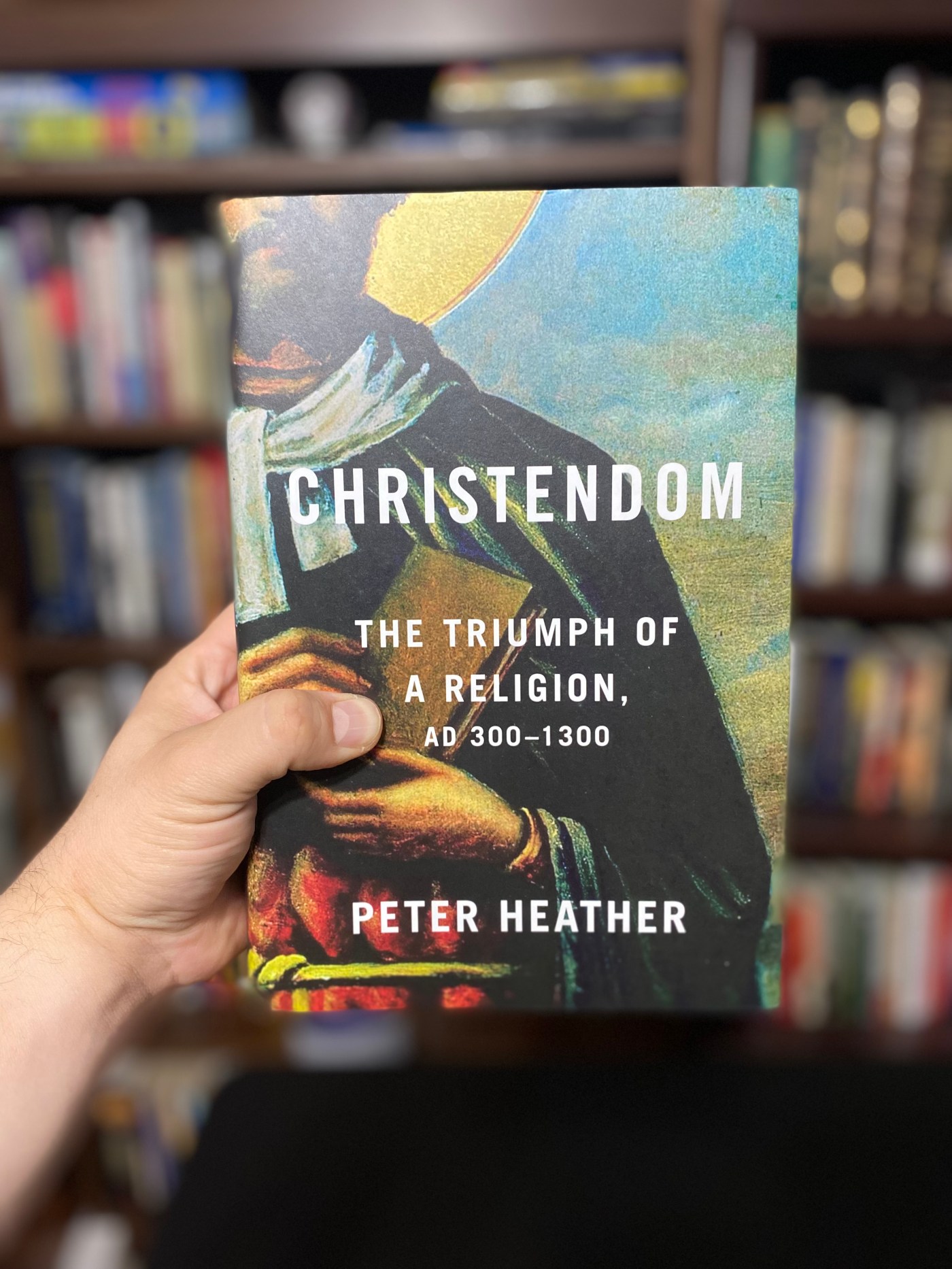
The book is Christendom by Peter Heather. It was originally published in 2023 by Alfred A. Knopf. I read the 2023 hardcover edition. I read it in August of 2025.
The title is the theme of the book, a world history of Christendom from the first disciples into the middle ages. The subtitle of the book is The Triumph of a Religion, AD 300–1300.
I read this book because I want to learn more about the history of Christianity and the Church. I randomly saw it at Barnes and Noble and bought it with a giftcard. Peter Heather is not a Christian. I didn’t know that before I bought it. It turned out not to be a huge deal. He’s not hostile to Christianity generally.
Heather’s argument basically is that Christianity got lucky throughout history and that’s the only reason it has triumphed. He centers his argument around the Council of Nicea and their definition of the nature of Jesus Christ. Homoousios vs homoiousios. Was Jesus homoousios, having the same exact nature of God therefore in his essence and being was God, or was he homoiousious, having a similar nature of God but not the same being as God himself? The Church determined upon homoousios.
Heather claims throughout the book that this distinction between homoousios vs homoiousios was somewhat arbitrary and it could have very well turned out the other way. It just so happened that the Church came to see Jesus as God and thus came to the understanding of a triune God, the Holy Trinity. He also points to some key battles and political shifts throughout history that landed in favor of what he calls Nicene Christianity and constantly makes the point that it could have very well gone the other way and orthodox Christianity would be completely different than how we know it today. My only response to this is…”but it didn’t.”
As an unbeliever Heather doesn’t see world history as the result of an omniscient omnipotent God ordaining all that happens. His presupposition is that it’s all unfolding randomly with no ultimate purpose or direction behind the events of history. So of course he believes that it “just so happened” that Christianity became popular.
“The same webs of patronage that were beginning to turn local elites towards Christianity could still have been manipulated to take them in a different direction.” (p150). …yeah but it didn’t. Christianity wasn’t manipulated to take them in a different direction. Nicene orthodox Christianity DID become popular with the local elites and its influence spread.
Another example. “it becomes clear that the political collapse of the imperial Confessional State, with which that particular ideology had become so deeply entwined, posed such a direct challenge to its continued prominence that it came within a whisker of not surviving at all.” (p162) …yeah but it did survive. He goes incident by incident saying that things could’ve gone another way where Christianity did not take hold and become popular. But the facts of history are that it did. Nicene orthodox Biblical Christianity did spread and triumphed over the world. And this did not happen by random chance and lucky breaks as Heather suggests. It happened by the will and promise of God.
This book made me think about how much more Christian history I need to read. There were several references to people and events that I’m unaware of. I need to learn more to have a better context.
I learned that Pope Gregory I sent missionaries to England because he saw anglo blonde-haired slave children and called them “not angles but angels” and sent the first monks to kick start the gradual conversion of the Anglo-Saxon kingdoms in 597AD. What a turning point in history.
I learned some fascinating information about the false origins of the pope.
“Around AD 400, a forgery known as the Clementine Recognitions, composed in Greek and translated into Latin, started to circulate. Purporting to be a letter of Pope Clement I (bishop of Rome from around 88 to 99) to James the brother of Jesus, then leader of the Church in Jerusalem, it tells how Clement had been converted and trained by St Peter, and how Peter had passed on to him his own unique religious authority as Jesus’ most important disciple.” (p303) I take Heather’s evidence against the legitimacy of the pope to be absolutely true.
There was a lot of good information in this book, but ultimately I don’t regard Heather as a good historian. It’s all conjecture. He’s determined to chock up the triumph of Christianity in the world to sheer luck and random chance. That perspective is pointless.
I would not recommend this book. It’s got some good information and Heather doesn’t seem to outright lie about any of his points, but he ultimately is so determined not to believe in the legitimate history of Christianity, that his argument is pointless and useless.
****************************************************
Quotations
“”””
I have been acutely conscious throughout of my many deficiencies. Perhaps the greatest, it might be argued, is the fact that I am not myself a Christian believer. I still love to go (occasionally) to church, and find deep inspiration in some Christian teachings, above all the Easter message that new hope can often be found even in the midst of deepest despair. All that said, I could not call myself anything more than a thoroughly lapsed Anglican. (xxiv)
“””
At this time, Christians were a pretty normal feature of the Roman world. No one thought, as they had in the first century, that Christians performed illicit, human sacrifices (the whole body and blood metaphor caused some initial confusion) and the Great Persecution is striking for its lack of popular enthusiasm. (p17)
“”””
A properly critical approach to likely Christian numbers, therefore, would suggest contra Burckhardt that Constantine’s Christian affiliation was, indeed, utterly sincere. Becoming, or coming out as, a Christian in the hostile environment created by the Tetrarchy’s signature policy of religious persecution was fraught with danger, and Christians represented only a very small constituency within the total imperial population. (p25)
“”””
thirteen leather-bound papyrus codices found at the end of the Second World War near Nag Hammadi in Upper Egypt, where they had been buried in a sealed jar. The manuscripts were written in the third and fourth centuries, but cross-references with extant papyrus fragments show that some of them, especially the famous Gospel of Thomas, were copies of much older texts, dating back to the late first and early second centuries: exactly the era when Matthew, Mark, Luke and John were being written. (p29)
“”””
It is also now clear that the texts even of the standard Gospels continued to be edited down to the third century, in part at least to weed out earlier readings that might support now unacceptable theological beliefs. But these are relative details. For the most part, the more extravagant texts and their radically alternative theologies were rejected by an emergent Christian mainstream before the year 200. (p30)
“”””
The key term chosen at Nicaea to define the relationship of Father to Son ‘of one substance’, homoousios was also a complete novelty. Ousios, with its meaning of ‘essence’ or ‘substance’, was a term with a long history in classical Greek philosophical discussions of the different manifestations that one overall Divine power might take. But it was a non-scriptural term, not appearing anywhere in the Old or New Testaments. (p32)
“”””
The Arian dispute is not (as it is often presented) a story of deviation from a well and long-defined mainstream Christian belief-set, but of an intense struggle to establish one for the first time.
Nicaea’s definition of the Faith was not in fact a statement of what everyone had always believed. The emerging doctrines of Christianity in the centuries before Nicaea had left much room for variation of doctrinal opinion in how exactly one should understand Christ’s distinctive combination of divine and human. (p35)
“”””
There is no way to know exactly how many of the rapidly Christianizing Roman elite of the fourth century were truly devout, and how many converted largely for economic and political reasons (or, like Pegasios, perhaps, merely pretended to).
Throughout history, elites who have the most to lose and gain have been particularly vulnerable when major cultural change transforms the political processes governing the distribution of favour. (p104)
“”””
Coming to adulthood in such a context, it’s possible to understand why Augustine was ready to contemplate the idea that Roma was not going to be that Aeterna. Be that as it may, in the City of God he constructed a view of the growing Christian Church as an institution that was fundamentally independent of the Roman state. Where the Empire could count on only contingent, time-limited assistance, the Church was God’s eternal vehicle for human salvation. (p124)
“”””
In the case of sees they cared about, emperors exercised the right to control appointments. And any sitting bishop, whatever his status, who fell foul of the regime could expect to receive his marching orders as happened, spectacularly, in the case of John Chrysostom, deposed as patriarch of Constantinople in the early fifth century (p. 76).
So, whatever the likes of Augustine wanted to believe, the emperor was to all intents and purposes the practical, functioning head of the Christian Church in the late Roman period. (p134)
“”””
Augustine’s City of God shows the analytical qualities of its author’s penetrative mind: as Augustine predicted, the Christian Church and the Roman imperial state were separable entities, and their coincidence in time and space was destined only to be temporary. But what emerged in the fourth and fifth centuries is an early version of what historians of other eras have come to label the Confessional State: a political entity whose formal and informal structures upheld a particular set of religious behaviours as ‘true religion’, and which based its own ideological legitimacy on the claim that this was its primary function. The imperial state and its inner workings, in other words, played a decisive role in the Christian takeover of the Roman world. Without them, the victory of Christianity is inconceivable. (p137)
“”””
As far as Julian was concerned, Christianity was a uniquely false religion, singularly devoid of even the tiniest grain of spiritual truth: a point repeatedly reiterated in his surviving writings, in which he often refers to Christians as ‘atheists’ (p140)
“”””
Christianity was winning, he clearly believed in fact he had to believe because of its structural cohesion, the apparently impressive holiness of its priests and its generous charitable provisions. If he could retool paganism to meet these practical challenges head on, then the overwhelming religious truth contained within traditional cultic practice would undoubtedly prevail. (p141)
“”””
What he needed was a big enough victory to show that he had Divine backing. He got close.
If Julian had managed to get himself and his army home after these successes, more or less in one piece, then he would have probably done enough to claim victory and the future could have been totally different. Julian’s restoration of the old gods would then have received the necessary Divine imprimatur. (p148-149)
“””””
The same webs of patronage that were beginning to turn local elites towards Christianity could still have been manipulated to take them in a different direction. This is not to say that Christianity would have been extinguished if Julian’s religious project had gathered momentum, but it would have been decoupled from the imperial system. It would probably have reverted to the rhythms of pre-Constantinian Christianity: a world less hierarchically structured, doctrinally more diverse, more ascetically world-rejecting, and of distinctly smaller congregations. (p150)
“”””
Once misleading hindsight the fact that Nicene Christianity eventually became accepted orthodoxy across the entire European landmass is stripped away, it becomes clear that the political collapse of the imperial Confessional State, with which that particular ideology had become so deeply entwined, posed such a direct challenge to its continued prominence that it came within a whisker of not surviving at all. (p162)
“”””
Not only that, but the path of overt resistance created so many difficulties, including) for those who wanted to remain Christian, that the Christian authorities themselves acted to discourage it. As the martyr movement gathered steam, Abd ar-Rahman II deployed the compliant Bishop Reccafredus (probably by this point the archbishop of Seville) to pressure the clergy of Córdoba publicly perhaps even at a council in 852/3, though the evidence on this is not absolutely clear to condemn the protests and try to bring the martyrdoms to an end. In doing so, Reccafredus and his allies drew on an old Christian discourse that had developed under the old pagan Roman emperors. Where no active persecution was underway as was the case in Córdoba it was not spiritually valid to seek out martyrdom by provoking the authorities to kill you. This was not martyrdom but suicide. Some Christians like Paulus or Eulogius, or, unsurprisingly, the martyrs themselves didn’t share this view. (p230)
“”””
Pope Gregory I (‘the Great’: 590-604) saw some beautiful, blond children for sale and wondered who they were. On being told that they were Angles from Britain, he replied, according to Bede, non angli sed angeli: ‘not Angles but angels’. Gregory promptly despatched a band of forty monks led by one Augustine, the future first archbishop of Canterbury. They reached the south-east coast of England in 597, their arrival kick-starting the gradual conversion of all the Anglo-Saxon kingdoms. (p238)
“”””
Such unreconstructed syncretism is straightforwardly condemned by Bede, but it’s highly likely that Christianity, especially early on, was often viewed as an add-on in cultures used to multiple divine powers. In Kent, it wasn’t until the mid-seventh century, under King Earconberht (c. 640-64), that idol worship was formally banned, two generations after Augustine’s arrival, while Kentish and Wessex law codes of the 690s still felt it necessary, a century after the missionaries appeared, to punish ‘sacrificing to devils’. (p272)
“”””
“You are Peter, and on this rock I will build my Church, and to you I give the keys of the Kingdom of Heaven. By itself, however, this verse does not substantiate anything, making no mention of either Rome or its bishopric; neither are the papacy’s two claims about St Peter explicitly confirmed in any of the earliest Christian texts, such as the Gospels or the Acts of the Apostles.
Around AD 400, a forgery known as the Clementine Recognitions, composed in Greek and translated into Latin, started to circulate. Purporting to be a letter of Pope Clement I (bishop of Rome from around 88 to 99) to James the brother of Jesus, then leader of the Church in Jerusalem, it tells how Clement had been converted and trained by St Peter, and how Peter had passed on to him his own unique religious authority as Jesus’ most important disciple. (p303)
“”””
Such syncretism was manifest in many Christian texts of the period, and would remain a dominant strand within Latin Christianity for the rest of the Middle Ages and beyond.
Gregory’s miracle collections and the stories
Read carefully, they take the form of an argument, carefully constructed to demonstrate what to Gregory was an irrefutable truth: that the new Christian saints’ cults were more powerful than the old magical practices so detested by Caesarius. In other words, as Gregory saw it, Christian saints could now serve exactly the same range of function as the old pagan cults had done before only far more effectively. (p329)
“”””
By the end of the century, Charlemagne had constructed an empire which, even if its epicentre was now north of the Alps, rivalled that of his west Roman predecessors. The second age of Christian Empire in the west had begun. Its official inauguration came on 25 December 800 at St Peter’s Cathedral in the city of Rome. There Charlemagne, king of the Franks and Lombards, was crowned emperor of the Romans by Pope Leo III. (p374)
“”””
Most of this expansion of Christian Europe, however, did not follow Charlemagne’s conversion-by-conquest model. Though it had eventually worked in Saxony, the approach presented too many problems to be more generally applicable. Even for the subservient clergy of warrior Christian rulers, the amount of violence required sat uncomfortably alongside the prescripts of the Gospel concerning love and peace (Ethelberht of Kent at the end of the sixth century had understood that he shouldn’t just force people to follow him into baptism: (p391)
“”””
In a move that proved much more contentious, it was also in the Carolingian period that the doctrine of the Real Presence the idea that the elements of bread and wine are transformed in the Mass into the literal body and blood of Christ was first fully articulated by a monk of the abbey of Corbie in north-eastern Francia named Paschasius Rad: bertus, in his treatise On the Body and Blood of the Lord, composed in the early 83os as part of a scholarly quarrel with a fellow monk named Ratramnus. (p431)
“”””
In the late fourth century, the forged Clementine Recognitions, presented as an authentic letter of the first-century Pope Clement, ‘documented’ two points: that St Peter had been the first bishop of Rome, and that he had passed on his unique status as Prince of the Apostles to all subsequent bishops of Rome. (p445)
“”””
This new way of thinking represented a radical break with established tradition, inherited from late antiquity, which held that, once promoted, only the highest clergy bishops should be unmarried, or at least give up having sex with their wives. While some had always believed that lesser clergy priests and deacons should also be celibate, this had never been a formal rule. In both Latin west and Greek east, therefore, it remained entirely normal for priests and deacons to be married, and indeed for the priesthood itself to be a hereditary position in some (perhaps many) of the small local churches built by landowners in substantial numbers since the year 900.
But during the tenth and eleventh centuries, this all started to change, with reform-minded clerics making increasingly vocal demands that not just monks, but all priests who might administer the Mass needed to be ‘pure’: i.e., fully celibate. (p453-454)
“”””
The whole crusading enterprise began as an initiative of Pope Gregory VII’s successor but one, Urban II, who, in response to Alexius’ request for military assistance, went on a preaching tour in the summer of 1095 to drum up support.
At the moment of revivalist climax, when Urban called out for crusaders, Bishop Adhemar of Le Puy shouted Deus le veult ‘God wills it’ and led the initial surge to sign up. (p475)
“”””
By its very success, therefore, the First Crusade added enormous lustre to papal prestige the same kind of proof positive of Divine support that Constantine and Charlemagne had both previously drawn from victorious warfare. Urban’s successors were quick to exploit this ideological windfall by ensuring that the papacy remained the prime mover of the broader western European crusading enterprise. (p478)
“”””
But, as the more contemporary first Life of Rodrigo makes clear, El Cid is much better understood as a mercenary adventurer, building up a personal fortune and landed patrimony in the course of his life: in the years prior to the First Crusade, he was happy to serve Muslim and Christian masters alike. (p485)
“”””
First, the papacy had taken over the mantle of calling ecumenical councils (first in I123) and, thanks to Gratian and the school of canon legal studies his work generated, it quickly became established among western Churchmenc that new papal rulings ranked highest in authority, so that papal decretals consequently became the weapon of choice for resolving all new problems. (p501)
“”””
On his great preaching tour in 1094 to drum up support for what became the First Crusade, Pope Urban II couched his call for crusade in terms of penance. Participants could, he said, have some, or all, of the ill-effects of their accumulated sinfulness washed away by joining up for the long march to Jerusalem. Alongside all the evidence for personal regimes of piety, and large-scale ecclesiastical foundation, the willingness of Latin Europe’s warriors to participate in large numbers in the arduous, financially demanding enterprise of crusade is direct confirmation that, by the later eleventh century, many had already bought into the new post-correctio theology of personal penitential piety. (p515-516)
“””””
with the world of Islam, where over the centuries Arab-language scholarship had both translated and continued to innovate within many ancient Greek mathematical, scientific and philosophical traditions.
These included, among many others, Aristotle’s works on science, logic and ethics, Euclid’s mathematical treatises, Ptolemy’s Astronomy, and the medical textbooks of Hippocrates and Galen (in many cases supplemented by Latin translations of key Arabic texts, which had expanded on the ancient traditions in important ways). (p519)
“”””
Pope Innocent IV (1243-54) declared in writing that only the effects of venial sins could be worked off in Purgatory, so that unconfessed and hence unforgiven mortal sins carried beyond the grave necessarily took you to Hell.
His major commentary on Lombard’s Sentences set out the exact consequences of every possible kind of sin, and by what penances the due punishment might be mitigated, whether by the sinners themselves while alive, or by loved ones after they had died.
paying for Masses, especially for the departed, became a regular form of palliative penance. Overall, Alexander established a coherent economy of salvation: the scale of offences (venial, mortal), their corresponding punishments at different points (penitential, here on earth, and in the hereafter: whether in Purgatory or Hell) and how each type of penitential remedy might be converted into the other: ‘each punishment is commuted into the punishment corresponding to it’. (p529-530)
“”””
On the one hand, Purgatory dealt a fatal blow to older notions that most individuals could satisfactorily pay off any debt of punishment owed for their sins before their own deaths. That was the bad news. More positively, if sacramental piety offered a much-expanded vision of sin and its lethal consequences, it also offered much more clearly defined hope for its eventual remission, and a much wider range of mechanisms by which both the living and the dead might achieve eventual salvation. (p530)
“”””
Fresh consideration of the mystery of the Incarnation the mixing of Divine essence with human flesh could not but bring Mary to the fore: what was it, male scholars pondered, about this particular woman, out of all the daughters of Eve, which made her God’s choice? Reflection on the likely answer to this question that there was something uniquely virtuous (i.e., sinless) about her was reinforced by interpretation of two key passages in Luke’s Gospel: Gabriel’s greeting to Mary (the Ave Maria, I:28); and Mary’s song (the Magnificat, 1:46-55). Interpretation of these passages now turned Mary ‘full of Grace’ according to Gabriel who willingly accepted God’s role for her whatever the cost to herself, into a figure who was qualified to act as the chief intercessor with God for her infinitely more sinful fellow humans: a figure who could quite literally tip the scales of judgement in favour of the poor human sinner. (p542-543)
 Solomon White
Leave a comment