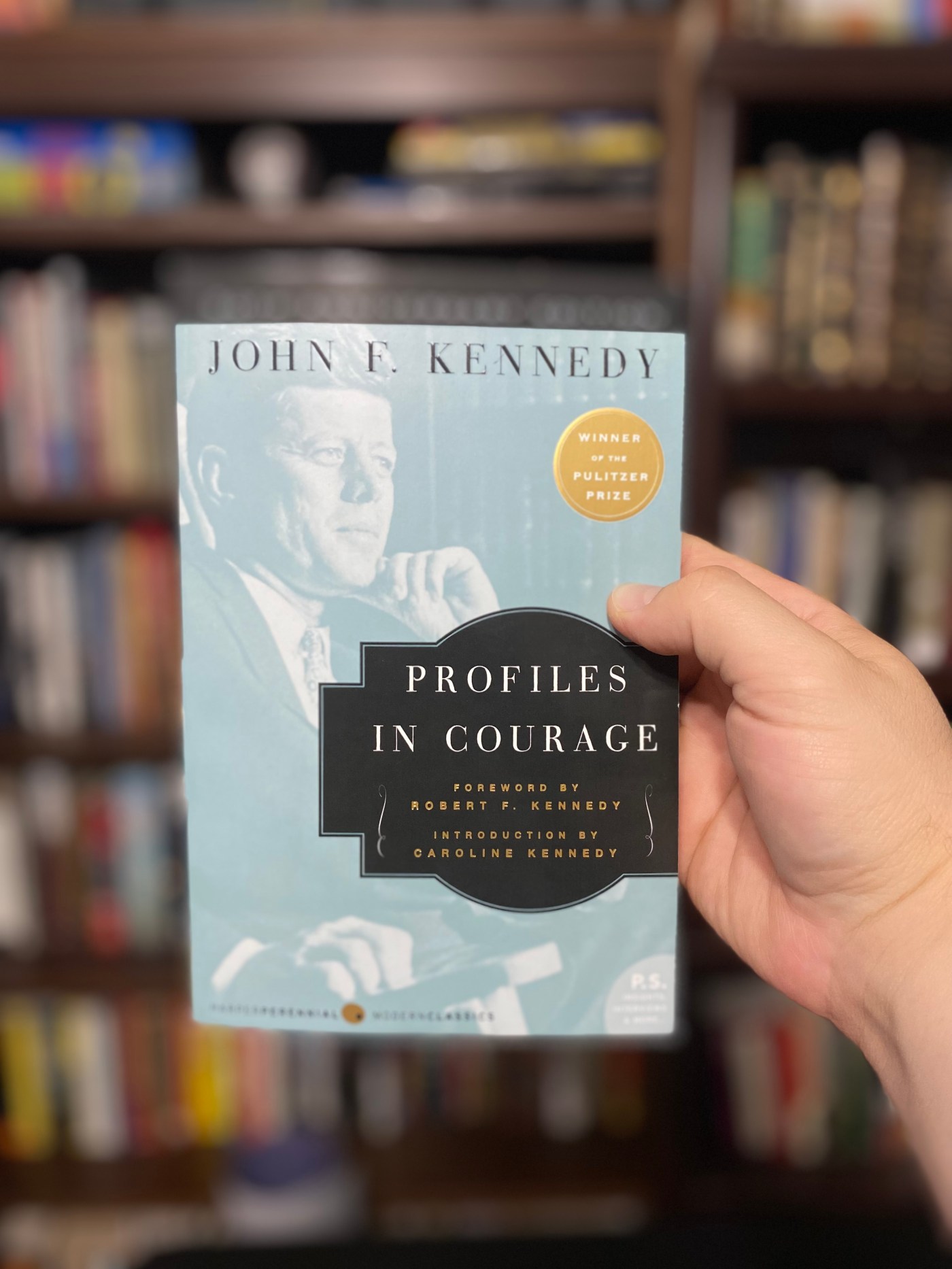
The book is Profiles in Courage by John F. Kennedy. It was originally published in 1955 by Harper Collins when Kennedy was a Senator. I read it in July of 2025.
The title refers to politicians in American history who had the courage of their convictions to stand up for what they believed was right even if it was unpopular. Kennedy gives profiles of these mostly Senators who stood their ground and voted in ways that were detrimental to their political careers.
This was a book club book. Nominated by my friend Randall.
It’s obvious from reading this that Kennedy believes that Senators and Congressmen should vote according to what they think is right even if that does not align with the views of their constituents whom they represent.
I’m not sure how I feel about this.
Kennedy writes the following.
“If [a Senator] allows himself to be governed by the opinions of his friends at home, however devoted he may be to them or they to him, he throws away all the rich results of a previous preparation and study, and simply becomes a commonplace exponent of those popular sentiments which may change in a few days. … Such a course will dwarf any man’s statesmanship and his vote would be simply considered as an echo of current opinion, not the result of mature deliberations. (p154)
But isn’t it the job of representatives to represent the voice of those who elected him to that office? Aren’t they supposed to be enacting the will of the people not their own personal opinion?
But then again, the Senator is a person himself. It’s inevitable that he will have his own opinion on issues and they might be more informed than the public’s. If a Senator is pro-life but then his district turns pro-choice, should he then vote against his own conscience? No, I guess he shouldn’t. But then his constituents have every right to vote him out of the office.
I guess the part that bugs me is the idea that the people are too stupid to know what’s good for them and that we need elected officials to take care of us and to do “what’s best for us” in any given situation.
If that’s the situation then the politician has a responsibility to convince the public that what he is doing is in their best interest. It’s a failure if he cannot.
There’s a case where Thomas Jefferson put an embargo on British ships and John Quincy Adams supported it even though it was destructive to Massachusetts ship and merchant industries. “Neither the merchants nor seamen could be convinced that the act was for their own good.” (p44)
If Adams thought it was the right thing to do he has a responsibility to persuade the people to see it his way too. That’s part of the job. What I dislike is the mentality that politicians get that they have to act against the will of the people “for their own good.” That top-down approach may have worked when we had competent leadership but I believe that era has gone away. Our civic leaders today have proven themselves mostly to be complete morons. I don’t want them deciding anything for me and my family.
But this is the system we have. It’s not perfect but it’s better than most alternatives. The people also have a responsibility to fully understand the consequences of electing certain people to powerful offices.
Deliberation is expected. The arguing and debating that is supposed to go in congress is a feature not a bug. This fact seems to be lost on the democratic left. What we have now is a impulsive and reactive Left that just want the politicians to “do something.” They want a powerful government to wave their magic wand of legislation and enact gun restrictions or healthcare laws, or redistribution policies. This is often based purely on emotion. We see it all the time. The same day after a school shooting or some other traumatic event we see congressman pounding their fists and yelling for action to be taken right away. There is no consideration of trade-offs or consequences that could happen as a result of such reactive legislation. They just feel a certain way and want something to be done right in the moment. With this sort of political system in place I don’t want any politician to make laws “for my own good.”
This book made me think about our current House and Senate and how different it is from what it used to be.
We used to have politicians who had at least a modicum of like-minded thinking as the people. But now the elite political class are so far removed from the lives of regular people. We don’t have the same values.
Tim Cain just recently disparaged people who believe our rights come from God and not government. It baffled him that there could be anybody who didn’t believe that it’s government who makes up our rights and bestows them on us from on high. Thomas Jefferson is rolling in his grave.
Kennedy was a clear writer. He stayed on point and explained his positions clearly.
So much has changed in our politics since 1955. There were things that were taken for granted like we all believed in the constitution. People believed in one truth. There wasn’t this victim mentality or oppression ideology. People had more in common than we do today. It’s just a different world. More people believed in God or at least in an absolute right and wrong.
I learned a lot from this book. I didn’t know most of the characters that were profiled. They weren’t familiar names.
I’d recommend this book to people interested in politics. I could see how it would be boring to those uninterested in government and civics.
****************************************************
Quotations
President Kennedy’s grandmother was living in Boston when President Kennedy was assassinated. She was also alive the year President Lincoln was shot. (pxvii)
“”””
Bonar Law said, “There is no such thing as inevitable war. If war comes it will be from failure of human wisdom.” It is true. It is human wisdom that is needed not just on our side but on all sides. (pxvii)
“”””
Mothers may still want their favorite sons to grow up to be President, but according to a famous Gallup poll of some years ago, they do not want them to become politicians in the process. (p2)
“””
This may not always be easy, but it nevertheless is the essence of democracy, faith in the wisdom of the people and their views. (p14)
“”””
We shall need compromises in the days ahead, to be sure. But these will be, or should be, compromises of issues, not of principles. We can compromise our political positions, but not ourselves.
Compromise need not mean cowardice. Indeed it is frequently the compromisers and conciliators who are faced with the severest tests of political courage as they oppose the extremist views of their constituents. (p18)
“”””
His [Adams] somber sense of responsibility toward his Creator he carried into every phase of his daily life. He believed that man was made in the image of God, and thus he believed him cqual to the extraordinary demands of self-government. The Puritan loved liberty and he loved the law; he had a genius for determining the precise point where the rights of the state and the rights of the individual could be reconciled. (p31)
“”””
Neither the merchants nor seamen could be convinced that the act was for their own good. (p44)
“”””
It was “out of the question,” he wrote, to hold his seat “without exercising the most perfect freedom of agency, under the sole and exclusive control of my own sense of right.” (p46)
“”””
Finally Benton announced that, if the Senate failed to protect him from such “false and cowardly” attacks, he intended “to protect himself, cost what it may.” On April 17, in the midst of another verbal assault upon him by Foote, Benton advanced toward the Mississippian, then turned back at a colleague’s restraining touch. Suddenly Foote whipped out a pistol and pointed it at Benton, who dramatically threw open his coat and cried: “I have no pistol! Let him fire! Let the assassin fire! (p89)
“”””
He could be all things to all men—and yet, when faced with his greatest challenge, he was faithful to himself and to Texas. (p99)
“””
At Waco his life was threatened. At Belton, an armed thug suddenly arose and started toward him. But old Sam Houston, looking him right in the eye, put each hand on his own pistols: “Ladies and Gentlemen, keep your seats. It is nothing but a fice barking at the lion in his den.” Unharmed, he stalked the state in characteristic fashion, confounding his enemies with powerful sarcasm. (p106)
“”””
If [a Senator] allows himself to be governed by the opinions of his friends at home, however devoted he may be to them or they to him, he throws away all the rich results of a previous preparation and study, and simply becomes a commonplace exponent of those popular sentiments which may change in a few days. … Such a course will dwarf any man’s statesmanship and his vote would be simply considered as an echo of current opinion, not the result of mature deliberations. (p154)
“”””
About this whole judgment there is the spirit of vengeance, and vengeance is seldom justice. (p199)
“””
When I say liberty, I mean liberty of the individual to think his own thoughts and live his own life as, he desires to think and live,
This was the creed by which Senator Taft lived, (p205)
“”””
House as Members, new and old, scrambled to denounce the bill. But not Calhoun:
This House is at liberty to decide on this question according to the dictates of its best judgment. Are we bound in all cases to do what is popular? Have the people of this country snatched the power of deliberation from this body? Let the gentlemen name the time and place at which the people assembled and deliberated on this question. Oh, no! They have no written, no verbal instructions. The law is unpopular, and they are bound to repeal it, in opposition to their conscience and reason. If this be true, how are political errors, once prevalent, ever to be corrected? (p212)
“”””
It may take courage to battle one’s President, one’s party or the overwhelming sentiment of one’s nation; but these do not compare, it seems to me, to the courage required of the Senator defying the angry power of the very constituents who control his future. (p222)
“”””
For democracy means much more than popular government and majority rule, much more than a system of political techniques to flatter or deceive powerful blocs of voters. A democracy that has no George Norris to point to— no monument of individual conscience in a sea of popular rule-is not worthy to bear the name. The true democracy, living and growing and inspiring, puts its faith in the people-faith that the people will not simply elect men who will represent their views ably and faithfully, but also elect men who will exercise their conscientious judgment-faith that the people will not condemn those whose devotion to principle leads them to unpopular courses, but will reward courage, respect honor and ultimately recognize right. (p223)
 Solomon White
Leave a comment