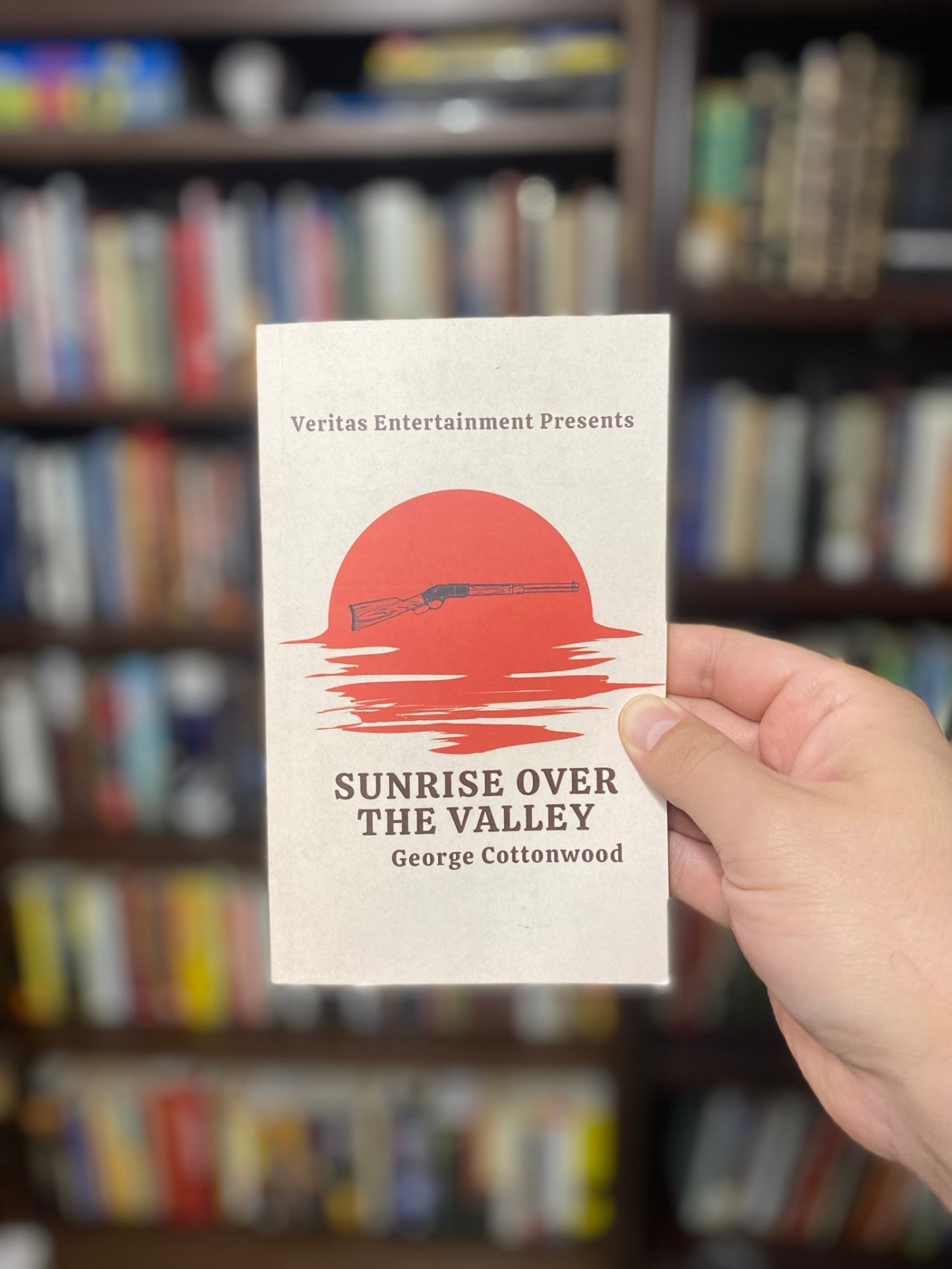
The book is Sunrise Over the Valley by George Cottonwood. It was published in 2025 by Veritas Entertainment.
The title refers to the main character Dean “Sunrise” Michalis. He’s a grocer in a small town but also a skilled gunman. This comes in handy when Dakota Tracy and his gang try to destroy (take over?) the little town of Pharr.
George Cottonwood is a very dear friend of mine. I believe it’s extremely important to encourage your friends’ creative endeavors and I couldn’t be prouder of him that he’s actually written a real honest-to-God book.
I liked the premise of the book. A humble hard working grocer rises to the challenge of defending his family and his town. That’s our favorite kind of story. It’s inspiring. It’s encouraging. Our current culture is in desperate need of more stories like this, of courageous men who stand up for justice and defend their loved ones.
It made me think about all the western movies and books I’ve read. It’s one of my favorite genres. Living in San Antonio, I can look around and see the scenery of these stories. I definitely saw that in this book.
As I address some problems I had with this book, I want to restate that Cottonwood is a friend and I would hope that I’ve built up enough credit to be afforded trust and confidence that any criticism comes from a place of good will and helpfulness.
I will also try to disregard the fact that the last two books I read were The Road by Cormac McCarthy and King Henry V by Shakespeare. I am not comparing Cottonwood to those authors. I want to keep this book within the context of its genre, a pulp western. As a pulp western story it hit the mark on pacing and economy of words. The tone and setting also worked very well.
Where this book fell short is in character development. Let’s start with Sunrise. I actually feel weird calling him that because no one in the story calls him that. Is it a nickname or isn’t it? He’s mostly referred to by other characters and by the author as Dean or Michalis. The nickname is given to him because he’s known stop doing his chores in the early morning and watch the sun rise. This is good character development because it shows that he appreciates God’s beauty in nature.
In an agrarian society it is significant that a man would stop his vital work to watch the sun rise. It also speaks to his work ethic that he is up before the sun. So from this we learn that he is hardworking and appreciative of the beauty of nature. But this good characterisation is forgotten throughout the story when no one calls him Sunrise. How characters refer to each other helps define their relationship. For example, his buddies and coworkers would call him Sunrise but his wife and mother would call him Dean. Whereas an authority figure or an enemy might call him Michalis. Either way, he is mostly referred to as Dean or Michalis, hardly ever as Sunrise. This is odd considering the title of the book.
Another character dimension that’s lacking for Sunrise is how he became so good as a gunman. The only explanation given is that his father was a law man and he taught him how to shoot. This is a missed opportunity to flesh out his biography and add dimension to the character. This being a pulp western shouldn’t prohibit a paragraph or two showing how Sunrise became the man he is today.
Joaquin “Graveyard” Reyes feels like an undecided character. He’s so good with a gun and has killed so many men that people start calling him Graveyard but then we see he’s rattled with guilt when it comes to taking over the town.
“He was disappointed in Joaquin Reyes, though. The man they called “Graveyard,” yellow? He couldn’t believe it.” (p51) The problem is neither can the reader.
It feels like a decision needs to be made about who this character is. Something you rarely find in a pulp western is a character so nuanced that the reader doesn’t know what to do with him. Where does his loyalty to Dakota Tracy come from? Did Tracy save his life? Is he paying off a debt? Why is he doing what he’s doing? If he is the hardened killer that deserves the name Graveyard, it would make the slaughter of the innocent farmer more believable than it is.
This brings me to the only other shortcoming in this book. Motivation. Why are the characters doing what they’re doing? What do they want and who or what is stopping them? These are the sources of tension and drama in any story. Dakota Tracy says he wants open range for grazing cattle, but then he’s okay if there is a town but he wants it to be lawless. But then he offers Graveyard a share in some pelts he wants to sell in Kansas? One of the tenants of a pulp story is simple, straightforward characters. The good guys wear white hats and the bad guys wear black hats.
So I guess my main problem with this book is that I want it to be longer. I feel intrigued by interesting characters but they’re not as developed as they could be. I really want to know more about Sunrise. I want to know who Reyes really is. Why did he join Tracy’s gang? If he’s not religious, why is he so scared of hell? I want to know what Dakota Tracy really wants.
There are some great lines in this book.
“Don’t worry about any legal troubles. But being in the right is a tough place to be when people in the wrong want to kill you. Keep your gun hand clear.” (p5)
This line reminded me of Cormac McCarthy.
“The sun rose above the horizon and partially backlit Dean’s already darkened face as they rode back south and west to Pharr, but he didn’t notice it.” (p41)
That’s a fantastic sentence.
I’d recommend this book because it is an interesting story that we need more of and because my friend wrote it and I’m incredibly proud of and impressed by him. It’s better than any book I ever wrote, which is none. Creative writing is extremely difficult and George Cottonwood is getting it done. I want to read more.
****************************************************
Quotations
“”””
Don’t worry about any legal troubles. But being in the right is a tough place to be when people in the wrong want to kill you. Keep your gun hand clear.” (p5)
“”””
Being scared don’t make a man yellow. It’s what he does when he is scared,” (p32)
“”””
The sun rose above the horizon and partially backlit Dean’s already darkened face as they rode back south and west to Pharr, but he didn’t notice it. (p41)
“”””
Joaquin didn’t like it. He had gone along with Tracy this far, and that was far too long. Too many of his friends had died and been buried. Too many other men murdered. He didn’t want to attack a town and add more to his guilt. Though he wasn’t a religious man, he was scared of hell, and knew that the grocer could send him there. (p44)
“”””
He wanted the open range, but if there had to be a town here, he wanted it to be a town where the law didn’t matter, where cattle moved fast and no one asked questions about branding irons. If he took Pharr, he wouldn’t just be running an outfit—he’d be building an empire. (p51)
“”””
He was disappointed in Joaquin Reyes, though. The man they called “Graveyard,” yellow? He couldn’t believe it. (p51)
 Solomon White
Leave a comment