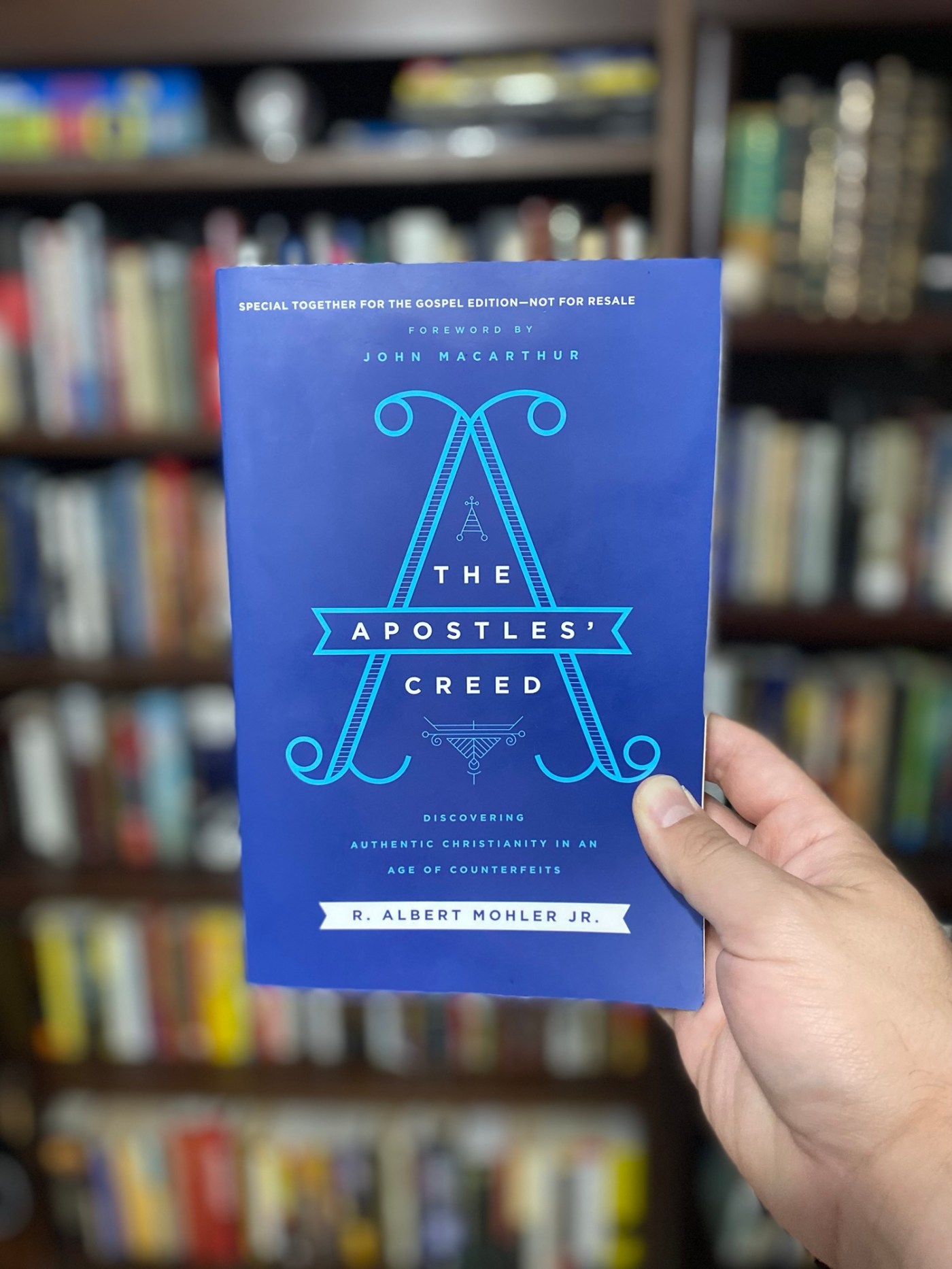
The book is The Apostles Creed by Al Mohler. It was originally published in 2019 by Thomas Nelson. I read it in May of 2025.
In this book Al Mohler walks through each section of the Apostles Creed line by line and explains each part.
I got this book from a friend who went to a Christian conference. They got a tote swag bag full of books and he gave them to me. I’ve had the book for years but just now getting to it. I went through it with my discipleship group.
Mohler’s main point was that the Apostles Creed is a way to tether our Christian belief with the same belief of our spiritual forefathers. We believe the same thing that the first Christians believe and it’s laid out in the Apostles Creed.
I believe in God, the Father almighty,
creator of heaven and earth.
I believe in Jesus Christ, his only Son, our Lord,
who was conceived by the Holy Spirit
and born of the virgin Mary.
He suffered under Pontius Pilate,
was crucified, died, and was buried;
he descended to hell.
The third day he rose again from the dead.
He ascended to heaven
and is seated at the right hand of God the Father almighty.
From there he will come to judge the living and the dead.
I believe in the Holy Spirit,
the holy catholic church,
the communion of saints,
the forgiveness of sins,
the resurrection of the body,
and the life everlasting. Amen.
The Apostles Creed is a safeguard against corruption of the faith. These are tenants that we hold to and they’re what make us Christian. If you are a Christian, you must affirm this creed. Mohler is quick to note that the creed doesn’t contain all aspects of Christian belief, but it covers the non-negotiables.
My main takeaway from this book is that a Christian legacy is not automatic. We must catechize our kids. We must teach our children the tenants of the Christian religion or else they will turn it into something else of their own creation. That’s a natural tendency of man, to remake the faith in our image. Remembering and passing down the Apostles Creed is how to reinstate right belief. We have to be able to articulate what we believe in a concise yet coherent statement.
Many Christians, if they were handed a blank sheet of paper and were asked to write down what the gospel is, they would struggle. That’s insane. It’s not enough to just feel it in our hearts or whatever, we have to be able to spell it out. The Apostles Creed does that for us. It helps us express our Christian belief in a definitive way.
We’re doing our best to catechize the kids. I read one question from the New City Catechism every time we sit down at the table for dinner, which is most nights. The Apostles Creed is one of the questions in the catechism. I read the Bible to them and we pray together before bed every night. For the kids it’s part of their night time routine like bathing and brushing their teeth. It always gets done no matter what. It would be weird and awkward if we didn’t do it. I want prayer and Bible reading to be a permanent fixture in our home.
This book made me think of the Third Day song Creed where they sing the Apostles Creed. But apparently that’s a cover of a Rich Mullins song. Anyway, it’s a great song. It helps to learn it when you sing it.
I learned what hell is. The line in the Apostles Creed that reads “he descended to hell” always threw me off. Did Jesus go to hell? Yes, but not as we understand hell. We usually think of hell as the place of torment and punishment for sin, the lake for fire. But that’s not the way the creed means it. The creed means it simply as the place of the dead. The Old Testament Hebrew word for “the place of the dead” is sheol and the New Testament Greek word for it is hades. Our word for it is hell.
Al Mohler explains further.
“The New Testament Greek also includes the word Gehenna, which is the place of torment. The Bible does not tell us that Jesus went to Gehenna; what it does tell us, boldly, is that Jesus truly died.
Luke 16:19-31, which speak of the rich man who was in torment in hades while Lazarus, also in hades, was comforted in Abraham’s bosom—a most honored place. Hades, the realm of the dead, contains both a place of torment and a place of great blessing,” (p89-91)
So hell, or sheol, or hades, has two places within it, the place of comfort (Abraham’s bosom) and the place of torment (Gehenna). Before Christ, all people just died and went to “the realm of the dead” (sheol, hades, hell). That’s another way Jesus’ death and resurrection changed everything. It changed the world and it changed the underworld.
I take Jesus’ descension into hell as explained by this verse in 1 Peter 3:18-20 “For Christ also suffered once for sins, the righteous for the unrighteous, that he might bring us to God, being put to death in the flesh but made alive in the spirit, in which he went and proclaimed to the spirits in prison, because they formerly did not obey,”
Jesus went to the realm of the dead for two reasons. One, to show that he truly died. He didn’t faint or fall asleep. He was truly dead and in the place of the dead just like all those before him. The second reason is to rescue all of the faithful in sheol to be released from the realm of the dead as well. Christ knows the way out of the grave.
I’d recommend this book to new Christians. It’s a great primer for what Christians believe and why.
****************************************************
Quotations
“”””
as Christians, we believe what the apostles believed. And we want to hand that same faith to the next generation. (xvii)
“”””
Kaufman argued that modern theologians needed to invent an entirely new language for speaking about God. The language found in the Bible, he believed, was out-of-date and unworthy of modern thinkers.
The reason we know these things is because God has Trin hath nature and Scripture,
The reason we know these things is because God has spoken.
If we begin with a wrong conception of God, we will misconstrue the entirety of the Christian faith. (p2-3)
“”””
The fact that any human being anywhere exists and lives and breathes is a testimony to a paternal and benevolent relationship between the Creator and his creation. But this does not mean that God is “Father” in a personal and saving way to everybody. Scripture clearly affirms that we become sons of God only as we are united to Christ and thereby adopted into God’s family (Gal. 4:4-5; Eph. 1:4-5). (p7)
“”””
we are to see God’s self-disclosure of his own character and his own being in Scripture as the ideal fatherhood. It is God the Father who defines what a human father must be like, not the other way around. (p10)
“”””
This larger story moves along four major epochs: creation, fall, redemption, and consummation -each like a major movement in a grand symphony. We, that is, humanity, are all characters in this story. If our lives are to have proper meaning, we must know our place in this narrative and understand how we can be part of God’s purpose of glorifying himself in creation.
The entire Christian worldview hangs on the Creator/creature distinction. (p15)
“”””
Dennett says Darwinism is like a universal ideological acid. It burns through everything, leaving nothing. This is why Darwinism and nihilism go hand in hand. Without God as the ultimate starting point, we have no purpose in life, and the universe is a mere accident. (p19)
“”””
In his 1980 mini-series called Cosmos, Sagan begins every episode by reiterating, “The cosmos is all that ever was, or is, or ever shall be.” This statement manifests a worldview of naturalistic materialism. Instead of beginning with God as Creator, naturalists begin and end with the cosmos itself, which leaves the door open to any other cosmos of which we are unaware.
Scripture gives us no reason to think that God created some other universe. Our universe is the space that God created. (p22)
“”””
Calvin is right, for the entire created order exists for one great purpose: to display the glory of God through the redemption of sinners through Jesus Christ the Son. Creation leads to new creation. Thus, God ultimately created the cosmos for redemptive purposes. The agent of creation becomes the agent of redemption. One day, the agent of redemption will become the agent of new creation. (p25)
“”””
Friedrich Schleiermacher, the father of theological liberalism, refused to speak of Christ and salvation in terms of the supernatural; for him, salvation did not require a supernatural intervention like the virgin birth. David Strauss suggested that the New Testament, an artifact of history, represents a primitive expression of religion —an expression rooted in myth and mysticism. (p46)
“”””
The creed affirms the reality of the historicity of the event by including the name “Pontius Pilate.” The suffering of Jesus constitutes an actual historical event that occurred in a certain place and time as revealed in Scripture. (p64)
“”””
Jesus, delivered up according to the definite plan and foreknowledge of God, you crucified and killed by the hands of lawless men” (Acts 2:22-23). This text underlines that the cross was not something that surprised God or merely happened to Jesus. It was God’s plan. (p72)
“”””
the Old and New Testaments describe as the realm of the dead. The Hebrew word from the Old Testament is sheol, and the Greek word from the New Testament is hades.
The New Testament Greek also includes the word Gehenna, which is the place of torment. The Bible does not tell us that Jesus went to Gehenna; what it does tell us, boldly, is that Jesus truly died.
Luke 16:19-31, which speak of the rich man who was in torment in hades while Lazarus, also in hades, was comforted in Abraham’s bosom—a most honored place. Hades, the realm of the dead, contains both a place of torment and a place of great blessing,
that he was not abandoned to
Hades, nor did his flesh see corruption. (Acts 2:29-31)
God raised him from the dead. And so, even as we confess that Christ descended into hell, we get ready to celebrate that hades could not hold him. (p89-91)
“”””
Peter, like Paul, associated regeneration language with Christ’s resurrection. Christians were made “to be born again to a living hope through the resurrection of Jesus Christ from the dead.” Christ’s resurrection provides the source of new spiritual life—new life is a sharing of Christ’s resurrection life (1 Peter 1:3). (p100)
“”””
Through Jesus’ ascension he gave the church the Holy Spirit.
“Nevertheless, I tell you the truth: it is to your advantage that I go away, for if I do not go away, the Helper will not come to you” (John 16:7)
Without his ascension the Spirit could not come; and, in some mysterious, spectacular way, the indwelling of the Spirit eclipses the physical presence of Jesus Christ. (p108)
“”””
Christ’s judgment will be so perfect that all the judged-whether declared righteous through Christ or not—will agree with the righteousness of the judgment. Those who go to hell will fully know the rightfulness of that verdict, as will those who go to heaven because of what Christ has done on our behalf.
God’s wrath is the appropriate and natural response of the Holy One to a rebellion against his perfect righteousness. (p131)
“”””
Do you come to God’s Word in humble prayer, asking the Spirit to guide you, teach you, and direct your thoughts? Do you realize the glorious truth Christ here proclaims to you: that the Spirit of God dwells in you to teach you the things of God? The Spirit, furthermore, teaches all the people of God through the Word and through the preaching of the Word.
“For no prophecy was ever produced by the will of man, but men spoke from God as they were carried along by the Holy Spirit” (2 Peter 1:21) (p139)
“”””
“My task is to inform you that there was someone between Jesus and your grandmother and then to convince you that it matters.” It struck me like a bullet,
the long, unbroken line of communion Christians share as members of Christ’s church. (p150)
“”””
Jesus said that upon Peter’s words, he would build his church. This text demonstrates four elements that make up the ontology of Jesus’ bride. Jesus revealed that his church is to be founded upon a confession, on truth, in power, and with authority. (p152)
“”””
that the true unity of the church is, in this age, not institutional but theological. When the Scripture is rightly preached and the gospel is cherished, there is the church.
Denominations result whenever deep convictions and religious freedom are found. (p158)
“”””
Modern Christians, unarmed with the teachings of the Scriptures, often run to the authorities of pragmatic preaching and find moralistic therapy devoid of any biblical truth.
All must see their sin as God himself sees it. (p173)
“”””
“So strike at God and you wish God would cease to be God. This is a horrible wickedness indeed… What will you say to such a wickedness as this, that it should enter into the heart of any creature, “O that I might have my lust and, rather than I will part with my lust, I would rather God should cease to be God than that I would leave my lust.”
Christian, your sin amounts to nothing less than a desire for God to cease being God. Your sin rebels as cosmic treason. (p174)
 Solomon White
Leave a comment