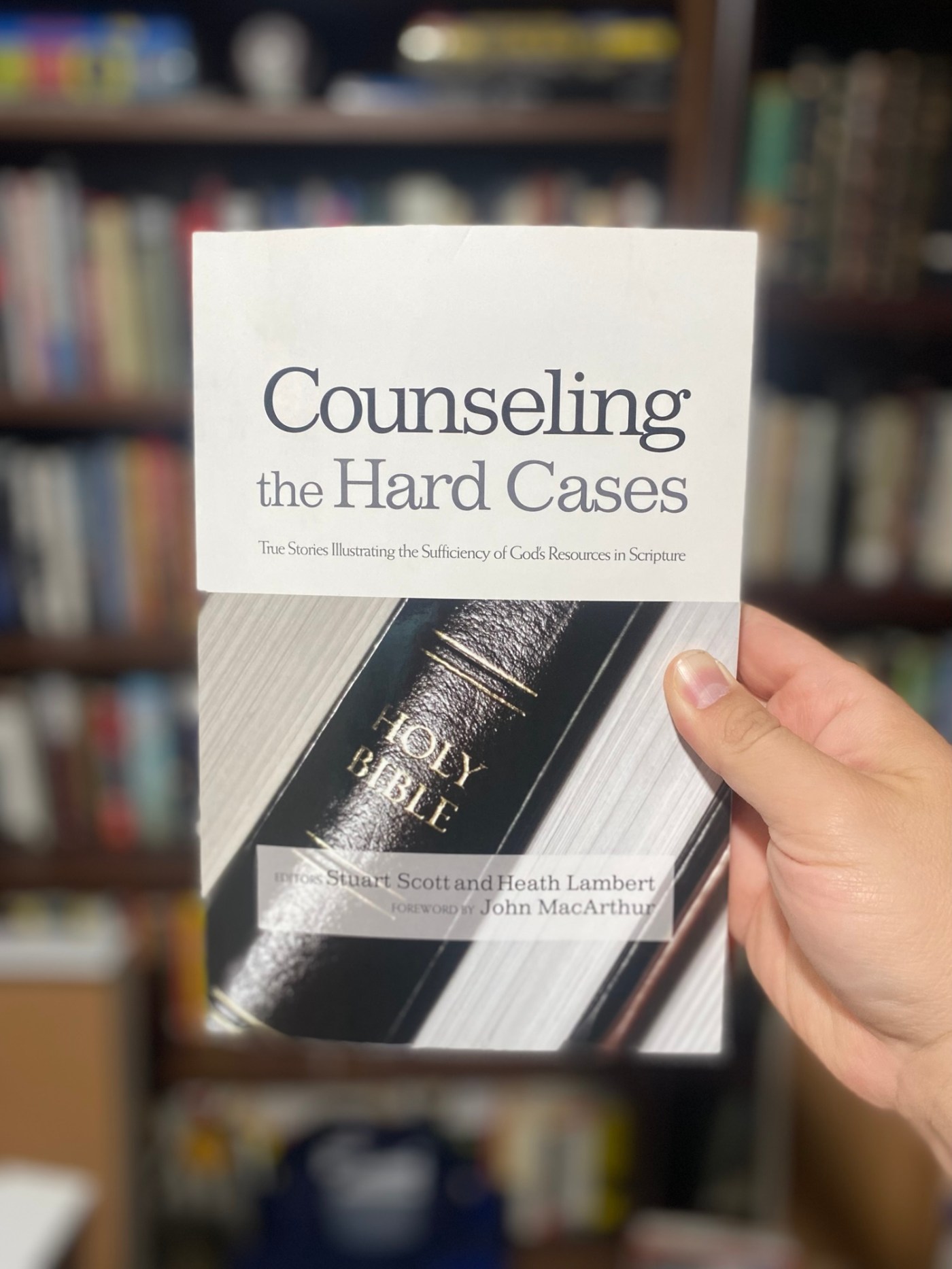
The book is Counseling the Hard Cases edited by Stuart Scott and Heath Lambert. It was originally published in 2015 by B&H Academic. I read the 2015 softcover edition. I read it in March of 2025.
The title is the theme of the book. It’s about Christian biblical counseling for the hardest cases you can think of. They’re all real life examples. Real patients. Real people. Suicidal, psychotic, multiple personalities, anorexia, homosexuality, depression, all the hardest psychological conditions that are out there.
This was a book club book nominated by Jonathan Ellis and voted by the club. Jonathan has mentioned this book several times before and I’ve been wanting to read it anyway. I was glad to have the chance to go through it with the book club.
The point Scott and Lambert are trying to make with this book is that real psychological life change can happen through the power of God’s Word, the gospel, sanctification, and discipleship.
This book was difficult for me to wrestle with because I would never say that there is no power in God’s Word to change lives but at the same time I was under the impression that certain psychological conditions are hardwired into people like blindness or being crippled. If that’s the case and these biblical counselors are bringing people out of schizophrenia and bipolar disorders wouldn’t that make them miracle healers?
I thought mental disorders like this were physical conditions in people’s brains that at best could just be managed in people’s lives for them to function somewhat normally. It’s almost as if this book was saying that biblical counseling and discipleship could cure someone of autism. I don’t believe that. I believe that autistic people can be saved…but they still have autism. I thought someone with bipolar disorder can be brought to salvation despite them still having bipolar disorder. That’s what’s hanging me up. But Scott and Lambert are saying that all these psychological conditions are sin and heart issues and can be changed through biblical counseling. I guess I just didn’t know the material scientific aspects of these conditions.
“Christian counselors,…They fail to understand that all problems in living emotional, mental, relational, behavioral-have a spiritual core. This is a powerful argument for the adequacy of Scripture’s counseling resources….the real concern is not with the sufficiency of Scripture but with the sufficiency of psychology.” (p9)
The difference is sin. An autistic person or someone with downs syndrome isn’t sinning. They have a real physical deficiency but that deficiency isn’t sinful. Someone who is habitually lying about voices in their heard is sinning. Is anxiety a sin? I think it can be. Finding your identity in something like homosexuality is a sin, even without the sodomy.
My main takeaway from this book is that I do not care enough about people. There was one line that was really convicting for me.
“one displays arrogance in assuming the worst of people, silently accusing them of being kooks and giving up on them as hopeless cases simply because one is not in their situation or presumes that one’s response in the same situation would be different.” (p93)
I have definitely written people off in my life because of their personality or mental issues. I tend not to have any time for someone who is destructive to everyone around them. My step-mother was a monster. She was a dark poisonous cloud over our lives and made everyone including herself miserable. When she and my dad divorced it was extremely easy to completely forget her as a person. I’ve not spoken to her since they divorced even though my half-brother lives with her. In that case I think it’s fair to have healthy boundaries against an extremely toxic person in your life. But I’ve written off other difficult people who I could’ve made more of an effort to try and help.
My thought is that if someone doesn’t want help then I’m not going to chase them. But this book spoke against that too.
“Church-based counseling is not consigned to the kind of finger-tapping approach that simply waits for the counselee to “come around.” Christ’s agenda for his people is much broader than that. Though much biblical counseling is reactive, we are not mainly to be responders but pursuers, like Jesus. Though Julie herself was not really pursuing change, our efforts to help her were not in vain for at least two reasons.” (p276)
I’m definitely not a pursuer but rather more of a responder. If someone comes to me asking for help, I’m happy to point them to what God’s word says about an issue they’re dealing with. But if they resist and run away I don’t chase after them. That’s a change I need to make. Reaching out to people more.
Identity was a common theme in this book. A lot of these people’s problems stemmed from who or what they thought they were. I don’t think it was conscious for them but in every case they had some false understanding of their identity especially if they claimed to be a Christian. They claimed to be a child of God, co-heir with King Jesus but then lived and thought like slaves and prisoners. That’s extremely common.
“Many Christians are spiritually stunted because they are trying to fulfill the commands of Ephesians 4-6 (the gospel imperatives) without soaking themselves in the foundational truths regarding their identity in Ephesians 1-3 (the gospel indicatives).” (p78)
I’ve also heard this expressed in terms of “descriptive” and “prescriptive.” Descriptive is describing yourself and the situation for what it is. Prescriptive is explaining what to do about it. A doctor wouldn’t prescribe a treatment without first making a diagnosis. The diagnosis is that you were a sinner in need of a savior. You have confessed of your sins, and repented and have received the savior Jesus Christ. So now your description has changed. You were a sinner but now you are clothed in Christ’s righteousness and redeemed. You are a saint and child of God now. You weren’t before but now you are. Understanding this new description of yourself enables you to now apply the prescription which is the power of the Holy Spirit to work in you towards life change through sanctification. You are now able to please God and choose rightly, so do it. In every hard case the realization of who they actually are in Christ had to happen before they were able to change.
We make a lot of assumptions about the mind and psychology. Psychology is the godless world’s attempt at working to heal people’s souls. To a certain degree this can “work” in a sense of stoic behavior modification. They can talk it out and get some pills and just white knuckle their issue for the rest of their life. But that isn’t real healing or freedom.
True freedom is found in Christ. We’re not looking for mere behavior change, we’re looking for eternal life change. The key for most of these people is realizing who they really were as Christians. Our current culture talks a lot about living your authentic self. Christians really need to do that. Live your authentic self as a saved child of God with the indwelling of the Holy Spirit. That’s who you authentically are so start living like it.
I’d recommend this to any Christian man who is pursuing eldership in their church. Counseling is one of the qualifications of being an elder. All men should be working on elder qualifications anyway because we are elders for our family. You will have to counsel your wife and kids in this way so we need to learn this.
****************************************************
Quotations
“”””
Christian counselors,
They fail to understand that all problems in living emotional, mental, relational, behavioral-have a spiritual core. This is a powerful argument for the adequacy of Scripture’s counseling resources.
the real concern is not with the sufficiency of Scripture but with the sufficiency of psychology. (p9)
“”””
Over time she abandoned the use of this metaphor to describe her internal state. Today Mariana says that she never had multiple personalities until they were “discovered” through hypnosis. (p36)
“”””
I encouraged her not to visualize or believe things she knew were untrue. I also told her that she could respond to frightening images like these by speaking truth to herself and telling herself that they were not real. Mariana had never considered talking down these false imaginations. Her previous psychotherapist had always received her metaphorical fears as reality, and she had never before been encouraged to reorient herself to actual reality when they occurred. (p37)
“”””
I encouraged Mariana to accept responsibility for her own sin while simultaneously insisting that she was not responsible for the sins that had been committed against her. (p47)
“”””
Many Christians are spiritually stunted because they are trying to fulfill the commands of Ephesians 4-6 (the gospel imperatives) without soaking themselves in the foundational truths regarding their identity in Ephesians 1-3 (the gospel indicatives). (p78)
“”””
The primary issue in Brian’s story had little to do with his driving and had everything to do with his identity. He had to learn _to think biblically about his Savior and himself (Rom 12:3). That new thinking needed to produce new patterns of living. (p79)
“”””
one displays arrogance in assuming the worst of people, silently accusing them of being kooks and giving up on them as hopeless cases simply because one is not in their situation or presumes that one’s response in the same situation would be different. (p93)
“”””
“I’m Zoe’s mommy,” she said. “I’m supposed to know how to take care of her, and I don’t. I’m just a bad mother.” “Sarah, let me read you something,” I responded. I turned to Titus 2:3-5 and read it aloud:
Sarah was overlooking the reality that good mothering is learned. (p100-101)
“”””
I began by clarifying that Sarah was not called to rejoice at the suffering but to rejoice in the suffering. This distinction is essential.
we do not rejoice in suffering because we love the suffering in and of itself. We rejoice in suffering because we look forward to what God is able to do through our suffering. Paul celebrated the fact that through our sufferings and afflictions God is bringing about endurance, proven character, and hope. (p105)
“”””
Does medicine ultimately solve heart problems? No. But is God’s will ultimately going to be hindered by medicine or a lack of medicine? No. God will work his will in a counselee’s heart regardless of whether they are medicated. My goal and responsi bility are to cultivate hope, to help people grow in Christlikeness, and to help them prosper in the freedom of the gospel and in God’s rich purpose for their lives. (p121)
“”””
Although this fear of losing family and friends can sound natural and right, it is typically founded on a premise of entitlement. The unstated assumption is that “I deserve to have a healthy family and nice friends” or “I don’t deserve a sick family and judgmental friends.” For Mary this assumption turned into a stronger conclusion: “I must have what I deserve or I cannot be happy. I must have what I deserve or God is not good.” This demand led to crippling anxiety. (p125)
“”””
Often counselees are so fixated on their feelings regarding their situation that they ignore the truths God has clearly revealed in his Word. These counselees are operating under the unstated assumption, “I feel it to be true; therefore, it is true.” Such patterns of belief are a poison to trust in Christ and his promises. It is deceptive and precarious logic; it elevates a sin-cursed person’s perception of circumstances above the absolute truth that God has established.
Paul urged believers to set their minds not on their feelings but on what is true (Phil 4:8). (p126)
“”””
I chose not to focus on secular labels for Mary’s unusual behavior. When referring to her problems, I purposefully avoided all terminology outside of biblical terminology. Others (especially secular specialists) might have labeled Mary’s behavior obsessive-compulsive disorder (OCD), but I chose not to label her behavior as OCD in our counseling sessions because this label often weakens a person’s sense of responsibility and indirectly undercuts hope. (p138)
“”””
Though their commitment to Tony’s ministries was astounding, their commitment to personal communion with God was shockingly absent—as shown by a slow decline in personal and family prayer, meditation on the Scripture, and pursuit of renewing their minds with God’s Word and applying it specifically and practically to daily life. (p174)
“”””
Tony looked like a model servant, but he had been neglecting his personal relationship with Christ and had replaced service with true devotion to Christ. (p187)
“”””
We unpacked 1 Cor 6:11 and 2 Cor 5:17 as we discussed the gospel and especially her identity in Christ. Whether Jackie’s old identity was viewed as multiple confused personalities or a singular enslaved personality, her past identity as a whole was just that—old and dead. “Such were some of you,” Paul wrote to the converted sinners of Corinth (1 Cor 6:11 NASB, emphasis added). Now, along with these redeemed saints, Jackie was, in a real sense, a new creation (2 Cor 5:17) (p214)
“”””
She also needed to learn the principle of exercising herself toward godliness in tangible and specific ways (1 Tim 4:7-8). Her application of the put-off/put-on principle from Eph 4:22-32 needed to differ entirely from her past efforts to staple good fruit onto a dead tree (her dead heart) and from the toxic legalism that once reigned in her life.? As expected, learning these lessons was not a one-time event but rather came in successive seasons of life in which she grew by increasing degrees. (p217)
“”””
key elements often identified with male homosexuality: a dominant mother, a passive father, early exposure to sexually explicit pictures or acts, and an inclination toward homosexual tendencies. (p230)
“”””
She also repeated her previous admission that she was more afraid of her husband’s standard than God’s standard, even though she expressed confusion about what those standards might be. (p263)
“”””
The core problems were not chronic pain, psychiatric medications, marriage and parenting failures, substance abuse, or even infidelity. At root Julie remained consumed with herself as she pursued happiness on her own terms. (p271)
“”””
Church-based counseling is not consigned to the kind of finger-tapping approach that simply waits for the counselee to “come around.” Christ’s agenda for his people is much broader than that. Though much biblical counseling is reactive, we are not mainly to be responders but pursuers, like Jesus. Though Julie herself was not really pursuing change, our efforts to help her were not in vain for at least two reasons. (p276)
 Solomon White
Leave a comment