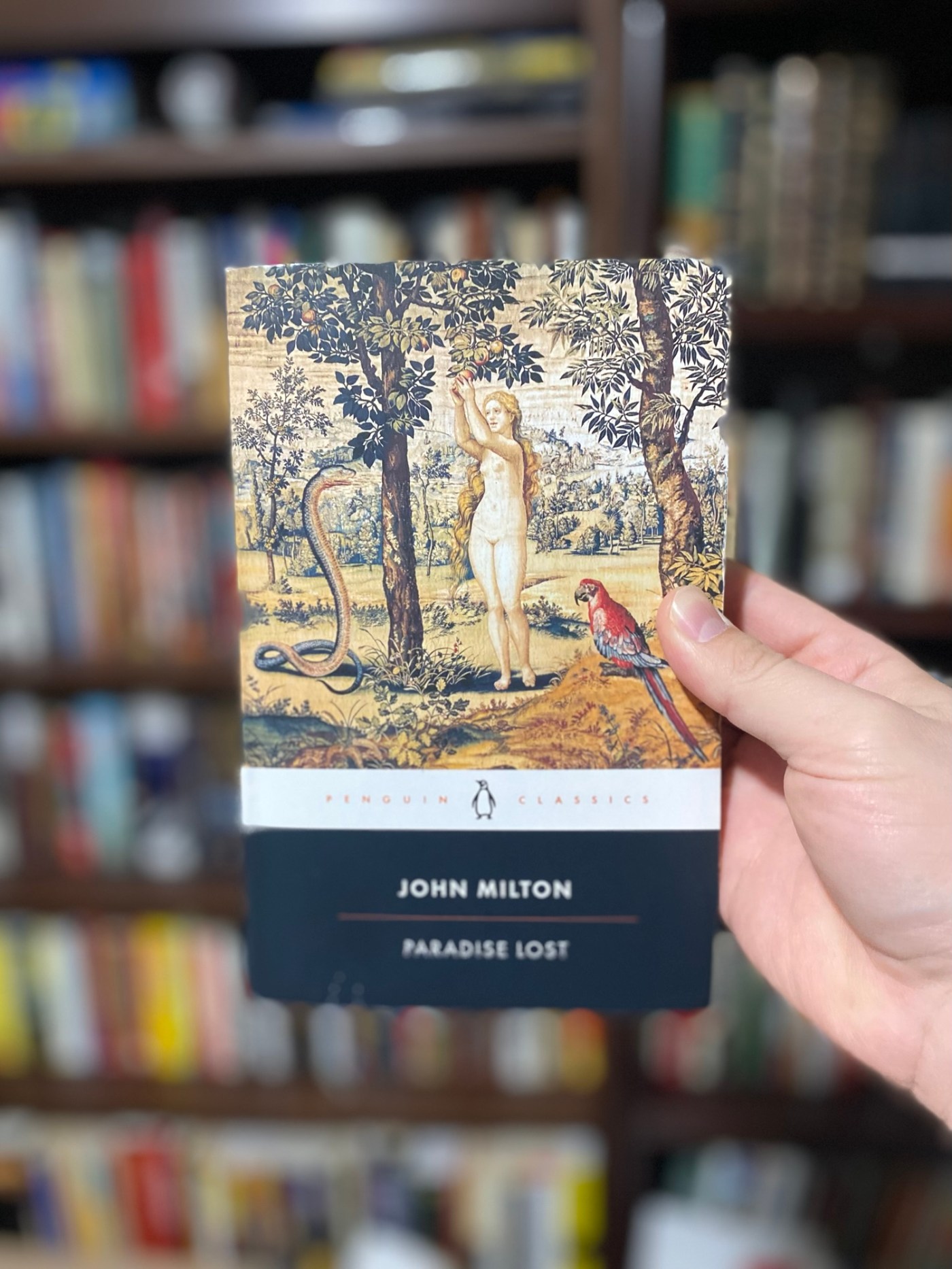
The book is Paradise Lost by John Milton. It was originally published in 1667. I read the 2000 Penguin Classics paperback edition. I read it in January of 2025.
The title refers to the context of the book which is the Fall of humanity in the garden of Eden. Milton’s goal was to rewrite the biblical story in the style of epic classical poetry. He accomplished this goal tremendously.
I read this as part of a research for a book I want to write. I’ve also just been wanting to read this for a long time because it’s a classic.
Milton’s writing is beautiful. He wanted this book to be the foundation from which other epic poets can write in the English language. I’m not aware of any.
The epicness of Milton’s poem is impactful. The characters of the biblical story come to life. They’re vivid. But in doing this Milton has taken a real historical event and pulled it into the realm of myth and legend. The Greek classics were myths, but the Bible is not. By rewriting the story of Adam and Eve in the garden of Eden, Milton dilutes the biblical reliability of the Fall as real history. I know he didn’t intend this but others have obviously taken this a license to ignore the literalness of the Bible.
I can’t say for certain that Paradise Lost is the primary reason that the story of the garden of Eden has slipped into mythology, but it certainly frames it that way in people’s minds. By turning Genesis into an epic poem, Milton tugs at a thread of reality that drags Adam and Eve into the world of Achilles and Zeus.
The most significant way Milton muttles the history of original sin, is by attributing motive and reason to Satan where the Bible does not. Satan’s motive is his jealousy of the Father’s love for Jesus.
“Satan, so call him now, his former name Is heard no more in Heav’n; he of the first, If not the first Archangel, great in power, In favour and pre-eminence, yet fraught With envy against the Son of God, that day
Honoured by his great Father, and proclaimed Messiah King anointed, could not bear Through pride that sight, and thought himself impaired.” (p118)
It’s like a movie of a real historical event. Creative liberties are taken and they actually change the story.
Milton also tries to deal with theodicy, the problem of evil in the world, and quickly falls into dualism. In his version of the story God has made Adam and Eve with free will, and they have chosen to rebel. In the case of Adam and Eve that may be true but Milton presents it as if that’s the case for us as well. He’s not specific to Adam and Eve. The way he writes it it sounds like that’s how he makes all mankind, with the capacity to choose not to sin through our own power.
This is a common mistake. Many Christians, in an attempt to “get God off the hook” for all the sin and pain we see in the world, put it all on humanity as our free choice, but this actually raises a human’s sovereignty to an inappropriate degree.
I would say it’s true that Adam and Eve were free to choose to eat of the tree or not, but there was no world where they do not eat of the tree. The Fall was preordained by God. In this way God remains unstained as the “author of evil” and remains sovereign Lord over all that happens.
Satan is shown too much as “speaking truth to power.” There is too much sympathy for the devil. He comes across as simply misunderstood. This could be the seed that grew into the postmodern plant we see today of villains in stories being seen as having a tragic past and so of course they would end up where they did. So would you if you were treated that way. It seems like Satan is not certain why he was punished to be in hell. That’s not correct. Satan knows exactly what he’s doing and he doesn’t feel sorry for himself. Satan is not a tragic figure, he’s a tool for evil.
This book made me think about the Greek classics. I read The Odyssey and The Iliad last year. This definitely reminds me of those works. It’s the Christian version of those epics. It also made me think about how the stories of the Bible were framed for me as a kid. My visualization of the unseen realm was mostly influenced by Chick tract comics. Those comics weren’t epic or poetry but they depicted life and God and angels and Satan in a serious way. That’s been my default visualization ever since and I don’t think it’s wrong.
Maybe it’s because I’m a Christian, I already appreciate the Bible as the greatest epic story ever told. I understand the grandeur of the Bible and its importance to western literature. A lot of people don’t and maybe this book would help them see the Bible that way.
The section showing Sin and Death accompanying Satan into the world was surprising. That’s not shown that way in the Bible, but the imagery is fantastic. Satan is trying to get out of Hell but the door is blocked by Sin. She refuses to let him out but Satan promises to take her and her son Death with him into the world. That’s amazing.
If someone asked me if this was hard to read I’d say yes. I’m not so arrogant to say that this was easy for me to follow along. I could but it wasn’t easy. You really have to pay attention as a reader, but it was beautiful and a joy to read.
The tone was ominous and epic. I felt the weight of the content.
The fall of humanity. Sin and death entering the world.
It was heavy, but beautiful.
The villain to avoid was obviously Satan. The lesson learned? Don’t feel sorry for yourself. Don’t let bitterness and resentment fester and grow inside you. When it does, you only want destruction. Understand where you have failed like Adam did and repent and confess and turn back to God.
This book lived up to the hype. I’d recommend this to real readers. Yes, I feel like an ass saying that but the average casual reader will have trouble with the language. But it is epic and beautiful. Don’t go building any theological doctrines on it. It won’t hold up. But as an epic English poem, it’s absolutely fantastic.
****************************************************
Notable Quotables
“”””
I may assert Eternal Providence, And justify the ways of God to men. (p3)
“”””
Where joy for ever dwells: hail horrors, hail Infernal world, and thou profoundest Hell Receive thy new possessor: one who brings A mind not to be changed by place or time. The mind is its own place, and in itself Can make a Heav’n of Hell, a Hell of Heav’n.
Here we may reign secure, and in my choice To reign is worth ambition though in Hell: Better to reign in Hell, than serve in Heav’n. (p9)
“”””
So deep a malice, to confound the race Of mankind in one root, and earth with Hell To mingle and involve, done all to spite The great Creator? But their spite still serves His glory to augment. (p34)
“”””
Then shining Heav’nly fair, a goddess armed Out of thy head I sprung: amazement seized All th’ host of Heav’n; back they recoiled afraid At first, and called me Sin, and for a Sign
Alone, but long I sat not, till my womb Pregnant by thee, and now excessive grown
Thine own begotten, breaking violent way Tore through my entrails, that with fear and pain
Made to destroy: I fled, and cried out Death; Hell trembled at the hideous name,
I come no enemy, but to set free From out this dark and dismal house of pain,
Both him and thee, (p44-45)
“”””
By some false guile pervert; and shall pervert; For man will hearken to his glozing lies, And easily transgress the sole command, Sole pledge of his obedience: so will fall
He and his faithless progeny: whose fault?
Whose but his own? Ingrate, he had of me All he could have; I made him just and right, Sufficient to have stood, though free to fall.
Such I created all th’ ethereal Powers
And Spirits, both them who stood and them who Freely they stood who stood, and fell who fell.
They therefore as to right belonged,
So were created, nor can justly accuse
Their Maker, or their making, or their fate,
As if predestination overruled
Their will, disposed by absolute decree
Or high foreknowledge; they themselves decreed (p55)
“”””
Their own revolt, not I: if I foreknew, • Foreknowledge had no influence on their fault, Which had no less proved certain unforeknown. So without least impúlse or shadow of Fate.
I formed them free, and free they must remain, Till they enthrall themselves: I else must change Their nature, and revoke the high decree Unchangeable, eternal, which ordained Their freedom; they themselves ordained their Fall. (p56)
“”””
This was that caution giv’n thee; be advised
God made thee perfect, not immutable; And good he made thee, but to persevere He left it in thy power, ordained thy will By nature free, not overruled by Fate Inextricable, or strict necessity;
Our voluntary service he requires,
Not our necessitated, such with him Finds no acceptance, nor can find, for how Can hearts, not free, be tried whether they serve Willing or no, who will but what they must By destiny, and can no other choose?
Because we freely love, as in our will “To love or not, in this we stand or fall: (p115)
“”””
Satan, so call him now, his former name Is heard no more in Heav’n; he of the first, If not the first Archangel, great in power, In favour and pre-eminence, yet fraught With envy against the Son of God, that day
Honoured by his great Father, and proclaimed Messiah King anointed, could not bear Through pride that sight, and thought himself impaired. (p118)
“”””
a creature who not prone
And brute as other creatures, but endued
With sanctity of reason, might erect His stature, and upright with front serene
Govern the rest, self-knowing, and from thence
Let us make now man in our image, man In our similitude, and let them rule
The breath of life; in his own image he
Created thee, in the image of God
Express, and thou becam’st a living soul. (p163)
“”””
And freely all their pleasant fruit for food Gave thee, all sorts are here that all th’ earth yields, Variety without end; but of the Tree, Which tasted works Knowledge of Good and Evil, Thou may’st not; in the day thou eat’st, thou diest; Death is the penalty imposed, beware, And govern well thy appetite, lest Sin Surprise thee, and her black attendant Death. (p154)
“”””
For man to tell how human life began
Is hard; for who himself beginning knew? (p173)
“”””
By quick instinctive motion up I sprung, As thitherward endeavouring, and upright Stood on my feet; about me round I saw
Myself I then perused, and limb by limb
Surveyed, and sometimes went, and sometimes ran With supple joints, as lively vigour led:
But who I was, or where, or from what cause,
Knew not; to speak I tried, and forthwith spake, My tongue obeyed and readily could name
Whate’er I saw. Thou sun, said I, fair light,
And thou enlightened earth, so fresh and gay,
Ye hills and dales, ye rivers, woods, and plains,
And ye that live and move, fair creatures, tell,
Tell, if ye saw, how came I thus, how here?
Not of myself; by some great Maker then,
In goodness and in power pre-eminent;
Tell me, how may I know him, how adore, From whom I have that thus I move and live,
And feel that I am happier than I know. (p174)
“”””
With various living creatures, and the air Replenished, and all these at thy command To come and play before thee? Know’st thou not Their language and their ways? (p176)
“”””
Alone, without exterior help sustained? Let us not then suspect our happy state Left so imperfect by the Maker wise, ‘As not secure to single or combined. Frail is our happiness, if this be so, And Eden were no Eden thus exposed.
Secure from outward force; within himself The danger lies, yet lies within his power:
Against his will he can receive no harm.
But God left free the will, for what obeys
Reason, is free, and reason he made right,
On what thou hast of virtue, summon all, For God towards thee hath done his part, do thine. (p194-195)
“”””
Within me clear, not only to discern Things in their causes, but to trace the ways Of highest agents, deemed however wise. Queen of this universe, do not believe Those rigid threats of death; ye shail not die:
How should ye? by the fruit? it gives you life To knowledge.
or will God incense his ire
For such a petty trespass, and not praise Rather your dauntless virtue, whom the pain Of death denounced, whatever thing death be, Deterred not from achieving what might lead To happier life, knowledge of good and evil; Of good, how just? of evil, if what is evil
Be real, why not known, since easier shunned? God therefore cannot hurt ye, and be just; Not just, not God; not feared then, nor obeyed: Your fear itself of death removes the fear.
Why then was this forbid? Why but to awe, Why but to keep ye low and ignorant,
His worshippers; he knows that in the day
Ye eat thereof, your eyes that seem so clear, (p203)
“””””
What fear I then, rather what know to fear Under this ignorance of good and evil, Of God or death, of law or penalty?
Forth reaching to the fruit, she plucked, she ate: Earth felt the wound, and Nature from her seat Sighing through all her works gave signs of woe, That all was lost. (p205)
“”””
How can I live without thee, how forgo
Thy sweet convérse and love so dearly joined, To live again in these wild woods forlorn?
Should God create another Eve, and I
Another rib afford, yet loss of thee Would never from my heart; no no, I feel The link of nature draw me: flesh of flesh,
Bone of my bone thou art, and from thy state Mine never shall be parted, bliss or woe. (p209)
“”””
To that false worm, of whomsoever taught To counterfeit man’s voice, true in our Fall, False in our promised rising; since our eyes Opened we find indeed, and find we know
Both good and evil, good lost, and evil got, Bad fruit of knowledge, if this be to know,
Which leaves us naked thus, of honour void, Of innocence, of faith, of purity, (p213)
“”””
They sat them down to weep, nor only tears Rained at their eyes, but high winds worse within Began to rise, high passions, anger, hate, Mistrust, suspicion, discord, and shook sore 25 Their inward state of mind, calm region once And full of peace, now tossed and turbulent: For understanding ruled not, and the will Heard not her lore, both in subjection now To sensual appetite, who from beneath 30 Usurping over sov’reign reason claimed Superior sway: from thus distempered breast, Adam, estranged in look and altered style, Speech intermitted thus to Eve renewed. (p214)
“”””
for what can ‘scape the eye Of God all-seeing, or deceive his heart Omniscient, who in all things wise and just, Hindered not Satan to attempt the mind Of man, with strength entire, and free will armed Complete to have discovered and repulsed Whatever wiles of foe or seeming friend (p219)
“”””
Upon thy belly grovelling thou shalt go, And dust shalt eat all the days of thy life. Between thee and the woman I will put Enmity, and between thine and her seed; Her seed shall bruise thy head, thou bruise his heel. So spake this oracle, then verified When Jesus son of Mary second Eve, Saw Satan fall like lightning down from Heav’n, Prince of the Air; then rising from his grave Spoiled Principalities and Powers, triúmphed In open show, and with ascension bright (p222)
“”””
Meanwhile in Paradise the hellish pair
Too soon arrived, Sin there in power before, Once actual, now in body, and to dwell
Habitual habitant; behind her Death
Close following pace for pace, not mounted yet On his pale horse: to whom Sin thus began. (p233)
“”””
Be it so, for I submit, his doom is fair, That dust I am, and shall to dust return: O welcome hour whenever! why delays His hand to execute what his decree
Fixed on this day? why do I overlive, Why am I mocked with death, and lengthened out To deathless pain? (p237)
“”””
Yet one doubt Pursues me still, lest all I cannot die, Lest that pure breath of life, the spirit of man
But I shall die a living death? O thought Horrid, if true! yet why? it was but breath Of life that sinned; what dies but what had life And sin? the body properly hath neither.
For though the Lord of all be infinite, Is his wrath also? be it, man is not so,
But mortal doomed. (p238)
“”””
Fair patrimony
That I must leave ye, sons; O were I able To waste it all myself, and leave ye none! So disinherited how would ye bless
Me now your curse! Ah, why should all mankind For one man’s fault thus guiltless be condemned, If guiltless? But from me what can proceed,
But all corrupt, both mind and will depraved, Not to do only, but to will the same With me? (p239
“”””
To know both good and evil, since his taste Of that defended fruit; but let him boast His knowledge of good lost, and evil got, Happier, had it sufficed him to have known Good by itself, and evil not at all.
He sorrows now, repents, and prays contrite, (p249)
 Solomon White
Leave a comment