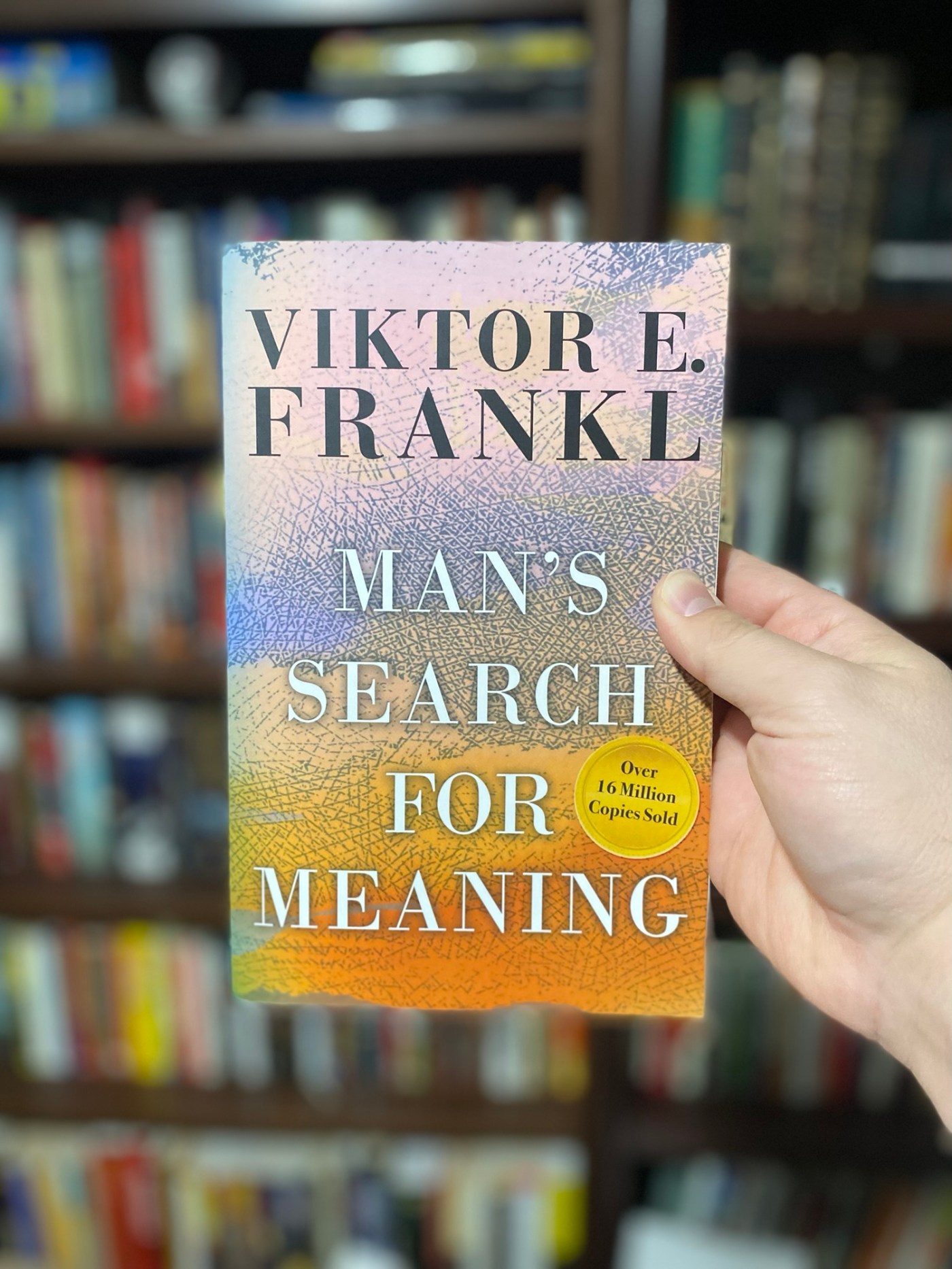
The book is Man’s Search for Meaning by Viktor E. Frankl. It was originally published in 1959. I read the 2006 Beacon Press paperback edition. I read it in January of 2024.
The title refers to Frankl’s thesis of finding meaning in life. Frankl was a holocaust survivor. He was a psychiatrist and when he was in the concentration camps he determined to write a book about this experience when he got out. This is that book.
This was a Book Club read. Randall chose it. I’ve heard of the book before and have been wanting to read it.
Frankl’s thesis is an example of the stoic maxim, “the obstacle is the way.” He views hardship as a way to make us stronger. He quotes Nietzsche throughout the book, “He who has a why to live for can bear almost any how,”
Do hard things. Embrace the suck. Muscle through. This message is needed in our current culture of comfort and ease. We have it so easy today, to our detriment.
My main takeaway from this book is that we have to have a mission in life. Frankl uses the word “meaning” because he doesn’t recognise that our ultimate meaning is to glorify God and enjoy him forever.
As a Christian I don’t really have to search for meaning in my life in the same way as Frankl. God is the ultimate meaning and Jesus Christ is the ultimate reason. I exist to glorify God in all that I do. That’s the ultimate “Why.” My specific responsibility is to figure out my particular mission in life. How exactly will I glorify God in all that I do? What will I do?
For me that’s been a hard question to answer. In college I changed my major four times. I’ve never had a real goal in my life that I’ve chased after. I think I got shaped by the circumstances of my life growing up with a single mom, to just pay the bills and survive. I never really felt like I had the breathing room to make a plan for something I want to do. I just need to pay the bills and survive.
I had very supportive parents that told me I could do anything I wanted as long as I loved the Lord and followed him. That’s great but it didn’t help me in figuring out what I’m supposed to do. I can do anything, but what should I do? I didn’t have that kind of guidance and direction. Just pay the bills and survive.
To be honest, I’m largely still in the same mindset. Still figuring out what my mission is. Maybe it’s not one isolated thing. I know part of my mission is to provide for my family and disciple them. I’m on that. I do think all men should be striving for the qualifications of being an elder in the church. That’s not to say every man should be an elder, but they should be elder qualified, because they are the pastor of their household. I am working on that.
Frankl is more focused on not killing yourself and not giving yourself over to a life of waste and despair. I think I’m pretty good on that but I’ve never faced something as difficult as the holocaust.
Frankl is right in that we need to be about the work of building fortitude. Mental, spiritual, and physical fortitude. Face hard things and do your best. Don’t shrink from a challenge. Don’t check out mentally or in any other way. Live with purpose and intention. Try to accomplish something. Do hard things in order to do great things.
I believe the greatest thing I can do with my time here on earth is to make disciples. The most important thing I can do is to make disciples, in my home, in my church, in my city, state, and nation, and then around the world.
I like to phrase it as “make disciples” because that implies so many other things. Of course making disciples means sharing the gospel but it also means learning and growing. A disciple is someone who follows Jesus, fights sin, and fulfills the mission. A big part of that is learning and growing in the spiritual disciplines.
I don’t want to just make decision makers who prayed a prayer one time at church camp or on the street with an evangelist. I want to make a disciple who will continue to follow Christ, learn and grow in every way of life as a Christian. I want to make Christian business men, Christians teachers, and Christian auto mechanics. I want to make Christian fathers and husbands. That’s my mission.
I also want to be well read. I want to learn as much as I can so I can teach as much as I can. There’s so much I don’t know.
This book made me think about the movie Schindler’s List. Great movie. Important in getting a visual of the atrocities of the holocaust.
Frankl expressed his points well. He’s a good writer. It’d be too much to say I could feel the pain of the concentration camps. Obviously that’s ridiculous but Frankl paints a picture you can really see. When he talked about sleeping on a cold board with his arm as a pillow. That sounds miserable.
I’d recommend this to Christians who have a firm understanding of the actual meaning of mankind. The chief end of man is to glorify God and enjoy him forever. That reader will be able to take the practical advice on an individual level of how to withstand extremely hard times. Frankl is a good reminder that the purpose of life is not to be comfortable and happy all the time. There is a general hardness of life that we will all face in this fallen world. But God’s common grace is still present to the point that even a lost jew like Frankl can teach true principles of endurance and perseverance.
Notable Quotables
“”””
The greatest task for any person is to find meaning in his or her life. Frankl saw three possible sources for meaning: in work (doing something significant), in love (caring for another person), and in courage during difficult times. Suffering in and of itself is meaningless; we give our suffering meaning by the way in which we respond to it. (px)
“”””
If someone now asked of us the truth of Dostoevski’s statement that flatly defines man as a being who can get used to anything, we would reply, “Yes, a man can get used to anything, but do not ask us how.” (p18)
“”””
If you want to stay alive, there is only one way: look fit for work. (p19)
“”””
Fortunately the Capo in my working party was obligated to me; he had taken a liking to me because I listened to his love stories and matrimonial troubles, which he poured out during the long marches to our work site. (p26)
“””””
Thus it is impossible to define the meaning of life in a general way. Questions about the meaning of life can never be answered by sweeping statements. “Life” does not mean something vague, but something very real and concrete, just as life’s tasks are also very real and concrete. (p77)
“”””
A man who becomes conscious of the responsibility he bears toward a human being who affectionately waits for him, or to an unfinished work, will never be able to throw away his life. He knows the “why” for his existence, and will be able to bear almost any “how.” (p80)
“”””
He had to be reminded that life still waited for him, that a human being waited for his return. But after liberation? There were some men who found that no one awaited them. Woe to him who found that the person whose memory alone had given him courage in camp did not exist any more! Woe to him who, when the day of his dreams finally came, found it so different from all he had longed for! (p92)
“””””
If architects want to strengthen a decrepit arch, they increase the load which is laid upon it, for thereby the parts are joined more firmly together. So if therapists wish to foster their patients’ mental health, they should not be afraid to create a sound amount of tension through a reorientation toward the meaning of one’s life. (p105)
“””””
At the beginning of human history, man lost some of the basic animal instincts in which an animal’s behavior is imbedded and by which it is secured. Such security, like Paradise, is closed to man forever;
No instinct tells him what he has to do, and no tradition tells him what he ought to do; sometimes he does not even know what he wishes to do. (p106)
“”””
What matters, therefore, is not the meaning of life in general but rather the specific meaning of a person’s life at a given moment. (p108)
“”””
“Is it not conceivable, Rabbi, that precisely this was the meaning of your surviving your children: that you may be purified through these years of suffering, so that finally you, too, though not innocent like your children, may become worthy of joining them in Heaven? (p120)
 Solomon White
Leave a comment