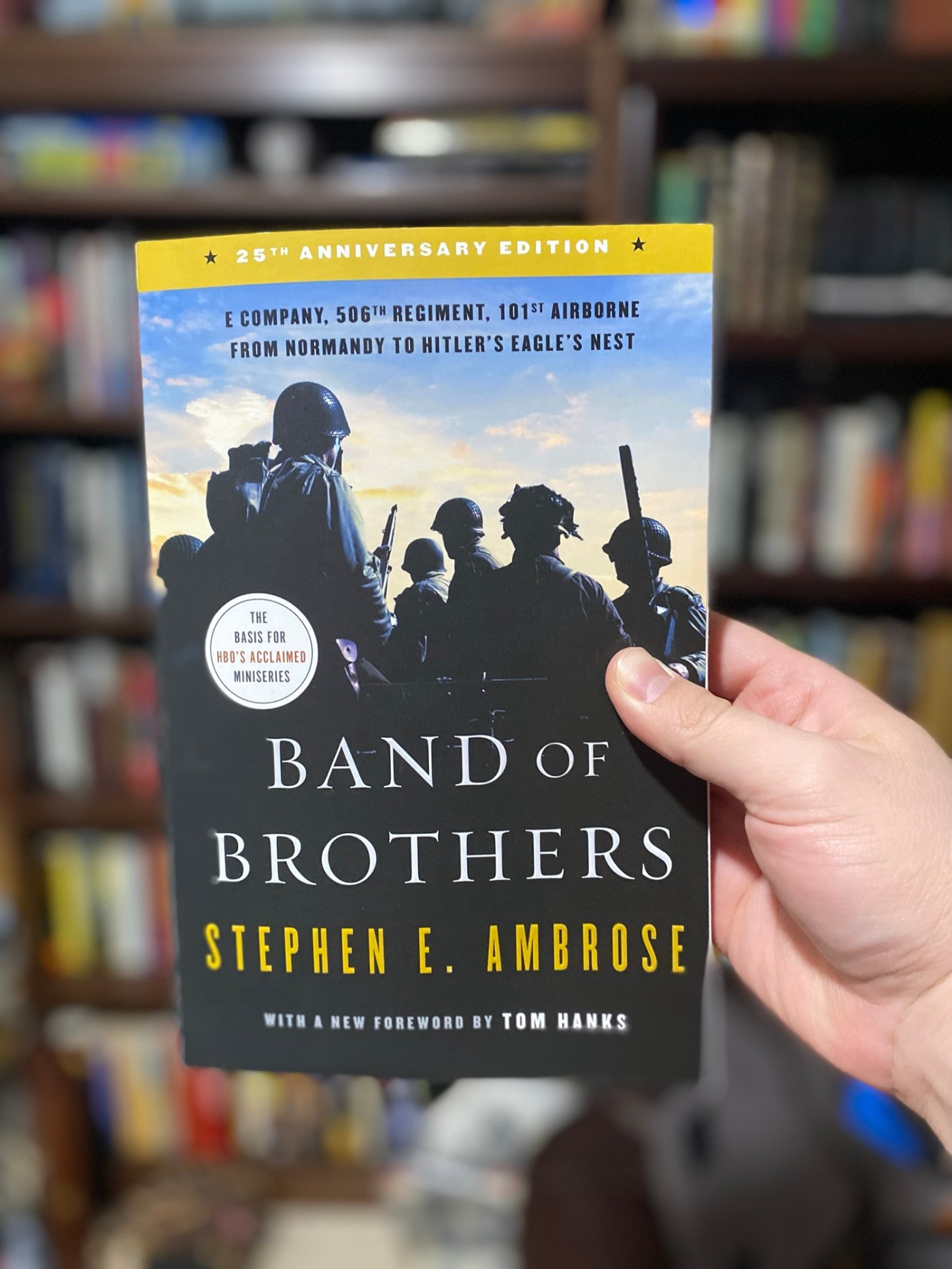
The book is Band of Brothers by Stephen E. Ambrose. It was originally published by Simon and Schuster in 1992. I read the 2017 paperback edition. I read it in December of 2024.
The title comes from a line in a speech from William Shakespeare’s Henry V.
“From this day to the ending of the world,
…we in it shall be remembered
…we band of brothers.
King Henry V gave the speech to his men to encourage them in the battle of Agincourt in 1415.
The use of the term “band of brothers” illustrates the bond soldiers experience in war. The book follows soldiers in World War II Easy Company, in the 101st Airborne as they lived the closeness that’s closer than brotherhood. They fought and died for each other. They knew each other better than they ever knew anyone.
This is the first book for a book club I’m in. I’ve been wanting to read it for years, ever since I saw the TV show on HBO. It’s a great miniseries.
It’s clear that Ambrose loves the soldiers of WWII. He admires them and is proud of them. In this book he is attempting to pass that admiration and inspiration on to a new generation that did not experience the war. In my case he succeeds tremendously.
My main takeaway was that I am way too soft. The soldiers of WWII were so badass. They had a completely different mindset about hard work, courage, strength, patriotism, and being a man.
It astonishes me how hard they worked for a job that they had no intention of turning into a long term career. They invested so much time and intelligence into learning how to do their job to the best of their ability. It could be said they did this because they would die if they didn’t. But that’s only part of it. Even the non-life-saving, seemingly mundane tasks of kitchen or latrine duty they took so seriously. Ambrose writes this. “The desire to be better than the other guy took hold.”
They took pride in doing their jobs well. The instinct for self preservation was there for sure, but they were also competitive and ambitious. They were just different men than in our time today. They had drive and motivation to not be outworked or outsmarted.
How do we get this spirit back? I’m not even sure an existential threat would unify us as a country to renew pride and patriotism. Covid came along and we were all at each others throats. There’s no unity.
I blame multiculturalism. Diversity has not been our strength. We as a country are not of one mind and heart anymore. We don’t value the same things at all. Too many people are fighting for victimhood status. We find currency in oppression. That’s a race to the bottom.
We need to arrive at a new sort of monoculture. This isn’t an appeal to an ethnic or racial unity of the past. That’s sinful and too shortsighted anyway. Our unity needs to go deeper. The only thing that can unite is in a serious way is Christ. “A man of many companions may come to ruin, but there is a friend who sticks closer than a brother.” (Proverbs 18:24)
Everyone just needs to become a Christian. That’s the only way we can be bonded in a meaningful way forever. “There is neither Jew nor Greek, there is neither slave nor free, there is no male and female, for you are all one in Christ Jesus.” (Galatians 3:28)
The contrast between Sobel and Winters seems ordained by God. It would be hard to find a more opposite pair. Maybe they helped shape each other to be that way. I feel like they brought the best and worst out of each other.
The soldiers said that Sobel brought them together and that his torturous training made them a better team and fighting unit. So then there’s a question of whether or not Sobel is really a villain. The answer to that question is yes. He’s chickenshit. He couldn’t even kill himself correctly.
“Captain Sobel shot himself. He botched it. Eventually he died in September 1988. His funeral was a sad affair. His ex-wife did not come to it, nor did his sons, nor did any member of E Company.” (p299)
This is the saddest way any man can go out. And if you live your life like Sobel, it’s exactly what will happen to you.
He was a man ruled and consumed by his insecurities. It was dangerous to ever put him in an any position of power. He wielded that authority like a petulant child. Court-martialing Dick Winters over nothing? Pathetic.
We all have insecurities but we don’t have to let them be what defines us to our core.
This book made me think about my dad. War stories always do. My dad is a veteran of the war in Afghanistan. Is that what it’s called? Shit name for a shit war. At least World War II sounds cool. The War on Terror? The War for Oil? The War for Nothing? In any case my dad served honorably. He was in the EOD for the Army. That’s the bomb squad. If you’ve seen the movie The Hurt Locker that’s exactly what he did. He’s sort of, I don’t want to say crazy, but let’s say eccentric. Unique. Brave certainly. He was in the shit and it took its toll on him physically and mentally. I’m not sure how much he likes war movies and stories. We don’t talk about it much. But stories like Band of Brothers always remind me of him and I’m proud. My dad was suited for war if that’s not too weird a thing to say. The military brought the best out of him, that’s for sure. He’s a leader like Winters. Men who follow him including me don’t want to let him down. He’s well respected like Winters. When he’s around everyone can take a sigh of relief and know that things will be under control. I hope to achieve that gravitas someday.
This book was great. I’m glad a I read it and I’m glad to be in this book club. My band of book brothers. Men need to read more.
Ambrose is not necessarily a joy to read, but it’s good information. It got a little confusing keeping up with all the military ranks and divisions but it didn’t detract from the story.
I’d recommend this to anyone interested in military history. Every man should read it. It’s inspiring and encouraging. It’s convicting in that it makes me question what I would fight this hard for. Everyone needs a little of that conviction and questioning, if we can answer honestly.
****************************************************
Notable Quotables
“”””
“The desire to be better than the other guy took hold.” Each man in his own way had gone through what Richard Winters experienced: a realization that doing his best was a better way of getting through the Army than hanging around with the sad excuses for soldiers they met in the recruiting depots or basic training. They wanted to make their Army time positive, a learning and maturing and challenging experience. Second, they knew they were going into combat, and they did not want to go in with poorly trained, poorly conditioned, poorly motivated draftees on either side of them. (p16)
“””
“Nor at any time did Dick Winters pretend to be God, nor at any time did he act other than a man!”, according to Rader. He was an officer who got the men to perform because he expected nothing but the best, and “you liked him so much you just hated to let him down.” He was, and is, all but worshiped by the men of E Company. (p23)
“”””
Sobel was the classic chickenshit. He generated maximum anxiety over matters of minimum significance. Paul Fussell, in his book Wartime, has the best definition: “Chickenshit refers to behavior that makes military life worse than it need be: petty harassment of the weak by the strong; open scrimmage for power and authority and prestige; sadism thinly disguised as necessary discipline; a constant ‘paying off of old scores’; and insistence on the letter rather than the spirit of ordinances. Chickenshit
is so called-instead of horse or bull or elephant shit-because it is small-minded and ignoble and takes the trivial seriously.” (p24-25)
“”””
Their officers stressed the importance of such things, that it would make the difference between life and death, that the men must do it instinctively right the first time, as there would not be a second. (p46)
“”””
(Paul Fussell, in Wartime, writes that the soldier going into combat the first time thinks to himself, “It can’t happen to me. I am too clever / agile / well-trained / good-looking / beloved / tightly laced, etc.” That feeling soon gives way to “It can happen to me, and I’d better be more careful. I can avoid the danger by watching more prudently the way I take cover / dig in / expose my position by firing my weapon / keep extra alert at all times, etc.” (p84)
“”””
They did not know the Articles of War backward and forward, they didn’t care about “the Book that ruled the lives of so many regular-army men.” They mingled with their men, they had not served in Panama or Hawaii or the Philippines. “They were civilian soldiers. They were the ones who saved America.” (p114)
“”””
His motivation has to be internal. Comradeship is by far the strongest motivator-not wanting to let his buddies down, in the positive sense, not wanting to appear a coward in front of the men he loves and respects above all others in the negative sense. Discipline won’t do it, because discipline relies on punishment, and there is no punishment the Army can inflict on a front-line soldier worse than putting him into the front line. (p155)
“”””
“Primarily, souvenirs appeared to give the soldier some assurance of his future beyond the destructive environment of the present. They represented a promise that he might survive.” (p155)
“”””
Father Maloney, who had his Communion set out. He announced that he was giving a general absolution. After the men who wanted one received their Communion wafer, he wished them “Good luck.” (p184)
“”””
making up losses by individual replacement. This meant that replacements went into combat not with the men they had trained and shipped overseas with, but with strangers. (p202)
“”””
They got through the Bulge because they had become a band of brothers. The company had held together at that critical moment in the snow outside Foy because 1st Sergeant Lipton and his fellow N.C.O.s, nearly all Toccoa men, provided leadership, continuity, and cohesiveness. (p222)
“”””
Glenn Gray writes that the “secret attractions of war” are “the delight in seeing, the delight in comradeship, the delight in destruction.” He continues, “War as a spectacle, as something to see, ought never to be underestimated.”1 Gray reminds us that the human eye is lustful; it craves the novel, the unusual, the spectacular. (p227)
“”””
As always on the front line, there was no past or future, only the present, made tense by the ever-present threat that violent death could come at any instant. “Life has become strictly a day to day and hour to hour affair,” Webster wrote his parents. (p228)
“”””
“The first thing I will try to explain… Dick, you are loved and will never be forgotten by any soldier that ever served under you or I should say with you because that is the way you led. You are to me the greatest soldier I could ever hope to meet.
Well you know why I would follow you into hell. When I was with you I knew everything was absolutely under control.” (p290)
“”””
Captain Sobel shot himself. He botched it. Eventually he died in September 1988. His funeral was a sad affair. His ex-wife did not come to it, nor did his sons, nor did any member of E Company. (p299)
“”””
she told me that Jesus loved me and she loved me and if I would repent God would forgive me for all the men I kept trying to kill all over again.
“That little girl got to me. I put her out of my room, told her to go to her Mommy. There and then I bowed my head on my Mother’s old feather bed and repented and God forgave me for the war and all the other bad things I had done down through the years. I was ordained in the latter part of 1949 into the ministry and believe me, Dick, I haven’t whipped but one man since and he needed it. I have four children, nine grandchildren and two great-grandchildren. (p299)
 Solomon White
Leave a comment