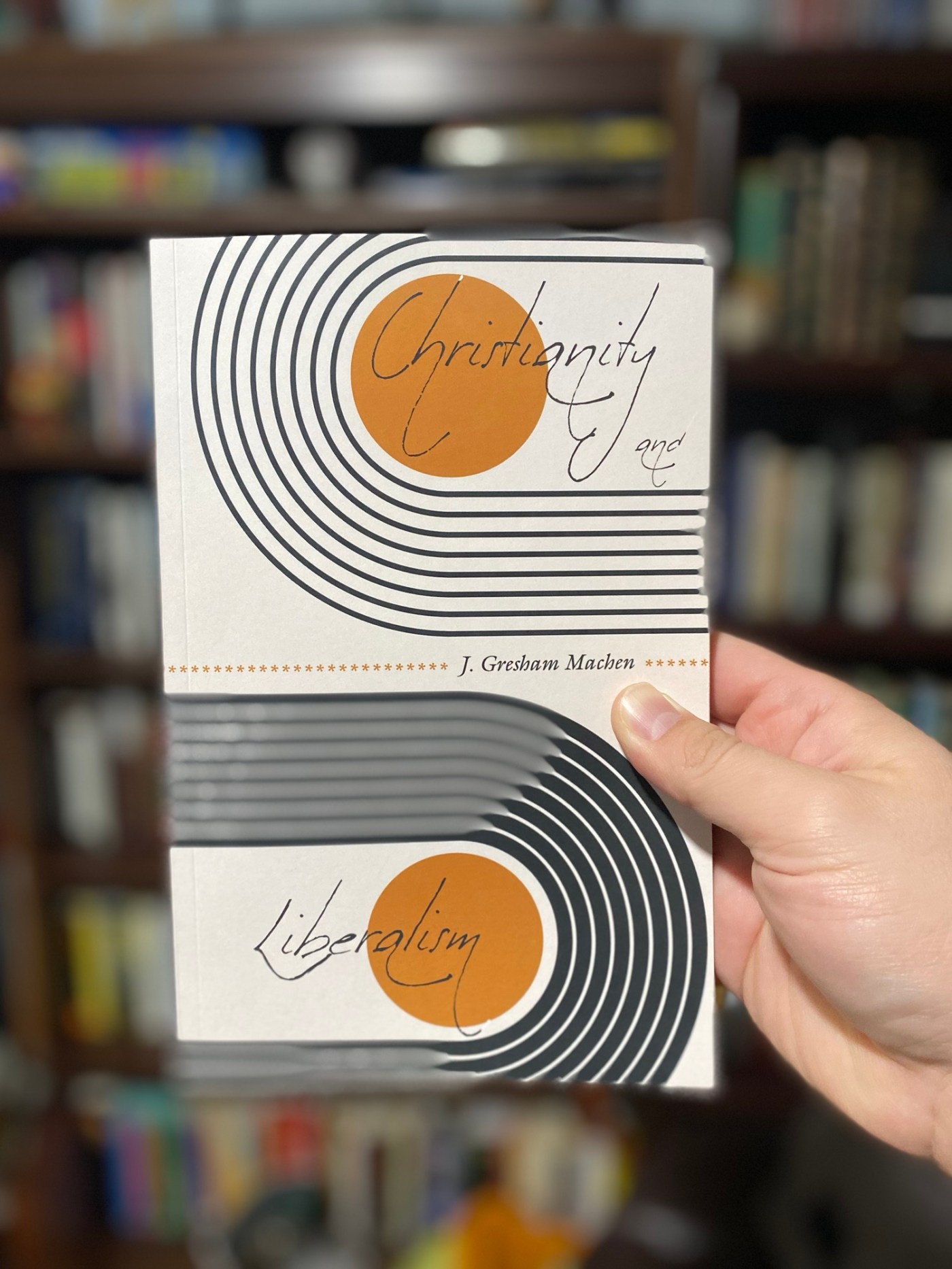
The book is Christianity and Liberalism by J. Gresham Machen. It was originally published in 1923. I read the Ichthus paperback edition. I read it in October of 2024.
The title refers to the theme of the book which is the stark differences between Christianity and modernist liberalism. Machen’s point is that the liberal version of Christianity that sprang up in his time and still exists today is no Christianity at all. There is a wide canyon, a deep yawning chasm between true biblical Christianity and liberal Christianity.
I’ve heard of this book a long time ago. Many pastors that I listen to spoke more about it last year as 2023 celebrated one hundred years of its publication. I finally got around to reading it.
I knew it was important to read this book because we are still battling the war against liberal Christianity today. Machen wrote his book in 1923 but it could’ve been written in 2023.
Have things really not gotten any better? In many ways, I believe things have gotten worse. However, one hundred years can be a small fragment of time in the whole of human history. This is the fight of our time. The early church fathers contended with the Gnostics. Then there were centuries where the doctrine of the church superseded the doctrines of grace. Then we had the protestant reformation and then the enlightenment and now here we are battling the “rise and triumph of the modern self,” as Carl Trueman would put it. Our fight goes on.
In this book Machen explains how and why the liberal Christianity of the modernists at the beginning of the 20th century was no true Christianity at all.
Machen lived in a time when ideas were being introduced rapidly and minds were being changed drastically. This was after the industrial revolution and Nietzche, and during the rise of Darwin’s theory of evolution and Karl’s Marxism. All of these were movements that challenged God’s truth about the world and his ways of doing things.
Church attendance was dwindling and there was panic that Christianity would fall away completely. So the unfaithful answer was to compromise doctrine in order stay relevant with the evolving modernist culture.
That’s ultimately what Christian liberalism is, compromise to the detriment of orthodoxy. It was a faithless response. Matthew 16:18 Christ says “And I tell you, you are Peter, and on this rock I will build my church, and the gates of hell shall not prevail against it.” Did they forget about this verse, or just not believe it?
Machen’s book is the faithful response. It’s a call to stay strong and fight back. The godless worldviews admittedly don’t have answers. Machen beckons us to avoid that blind path and stay in the light of God’s truth.
When we talk about the dichotomy between religion and science, between faith and reason, Christianity and liberalism, there’s a question that I cannot stand to hear. Does Christianity have a place at the table of reason and science? It drives me absolutely insane. We have to get it through our heads that there is NO table of reason and science without the God of Christianity!
Science is the endeavor to discover the truth about a knowable universe. The idea that the world is intelligible in the first place is a biblical idea! All the first scientists were Christians or at least believed in a creating Gods. They embarked on the journey of scientific discovery to begin with because the fact there were truths to discover was a given in a world created by the God of the Bible.
Reason and logic are godly things. They make no sense in a strictly empirical materialist world that the Darwinists propose. We get the word logic from logos with means word in Greek, as in “In the beginning was the Word and the was with God and the Word was God.” (John 1:1) Christ makes everything make sense.
It’s a false dichotomy. Reason and faith are separate categories but they’re not opposed to each other. They’re both under God’s sovereignty and our stewardship. It’s the same mistake often made with the Christian idea of separation of Church and state. People take it to mean separation of God and state. That’s not the idea at all.
The rise of liberalism in Christianity comes from fear of being offensive. It’s what Doug Wilson has calls the sin of empathy. The sin of empathy can best be described by this statement. “You’re crying therefore I’ve sinned.”
As saved children of God, we ought not to empathize with sinners. We’re no longer identified as blind sinners so we should not close our eyes and start bumping into walls just because unsaved people are.
We can sympathize with them because we were once like them. We remember what it was like walking in their shoes. But we should not affirm or agree with them in their feelings. If we follow Jesus example, he met with sinners and criminals. But he called them to repentance. He went to where they were but he called them to where he is. We should do the same.
It’s offensive to call people to repent of their sin because it implies that what they’re doing is a sin. They don’t want to hear that. They would much rather just be affirmed of where they are. In today’s culture, and in Machen’s time that’s seen as the compassionate way. It’s sinful empathy.
You would never want to shove your lost friend down into a ditch. But you would happily do it if they were about to be hit by a bus. It would be unloving not to shove them. That’s how we have to see sharing an explicit gospel that calls them out for what the Bible calls sin.
My main takeaway from Machen’s book is that if we are on a quest for Christlike godliness and biblical righteousness a pragmatic Christianity is not nearly sufficient.
Christianity is not an idea, it’s a claim to an historical fact. All of true Christianity stands or falls on the truth of Christ’s resurrection. If he did not physically resurrect from the dead then there is no Christianity. If someone doesn’t believe in the historical event of the resurrection, then he is no Christian at all.
It’s important that we draw this hard line in the sand. In 1 Corinthians 15:17 Paul says “And if Christ has not been raised, your faith is futile and you are still in your sins.”
The whole point of Christianity is the fact that the third person of the triune God, the Word, the logos of all existence, became flesh and dwelt among us, kept the law perfectly and then died in our place to save us from eternal sin and death. If he did not rise from the dead then neither will we. If Christ didn’t rise from the dead then he is no different than Moses, Muhammad, or Buddha. They’re all religious leaders and they’re all still dead. Any Christianity that dispenses with the real historical fact of Christ’s resurrection from the dead is no Christianity at all.
The resurrection is what makes Christianity unique to everything that came before. There were legends of heroes coming back from the dead and even in the Bible Jesus resurrected people but then they died again.
Enoch and Elijah should not be seen as upstaging Christ because they never died. (Gen 5 and 2 Kings 2) They were taken up to heaven while they were still alive. They didn’t experience death so they didn’t conquer it. Christ actually died, and rose again out of death. He conquered the grave, Enoch and Elijah just avoided it.
Liberal Christianity like all the other religions is merely behavior modification. In other religions a person has to work their way up to God. In other religions, following a strict set of rules and codes of conduct, a person can do enough good things and transcend up to heaven. But this is irrational. The finite cannot transcend out of its finite limitations. But the infinite can condescend into the finite to make a way. And that’s exactly what happened with the incarnate Christ. Man cannot become God. But God became man. He did the transcendent work (follow the law perfectly) for us. No other religion or belief system offers this.
Philosophies like stoicism say that we can summon the willpower on our own to make positive changes in our life. This may be true to an extent but it’s limited to that behavior modification. It can’t save us eternally. This is what liberalism offers as well. That’s not the claim of biblical Christianity. The gospel is the story of what Jesus did on the cross. It’s a narrative. It’s not an appeal to the strength that’s in ourselves, an appeal to just white knuckle it and muscle through on our own power.
This book made me think about Jordan Peterson a lot. Whenever Peterson is asked what he personally believes about God and Christianity, he always says something like God is the highest good you can imagine. It sounds very much like the vague higher power of Alcoholics Anonymous. But the higher power could be anything you want it to be, and if your inventing or imagining the higher power into existence then the real higher power is yourself. That’s the case for most people. They project their made-up higher power on to an artificial external so that they can aspire to it. That’s ultimately what Peterson suggests.
It’s discouraging because Peterson is smart and he gets a lot of things right practically speaking, but that’s also exactly the problem. He only offers a practical pragmatic Christianity which is just a spiritualized, Christianized psychotherapy.
Real Christianity deals with a personal God. When Peterson is asked if God is real, he says he’s real as logic and beauty are real which sounds a lot like Plato’s forms. Some perfect abstraction that we can aspire to but never really hold in our hands.
Peterson says God is not real as this table is real. God is not objective. But that’s completely wrong. God became man and dwelt among us. He ate real objective food and spoke and laughed and went to the bathroom, and got tired and stubbed his toe. And ultimately he was brutally murdered on the cross. He wasn’t a ghost or an apparition. He was truly human. He felt every bit of it as we would have. And that’s the point. Peterson’s Christianity excludes the immaculate conception and the incarnate Christ. The Word became flesh. He doesn’t believe that. But that is the essence of true Christianity.
Petersons also says we should all live as if there is a God. But everyone already does that. And that’s exactly the liberalism Machen was fighting against. Romans 1 tells us that everyone knows that God exists by the created world around us. But they don’t honor and worship him as God. God is not an idea that humans have evolved over time in order to give us a moral scaffolding for a good functioning society. Christianity does that but that’s not what it is. Everyone wants the fruits of Christianity but see no need for the orchard.
There is one video clip I’ve seen of Peterson crying (as usual) talking about the Christian claim about Jesus. He said if it’s true, what he calls “the narrative meeting the objective” in the real God-man person of Jesus Christ, he says that changes everything, absolutely everything. That’s true. But it seems he doesn’t believe it.
I do appreciate Peterson counting the cost of becoming a Christian. He rightly admits that it would flip his whole world upside down. It appears he’s resisting that. But I appreciate the consideration. However, he should not call himself a Christian and as far as I know he doesn’t. I’ll continue to pray that he finally does surrender and become a real Christian. My larger concern is that people follow him and think they’ve converted to Christianity. That’s a huge problem. There are already too many people who have been baptized into a liberalism and are still headed straight for hell.
The most important thing Machen says in this book is when he mentions that liberalism has lost the reality of sin.
“according to modern liberalism, there is really no such thing as sin. At the very root of the modern liberal movement is the loss of the consciousness of sin.” (p67)
Everything hangs on this concept. If sin is not real then there is no need for a real savior. If we lose the concept of real sin then we lose the concept of a real Jesus Christ because that’s the whole reason he came to earth, to redeem us from our sin.
It’s so easy for liberal theology to lose the reality of Christ’s resurrection as a literal event in history because that’s exactly what they’ve done with sin. They have psychologized and philosophized sin away into merely a mental condition that we can self-help our way out of. If we can do that, then we don’t need Christ.
If there was no real garden of Eden and no real Adam and Eve then there was no real Fall, then that means means there was nothing to fall from which means there was no real good that God intended from the beginning. If there was no real good that God intended then we are free to make up what is good for ourselves. This is exactly what’s being done in liberalism.
Machen hits the nail on the head, knocks it out of the park, whichever metaphor you like. This book is excellent. He makes so many great points, it’d be another book to comment on all of them.
I highly recommend this book to all Christians especially in our time. We’ve come full circle on this liberalism insanity, or maybe we never really shook it. Maybe it will never go away, and that’s all the more reason that a hard dividing line needs to be drawn and liberal Christianity needs to be noticed and called out for the non-Christian heresy that it most certainly is. Machen’s book draws that line tremendously.
Required reading for all true, Bible believing Christians.
****************************************************
Notable Quotables
“”””
liberal theologian has retained after abandoning to the enemy one Christian doctrine after another is not Christianity at all, but a religion which is so entirely different from Christianity as to belong in a distinct category. (p7)
“”””
Such a closing of the question, however, whether it approve itself finally or no, is in its present form based upon a very imperfect view of the situation; it is based upon a grossly exaggerated estimate of the achievements of modern science. (p10)
“”””
Few desires on the part of religious teachers have been more harmfully exaggerated than the desire to “avoid giving offence.” (p18)
“”””
Jesus did not content Himself with enunciating general principles of religion and ethics; the picture of Jesus as a sage similar to Confucius, uttering wise maxims about conduct, may satisfy Mr. H. G. Wells, as he trips along lightly over the problems of history, but it disappears so soon as one engages seriously in historical research. “Repent,” said Jesus, “for the Kingdom of Heaven is at hand.” (p31)
“”””
The persons to whom the Golden Rule is addressed are persons in whom a great change has been wrought—a change which fits them for entrance into the Kingdom of God. (p39)
“”””
What was it that within a few days transformed a band of mourners into the spiritual conquerors of the world? It was not the memory of Jesus’ life; it was not the inspiration which came from past contact with Him. But it was the message, “He is risen.” That message alone gave to the disciples a living Savior; and it alone can give to us a living Savior today. We shall never have vital contact with Jesus if we attend to His person and neglect the message; for it is the message which makes Him ours. (p44)
“”””
The liberal preacher is really rejecting the whole basis of Christianity, which is a religion founded not on aspirations but on facts. Here is found the most fundamental difference between liberalism and Christianity-liberalism is altogether in the imperative mood, while Christianity begins with a triumphant indicative; liberalism appeals to man’s will, while Christianity announces, first, a gracious act of God. (p48)
“”””
Although the ideals of the Cynic and Stoic preachers were high, these preachers never succeeded in transforming society. The strange thing about Christianity was that it adopted an entirely different method. It transformed the lives of men not by appealing to the human will, but by telling a story; not by exhortation, but by the narration of an event. (p49)
“”””
Indifferentism about doctrine makes no heroes of the faith. (p52)
“”””
The relation of Jesus to His heavenly Father was not a relation to a vague and impersonal goodness; it was not a relation which merely clothed itself in symbolic, personal form. On the contrary, it was a relation to a real Person, whose existence was just as definite and just as much a subject of theoretic knowledge as the existence of the lilies of the field that God had clothed.
Certainly the atheistic or agnostic Christianity which sometimes goes under the name of a “practical” religion is no Christianity at all. At the very root of Christianity is the belief in the real existence of a personal God. (p60-61)
“”””
according to modern liberalism, there is really no such thing as sin. At the very root of the modern liberal movement is the loss of the consciousness of sin. (p67)
“”””
Paganism is that view of life which finds the highest goal of human existence in the healthy and harmonious and joyous development of existing human faculties. Very different is the Christian ideal. Paganism is optimistic with regard to unaided human nature, whereas Christianity is the religion of the broken heart. (p69)
“”””
Christianity is founded upon the Bible. It bases upon the Bible both its thinking and its life. Liberalism on the other hand is founded upon the shifting emotions of sinful men. (p83)
“”””
Not the example of Jesus, but the redeeming work of Jesus was the primary thing for Paul. The religion of Paul was not primarily faith in God like Jesus’ faith; it was faith in Jesus; (p87)
“”””
Jesus was the most religious man who ever lived; He did nothing and said nothing and thought nothing without the thought of God. If His example means anything at all, it means that a human life without the conscious presence of God-even though it be a life of humanitarian service outwardly like the ministry of Jesus—is a monstrous perversion. (p99)
“”””
It may certainly be admitted that if the New Testament narrative had no miracles in it, it would be far easier to believe. The more commonplace a story is, the easier it is to accept it as true. But commonplace narratives have little value. (p109)
“”””
It is small comfort to be told that there was goodness in the world, when what we need is goodness triumphant over sin.
Without the miracles we should have a teacher; with the miracles we have a Savior. (p110)
“”””
But the acceptance of the supernatural depends upon a conviction of the reality of sin. Without the conviction of sin there can be no appreciation of the uniqueness of Jesus; it is only when we contrast our sinfulness with His holiness that we appreciate the gulf which separates Him from the rest of the children of men.
The truly penitent man glories in the supernatural, for he knows that nothing natural would meet his need; the world has been shaken once in his downfall, and shaken again it must be if he is to be saved. (p112-113)
“”””
In a somewhat similar way, the liberal preacher says that Jesus is God. He does not mean at all to say that Jesus is identical in nature with a Maker and Ruler of the universe, of whom an idea could be obtained apart from Jesus. In such a Being, he no longer believes. All that he means is that the man Jesus—a man here in the midst of us, and of the same nature as ours — is the highest thing we know. (p117)
“”””
The objection depends, of course, upon the liberal view of sin. If sin is so trifling a matter as the liberal Church supposes, then indeed the curse of God’s law can be taken very lightly, and God can easily let bygones be bygones. This business of letting bygones be bygones has a pleasant sound. But in reality it is the most heartless thing in the world. It will not do at all even in the case of sins committed against our fellow-men. To say nothing of sin against God, what shall be done about the harm that we have wrought to our neighbor? (p138)
“”””
It is a fearful thing to fall into the hands of the living God. Were we not safer with a God of our own devising—love and only love, a Father and nothing else, one before whom we could stand in our own merit without fear? He who will may be satisfied with such a God. But we, God help us — sinful as we are, we would see Jehovah. Despairing, hoping, trembling, half-doubting and half-believing, trusting all to Jesus, we venture into the presence of the very God. And in His presence we live. (p144)
“””””
What is really needed is not a salve to palliate the symptoms of sin, but a remedy that attacks the root of the disease.
Man is not merely ill, but he is dead—dead in trespasses and sins, and what is really needed is a new life. That life is given by the Holy Spirit in “regeneration” or the new birth. (p147-148)
“”””
Christianity will indeed accomplish many useful things in this world, but if it is accepted in order to accomplish those useful things it is not Christianity. Christianity will combat Bolshevism; but if it is accepted in order to combat Communism, it is not Christianity: (p162)
“””””
According to Christian belief, man exists for the sake of God; according to the liberal Church, in practice if not in theory, God exists for the sake of man. (p164)
“””””
The “otherworldliness” of Christianity involves no withdrawal from the battle of this world; our Lord Himself, with His stupendous mission, lived in the midst of life’s throng and press. Plainly, then, the Christian man may not simplify his problem by withdrawing from the business of the world, but must learn to apply the principles of Jesus even to the complex problems of modern industrial life.
On the contrary, the whole of life, including business and all of social relations, must be made obedient to the law of love. The Christian man certainly should display no lack of interest in “applied Christianity.” (p165)
“””””
Human institutions are really to be molded, not by Christian principles accepted by the unsaved, but by Christian men; the true transformation of society will come by the influence of those who have themselves been redeemed. (p169)
“””””
At the present time, when the opponents of the gospel are almost in control of our churches, the slightest avoidance of the defense of the gospel is just sheer unfaithfulness to the Lord. There have been previous great crises in the history of the Church, crises almost comparable to this. One appeared in the second century, when the very life of Christendom was threatened by the Gnostics. Another came in the Middle Ages when the gospel of God’s grace seemed forgotten. In such times of crisis, God has always saved the Church. But He has always saved it not by theological pacifists, but by sturdy contenders for the truth. (p185-186)
 Solomon White
Leave a comment