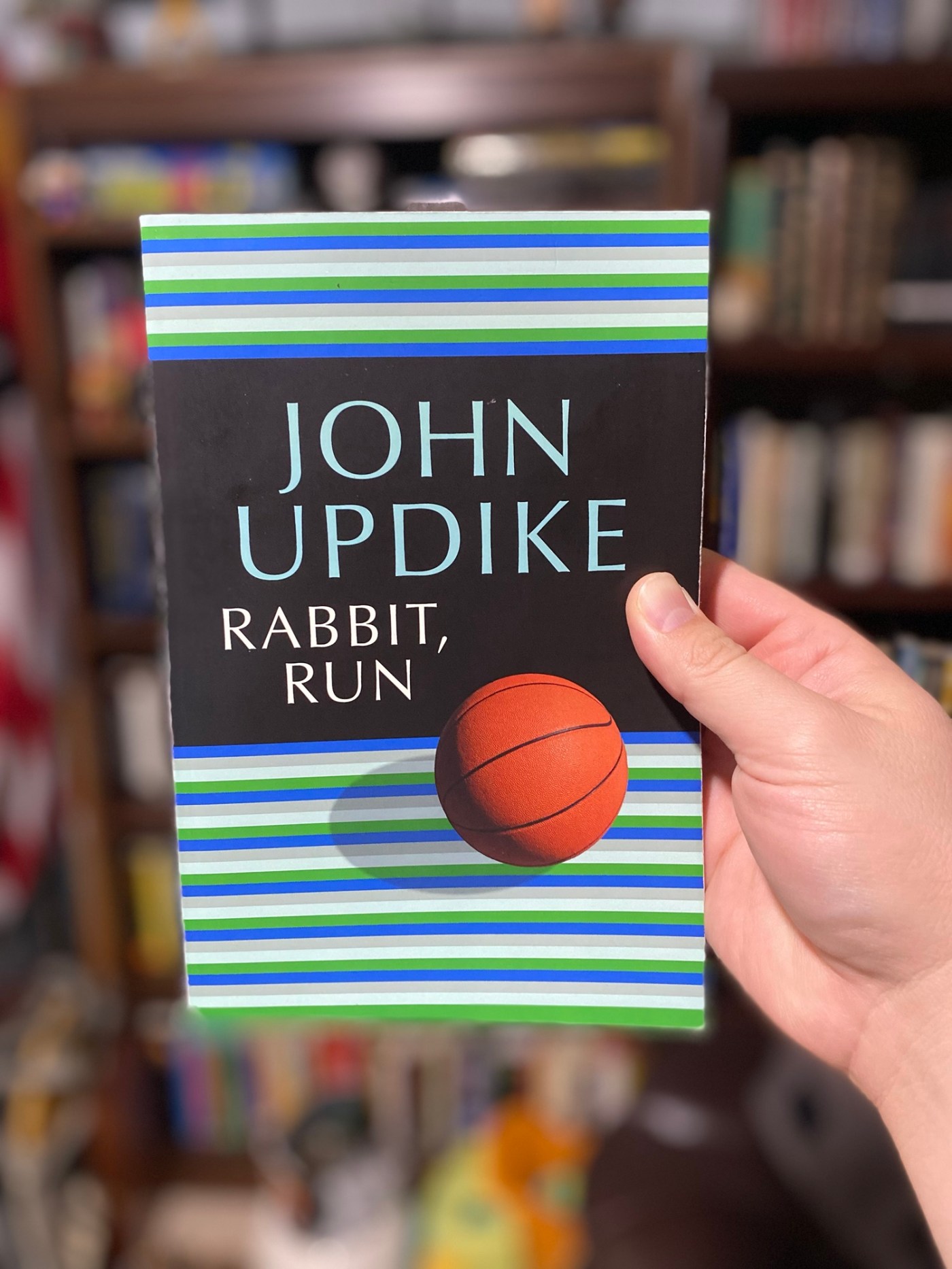
The book is Rabbit, Run by John Updike. It was originally published in 1960 by Alfred A. Knopf a division of Random House. I read the 2012 paperback edition. I read it in September of 2024.
The title refers to the main character Harry Angstrom. His nickname is Rabbit. Although not a lot of people in the book actually call him Rabbit. He’s referred mostly by the other characters as Harry. He was called Rabbit in high school where he was a basketball star.
There is a picture of a basketball on the cover and I’m not sure why. It’s revealed that the root of Harry’s frustration comes from not being great at something anymore. In high school he was great at basketball and that gave him a sense of purpose and meaning. Otherwise, basketball has nothing to do with the story at all.
“I once did something right. I played first-rate basketball. I really did. And after you’re first-rate at something, no matter what, it kind of takes the kick out of being second-rate. And that little thing Janice and I had going, boy, it was really second-rate.” (p111)
This is also shown later on in the story when he sinks a difficult putt. He and the local episcopal priest are playing a round of golf and discussing the missing thing in Harry’s life. The thing he can’t define or put his finger on, what is missing that makes him feel so miserable. Then he hits a great putt and it goes right in and he says “That’s it!” he cries and, turning to Eccles with a grin of aggrandizement, repeats, “That’s it.” (p141)
I don’t understand the title. Rabbit, Run. That comma makes it sound like a command. Someone is telling him to run. This is the first in a series of novels by John Updike about the character Rabbit. None of the other Rabbit book titles read this way. Rabbit Redux, Rabbit is Rich, Rabbit at Rest. Who is telling Rabbit to run? Himself?
I read this because I’ve heard that John Updike is a great American author. I read a book of short stories he wrote called Trust Me. I liked that a lot so I wanted to read more.
Updike is trying to express how men often feel. Men can be really selfish assholes. That’s definitely depicted in Rabbit. Updike doesn’t justify or criticize Rabbit for what he does. It’s just showing a sadly all too real American story.
The crushing weight of responsibility that men feel is real. Especially so in 1960 when this book was written. The impulse to just run away when life gets hard is relatable. Moreso in a boy’s early teen years. Rabbit is a little old to be feeling this way still in his late 20’s.
There are certain expectations of men in western society and if those duties aren’t understood in the right context they can seem like a massive burden. The expectations to get and keep a good job, get married, have kids, buy a house, settle down and be a good upstanding citizen, these responsibilities can feel like a huge boulder hanging over a man’s head. One wrong move and you’re crushed.
The way these responsibilities are presented to young men is usually as an anchor around the neck that we just have to accept because that’s the way things are. So then young men don’t look forward to adulthood. Current movies and TV depict fathers and husbands as buffoons. Completely uncool, overweight, dopes who are the butt of every joke and the sad sack of the family. Growing up watching sitcoms, why would young men desire fatherhood?
In most cases young men aren’t given a good example of how to take on these responsibilities or what they mean. So they crumble under the pressure. It’s annoying how older boomer types can complain about the soft generations that came after them as inept snowflakes, when they’re the ones that raised that generation. All these soy boys are the fruit of their labors. Or rather, the consequence of their inaction.
Many men abdicated their responsibilities in raising the next generation of men either by completely abandoning the family in divorce or by a lifetime of mental, emotional, and spiritual absence. So many men are just checked out when it comes to raising their sons.
This is the story for Rabbit. On an emotional impulse he abandons his pregnant wife and toddler son. He crashes with his old high school coach who is a pathetic aging bachelor. They go out on the town and he meets Ruth, a prostitute, and immediately falls for her. He shacks up with her and they play house for two months.
This part of the story raises some questions. Rabbit remains faithful to Ruth and doesn’t go on a binge of one-night stands with a bunch of women, as would be expected of a man who is fleeing the shackles of domestic life. He wants to marry Ruth. But what is he pursuing with her? Married life? Kids? He has that and he is miserable. If it’s strictly about the sex then why stay with one woman? He expresses a genuine affection and desire for Ruth.
So then is it only Janice, his wife that is the problem? That seems to be the key. He isn’t angry with his son. His love for him is genuine. In fact he says that’s the hardest part of leaving. Janice has her parents to take care of her so he doesn’t feel bad about that. But his son Nelson still wants and needs him. And he wants and needs his son.
“Ruth and Janice both have parents: on this excuse he dissolves them both. Nelson remains: here is a hardness he must carry with him. On this small fulcrum he tries to balance the rest, weighing opposites against each other: Janice and Ruth, Eccles and his mother, the right way and the good way,” (p324)
Leaving his son is “a hardness he must carry with him.” If he didn’t have kids he and his wife could make a clean break and just go their own way. But they’ve become one in Nelson. Forever linked to each other through their progeny. They’re tethered to each other. Children in divorce make all the difference.
Being a child of divorce myself, this book brought up a lot of personal pain for me. It’s a heartbreaking thing to consider. A man will say he would do anything for his kids. He’d take a bullet for them. He’d lie down in traffic for them. All very dramatic. Will he stay in an unhappy marriage for them? Would he set aside the triumph of his modern self? Would he scale back his career dreams for them? Can he endure? Would he stay together for the kids? Or would he rather take a bullet in the head for the kids? What’s true? Is this the selfishness of men?
In Rabbit’s case it’s pure immature selfishness. Yes, Janice sounds like a drag to live with and it reveals massive weakness that he can’t endure. Not even for the sake of his son whom he claims to love.
One excuse could be that people didn’t know the damage done to kids who are abandoned by their fathers. I’m sure lots of men think “well I was barely home anyway. How much difference will it make? I’ll pay child support. The kid will be fed and housed and clothed. He’ll survive.”
If by survive you mean the kid will keep breathing, and his heart will keep beating and he’ll stay alive, that’s true. But a father leaving his family pierces so deeply. The kid’s sense of security is completely destroyed. It plants a seed of bitterness and resentment and insecurity that never goes away. It’s very hard for the kid to develop confidence. There’s a hesitancy to invest in relationships for fear of rejection and abandonment. A sense of inferiority sets in. The kid knows his life is weird and different from his friends. He feels and resents their pity.
A father leaving is worse than a father dying because if he died it wasn’t necessarily his choice. If your dad dies in a car accident that’s not his fault. He didn’t want to die. But divorce is a choice. He’s choosing to leave you. He can’t endure, not even for you. That hurts.
Divorce is an extremely serious failure in a man. It’s a sign that he cannot hack it where it is most meaningful. We ought to be more intolerant of it as a society. A family is a valuable thing and it should not be broken. A man who destroys a family is not a man to be easily trusted. If the woman leaves him then he picked the wrong woman.
Some women are just batshit crazy and they cheat on you and leave you and there’s nothing you can do about it. But there should be a proper vetting period during dating where the red flags are discovered. You have to date someone for longer than five minutes to learn the dangers. Foolish men rush into a marriage and then get stuck with a psycho. Eventually she leaves him but it’s still his fault for marrying the wrong woman.
All that being said, there are grounds for divorce. Infidelity and abandonment. And this is where we get back to Rabbit. In the beginning of the story he has no grounds for divorce. He’s an immature asshole who can’t endure or lead a boring lazy wife. But then she gets drunk and accidentally drowns their baby girl. That’s grounds for divorce. But it happened after Rabbit storms out of the house because she wouldn’t have sex with him so soon after delivering a baby. She gets drunk to cope and then ends up killing the baby. She is immediately guilty of the death but he is ultimately responsible. He should have been there and he wasn’t. Most bad things happen in a family because the man should’ve been there but he wasn’t. A man just being present can save lives.
What would be my advice to Rabbit? If he came to me and laid out the situation and asked me what he should do. I’d tell him to grow the fuck up. His wife is boring and lazy? Tough shit. This is the woman you knocked up and married. And why don’t you look in the goddamn mirror? You’re no prize husband either. You sell a MagiPeeler kitchen gadget at grocery stores and play basketball with kids all evening. Maybe you should’ve aimed a little higher in all areas of your life. And maybe you still can. Start by changing the shit you’re contributing to your situation before complaining about others. If you change, most likely she’ll change.
If the highlight of your life was in high school then you have seriously fucked up your life. Your perspective is completely wrong. Sadly this is the case with many people. It blows my mind that people actually go to a high school reunion. I’ll never understand that. High school and the teenage years shouldn’t even be a thing anymore. This prolonged adolescence. It was invented in the 50’s and it’s been a failed experiment. We’re worse off for having it. It needs to stop.
Updike brings up God a lot in this book. It makes sense that he would since this story takes place in the 1960s when divorce was uncommon and unchristian. Rabbit isn’t Catholic but it’s still taboo in his episcopalian upbringing. One of the main characters is Jack Eccles, the family episcopalian priest. He and Rabbit have several conversations about what Rabbit is doing. Jack advises him to return to his wife but for a priest he seems just as uncertain as Rabbit.
The Christianity Updike presents is very moralistic. It’s the type of Christianity that’s used to make upstanding patriotic citizens. It’s more interested in providing a moral scaffolding for a socially respectable life rather than a true biblical gospel. It’s definitely your grandparent’s traditional American Christianity. But this means Rabbit isn’t let off the hook. He’s rightly judged as an asshole.
In one scene Rabbit is talking with Ruth and he doesn’t understand why she doesn’t believe in God.
He presses her. “Why don’t you believe anything?”
“You’re kidding.”
“No. Doesn’t it ever, at least for a second, seem obvious to you?”
“God, you mean? No. It seems obvious just the other way. All the time.”
“Well now if God doesn’t exist, why does anything?”
“Why? There’s no why to it. Things just are.” She stands before the mirror, and her comb pulling back on her hair pulls her upper lip up; women are always looking that way in the movies.
“That’s not the way I feel about you,” he says, “that you just are.
“Hey, why don’t you get some clothes on instead of just lying there giving me the Word?” (p95)
This exchange reveals a single truth in two ways. It shows that people do not live according to what they claim is true about the world. Ruth says “There’s no why to it. Things just are.” But she herself does not live this apathetically. No one does. She cares about what happens to her. She gets pregnant and doesn’t tell Rabbit. Why not? “Things just are” right? She knows that’s not true. We all do.
Rabbit says he believes in God but here he is incurring the wrath of that God in the heights of hypocrisy abandoning his family and shacking up with a prostitute. He claims to believe in the Christian God but then lives a completely sensuous hedonistic life. He wants a God on his own terms. Both Ruth and Rabbit, in opposite directions, betray what they say they believe.
In another section Updike writes this.
“Harry has no taste for the dark, tangled, visceral aspect of Christianity, the going through quality of it, the passage into death and suffering that redeems and inverts these things, like an umbrella blowing inside out. He lacks the mindful will to walk the straight line of a paradox. His eyes turn toward the light however it catches his retinas.” (p249-250)
What does this say about Updike’s understanding of Christianity? It’s a synergistic Christianity where we take part in the death and suffering in an effort towards our own redemption. This is true but not in the sense that Updike means it. Our sinful selves die with Christ in the work he himself has done on the cross. But it’s his death and suffering that redeems us, not ours. The Christianity that Updike is referring to is a Christianity that sees Christ as merely an example of how also can save ourselves. That’s a twisting of the biblical gospel. The biblical gospel says that you’re not able to contribute anything to your salvation. Now, as a result of being Christians in this still fallen world, we can expect to face persecution and strife. But that’s a different message than “your own suffering redeems you.” If that’s what Updike is saying then he’s got it all wrong.
Updike offers another tired old slight against God. His “absence.”
“He watches the line of water slide slowly and evenly down the wall of the tub, and then with a crazed vortical cry the last of it is sucked away. He thinks how easy it was, yet in all His strength God did nothing. Just that little rubber stopper to lift.
He tries praying to relax him but it doesn’t do it. There’s no connection.
Forgive me, forgive me, he keeps saying silently to no one.” (p292-293)
The context for this is that Rabbit’s baby daughter drowned in the tub. So the logic goes “bad things have happened to me therefore God doesn’t exist.” That’s another way of saying “if God exists then only good things will happen for me.” But it ignores one question. Who the hell do you think you are? In Rabbit’s thought there is little consideration of his own deep grievous sin. In this moment of reflection he doesn’t even see his daughter’s tragic death as a result of his own sin, which it most certainly was. God sacrificed his own son to save us from our sin. And now we’re going to expect more from him when we stay in our sin? Many people think this way. They have no idea who God is nor who we are.
This incident brings up a question. Romans 6:23 says the wages of sin is death. So did the baby die because Rabbit sinned? The “death” mentioned in Romans 6:23 refers to the eternal death of hell. If we die in our sins we go to hell. This is understood by way of the contrast of the rest of the verse, “but the gift of God is eternal life in Christ Jesus our Lord.”
So the answer is no. The baby didn’t die as wages for Rabbit’s sin. However, the baby did die as a consequence of Rabbit’s sin. There are temporal consequences in this life that happen as a result of our actions, and there’s a tendency to over spiritualize it and call it a punishment from God. But God’s punishment for sin is hell.
Now, what about God’s discipline? He disciplines those he loves meaning Christians. (Heb. 12:4-11) So the distinction between punishment and discipline is being a Christian. If God’s punishment for sin is hell then Christians should never say that God is punishing them for something. But is it always discipline when bad things happen to Christians? How do you identify God’s discipline versus just the normal shittyness of this fallen world or temporal consequences for foolishness? If I never get an oil change and my car breaks down, that’s not God’s punishment nor his discipline. It’s just a result of my bad decisions. We don’t need to over spiritualize everything. That’s not to say God isn’t sovereign over everything. He does tell us how to live in every aspect of our life. He calls us to be wise instead of foolish. Neglecting maintenance on your car is foolish. So even something like that doesn’t go unaddressed. God is sovereign and has told us how to live.
In one scene the priest says this.
“Playing golf with someone is a good way to get to know him. That’s what I try to do, you understand-get to know people. I don’t think you can lead someone to Christ unless you know him.” (p159)
This statement is not true. You can certainly lead someone to Christ without knowing them, because it’s not you that’s leading them to Christ. God either draws them to himself or not. He can use you and you can sometimes get the blessing of seeing the fruit of that in sharing the gospel when they respond with belief.
People think you need to lay some ground work down first before sharing the gospel with someone, that we should build up some trust with a person and then spring the Jesus stuff on them later. That’s not necessary. It’s planting and watering. You can share the gospel in 30 seconds with someone on the bus and if God is drawing that person to himself, then that could be a seed that flourishes into their salvation.
So overall, my main takeaway from this book was, don’t abandon your family. Books like this are a cautionary tale of what not to do. Sadly this is a very real American story. People go through tragic experiences like this personally and look back with a lot of regret and shame. It’s better if you can just read the book.
We can judge a character like Rabbit very harshly but we have to also acknowledge the fact that but for the grace of God go I. We all make mistakes which could lead to more and more tragic mistakes and before we know it we’re down a road without any idea how we got there. It’s important to read stories like this and learn to avoid such foolish paths.
For that reason I’d recommend this to men. Don’t be foolish. Don’t leave your family. Be a good father and husband. Family life and domesticity are not things to dread. Grow up. Work hard. Endure physical and emotionally difficult situations. We all face them. There’s nothing new. Your suffering is not special. And there are answers.
****************************************************
Notable Quotables
“”””
He walks downhill. The day is gathering itself in. He now and then touches with his hand the rough bark of a tree or the dry twigs of a hedge, to give himself the small answer of a texture. (p16)
“”””
Everybody who tells you how to act has whisky on their breath. (p30)
“”””
The thought of police for a second paints his mind blue. He feels the faded night he left behind in this place as a net of telephone calls and hasty trips, trails of tears and strings of words, white worried threads shuttled through the night and now faded but still existent, an invisible net overlaying the steep streets and in whose center he lies secure in his locked hollow hutch. (p43)
“”””
But now these reflexes, shallowly scratched, are spent, and deeper instincts flood forward, telling him he is right. He feels freedom like oxygen everywhere around him; (p53)
“”””
I’ll tell you about Janice. I never thought of leaving her until the minute I did; (p73)
“”””
He presses her. “Why don’t you believe anything?” “You’re kidding.”
“No. Doesn’t it ever, at least for a second, seem obvious to you?” “God, you mean? No. It seems obvious just the other way. All the time.”
“Well now if God doesn’t exist, why does anything?”
“Why? There’s no why to it. Things just are.” She stands before the mirror, and her comb pulling back on her hair pulls her upper lip up; women are always looking that way in the movies.
“That’s not the way I feel about you,” he says, “that you just are.
“Hey, why don’t you get some clothes on instead of just lying there giving me the Word?” (p95)
“”””
Rabbit doesn’t quite run. The downhill pavement jars his heels at every stride. (p106)
“”””
I once did something right. I played first-rate basketball. I really did. And after you’re first-rate at something, no matter what, it kind of takes the kick out of being second-rate. And that little thing Janice and I had going, boy, it was really second-rate.”
“Do you think, then, that God wants you to make your wife suffer?”
“Let me ask you. Do you think God wants a waterfall to be a tree?” This question of Jimmie’s sounds, Rabbit realizes, ridiculous;
“If you’re telling me I’m not mature, that’s one thing I don’t cry over since as far as I can make out it’s the same thing as being dead.”
“Well, I’m not going back to that little soppy dope no matter how sorry you feel for her. I don’t know what she feels. I haven’t known for years. All I know is what’s inside me. That’s all I have. (p111-113)
“”””
His day has been bothered by God:
Someone is dying. In this great stretch of brick someone is dying. The thought comes from nowhere: simple percentages. Someone in some house along these streets, if not this minute then the next, dies; and in that suddenly stone chest the heart of this flat prostrate rose seems to him to be. He moves his eyes to find the spot; perhaps he can see the cancer-blackened soul of an old man mount through the blue like a monkey on a string. He strains his ears to hear the pang of release as this ruddy illusion at his feet gives up this reality. Silence blasts him. (p119)
“”””
I don’t think even the blackest atheist has an idea of what real separation will be. Outer darkness. What we live in you might call”. -he looks at Harry and laughs “inner darkness.” (p133)
“”””
His putt slides past on the down side and goes two or three fucking feet too far. Four feet. Fuck.
“Harry,” he asks, sweetly yet boldly, “why have you left her? You’re obviously deeply involved with her.”
“I told ja. There was this thing that wasn’t there.”
“What thing? Have you ever seen it? Are you sure it exists?”
“Christianity isn’t looking for a rainbow. If it were what you think it is we’d pass out opium at services. We’re trying to serve God, not be God.”
They pick up their bags and walk the way a wooden arrow tells them.
“I tell you, I know what it is.” “What is it? What is it? Is it hard or soft? Harry. Is it blue? Is it red? Does it have polka dots?”
It hits Rabbit depressingly that he really wants to be told.
he really wants to be told about it, wants to be told that it is there, that he’s not lying to all those people every Sunday. As if it’s not enough to be trying to get some sense out of this crazy game you have to carry around this madman trying to swallow your soul. The hot strap of the bag gnaws at his shoulder.
“The truth is,” Eccles tells him with womanish excitement, in a voice embarrassed but determined, “you’re monstrously selfish. You’re a coward. You don’t care about right or wrong; you worship nothing except your own worst instincts.
Very simply he brings the clubhead around his shoulder into it. The sound has a hollowness, a singleness he hasn’t heard before. His arms force his head up and his ball is hung way out, lunarly pale against the beautiful black blue of storm clouds, his grandfather’s color stretched dense across the north. It recedes along a line straight as a ruler-edge. Stricken; sphere, star, speck. It hesitates, and Rabbit thinks it will die, but he’s fooled, for the ball makes its hesitation the ground of a final leap: with a kind of visible sob takes a last bite of space before vanishing in falling. “That’s it!” he cries and, turning to Eccles with a grin of aggrandizement, repeats, “That’s it.” (p139-141)
“”””
Some nights he tries to bring her up but she’s just so sleepy and so heavy down there it’s nothing; sometimes she just wants to push him off and shake him and shout, I can’t, you dope, don’t you know you’re a father! But no. She mustn’t tell him. Saying a word would make it final; it’s just been one period and the next is coming up in a day maybe she’ll have it and then she won’t have anything.
That was the thing about him, he just lived in his skin and didn’t give a thought to the consequences of anything.
“I’ll tell you,” he says. “When I ran from Janice I made an interesting discovery.” The tears bubble over her lids and the salty taste of the pool-water is sealed into her mouth. “If you have the guts to be yourself,” he says, “other people’ll pay your price.” (p156-157)
“”””
“Playing golf with someone is a good way to get to know him. That’s what I try to do, you understand-get to know people. I don’t think you can lead someone to Christ unless you know him.” (p159)
“”””
he explains what he thinks happened: how Harry has been in a sense spoiled by his athletic successes; how the wife, to be fair, had perhaps showed little imagination in their marriage; how he himself, as minister, had tried to keep the boy’s conscience in touch with his wife without pressing him into a premature reunion, for the boy’s problem wasn’t so much a lack of feeling as an uncontrolled excess of it; how the four parents, for various reasons, were of little help;
I know what they teach you at seminary now: this psychology and that. But I don’t agree with it. You think now your job is to be an unpaid doctor, to run around and plug up the holes and make everything smooth. I don’t think that. I don’t think that’s your job.”
What I heard was this: the story of a minister of God selling his message for a few scraps of gossip and a few games of golf. What do you think now it
Looks like to God, one childish husband leaving one childish wife? Do you ever think any more what God sees? ( p179)
“”””
She doesn’t think after all she has it in her to throw up but stays there anyway because it pleases her, her bare arm resting on the icy porcelain lip; she grows used to the threat in her stomach, which doesn’t dissolve, which stays with her, so in her faint state it comes to seem that this thing that’s making her sick is some kind of friend. (p203)
“”””
He does not expect the fruit of Janice’s pain to make a very human noise. His idea grows, that it will be a monster, a monster of his making. The thrust whereby it was conceived becomes confused in his mind with the perverted entry he forced, a few hours ago, into Ruth. Momentarily drained of lust, he stares at the remembered contortions to which it has driven him. His life seems a sequence of grotesque poses assumed to no purpose, a magic dance empty of belief. There is no God; Janice can die: the two thoughts come at once, in one slow wave. He feels underwater, caught in chains of transparent slime, ghosts of the urgent ejaculations he has spat into the mild bodies of women. His fingers on his knees pick at persistent threads. (p208)
“”””
Did we want a girl? Say we did.”
“I did.” He discovers this is true, though the words discover the desire.
“Now I’ll have somebody to side with me against you and Nelson.”
“How is Nelson?”
“Oh. Every day, ‘Daddy home day?’ until I could belt him, the poor saint. Don’t make me talk about it, it’s too depressing.”
“Oh, damn,” he says, and his own tears, that it seemed didn’t exist, sting the bridge of his nose. “I can’t believe it was me. I don’t know why I left.” (p215)
“”””
You kept me alive, Harry; it’s the truth; you did. All winter I was fighting the grave and then in April I looked out the window and here was this tall young man burning my old stalks and I knew life hadn’t left me. That’s what you have, Harry: life. It’s a strange gift and I don’t know how we’re supposed to use it but I know it’s the only gift we get and it’s a good one.” (p235-236)
“”””
Harry has no taste for the dark, tangled, visceral aspect of Christianity, the going through quality of it, the passage into death and suffering that redeems and inverts these things, like an umbrella blowing inside out. He lacks the mindful will to walk the straight line of a paradox. His eyes turn toward the light however it catches his retinas. (p249-250)
“”””
“Daddy go way?” He’s such a good boy saying this to make it easy on her, all she has to do is answer “Yes.” “No,” she says. “Daddy went out to work early this morning before you got up. He’ll be home for supper like he always is.”
The child frowns at her and then parrots with sharp hope, “Like always is?”
Worry has stretched his head high, so his neck seems a stem too thin to support the ball of his skull with its broad whorl of pillow-mussed hair. “Daddy will be home,” she repeats. Having taken on herself the burden of lying, she needs a bit more whisky for support. (p270-271)
“”””
She has a hold, feels a heartbeat on her thumb, and then loses it, and the skin of the water leaps with pale refracted oblongs that she can’t seize the solid of;
Though her wild heart bathes the universe in red, no spark kindles in the space between her arms; for all of her pouring prayers she doesn’t feel the faintest tremor of an answer in the darkness against her. Her sense of the third person with them widens enormously, and she knows, knows, while knocks sound at the door, that the worst thing that has ever happened to any woman in the world has happened to her. (p278-279)
“”””
He watches the line of water slide slowly and evenly down the wall of the tub, and then with a crazed vortical cry the last of it is sucked away. He thinks how easy it was, yet in all His strength God did nothing. Just that little rubber stopper to lift.
He tries praying to relax him but it doesn’t do it. There’s no connection.
Forgive me, forgive me, he keeps saying silently to no one. (p292-293)
“”””
“Let me tell you something. Will you listen?”
“Sure.”
“Right and wrong,” he says, and stops; his big head shifts, and the stiff downward lines of his mouth and bad eye show. “Right and wrong aren’t dropped from the sky. We. We make them. Against misery. Invariably, Harry, invariably’—he grows confident of his ability to negotiate long words— “misery follows their disobedience. Not our own, often at first not our own. Now you’ve had an example of that in your own life.” (p295)
“”””
Why does anyone live here? Why was he set down here; why is this particular ordinary town for him the center and index of a universe that contains great prairies, mountains, deserts, forests, cities, seas? This childish mystery— the mystery of “any place,” prelude to the ultimate, “Why am I me?” —re-ignites panic in his heart. Coldness spreads through his body. (p299)
“”””
Ruth and Janice both have parents: on this excuse he dissolves them both. Nelson remains: here is a hardness he must carry with him. On this small fulcrum he tries to balance the rest, weighing opposites against each other: Janice and Ruth, Eccles and his mother, the right way and the good way, (p324)
 Solomon White
Leave a comment