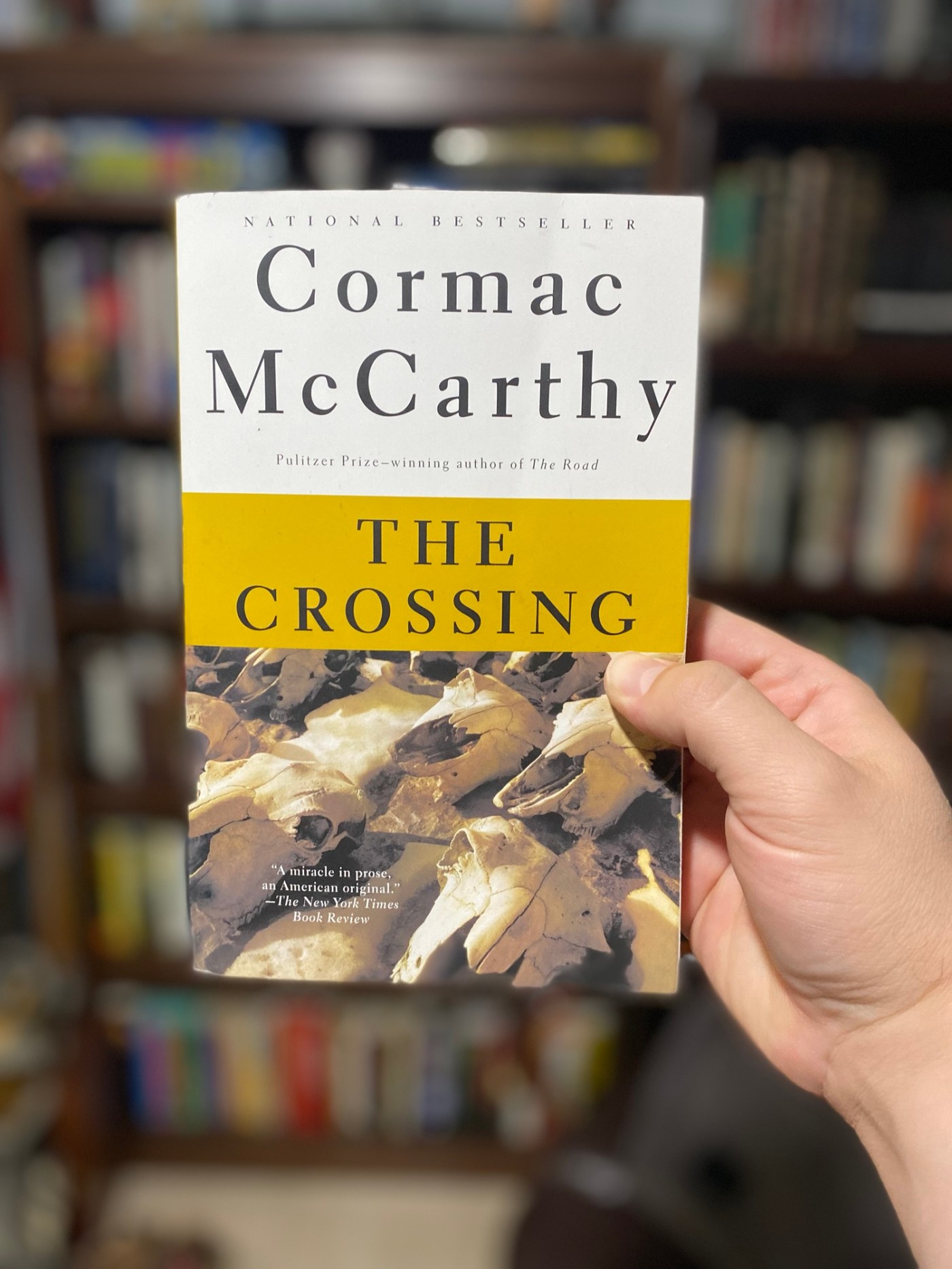
The book is The Crossing by Cormac McCarthy. It was originally published in 1994 by Alfred A. Knopf. I read the March 1995 First Vintage International Edition. I read it in September of 2024.
The title refers to crossing the border between the US and Mexico. A wolf has crossed from Mexico into New Mexico and a boy named Billy Parham tracks it down and takes it back to Mexico. So there’s a lot of travel back and forth across the border.
Which makes sense because this is the second book in Cormac McCarthy’s Border Trilogy. The first book was All the Pretty Horses where John Grady Cole passes back and forth across the border many times.
I read this as part of my author project of reading all the works of Cormac McCarthy. This was the next book in publication order. I’ve enjoyed seeing how Cormac McCarthy’s novels have changed throughout his writing career. His first novels took place in and around Tennessee. Now they’re set in Texas/Mexico. Blood Meridian was his first Texas book and his gnarliest. I wonder if something change in his life when he started writing about Texas.
McCarthy says a lot about God in this book. More than his other works I think. Or at least more directly. His books are so great, they usually speak about everything to some degree. The human condition. Despair. Loneliness.
He writes a lot about man trying to fix himself in the cosmos somehow. What is our position in existence? Who is God and who are we? Does it even matter? He definitely lands more on the nihilistic side. But then you get a sense that he doesn’t actually believe it’s all meaningless. It’s like he believes there is a hope but he’ll never be able to articulate it. This is a particular problem for McCarthy because he can articulate a lot of things really well. He’s a genius but he can’t get inside the mind of God. So he thinks there is no answer to the suffering we see around us, or he starts making up his own.
He’s able to see and express so much about the human condition and the world but he can’t see God’s reasons behind all pain and death and suffering. So it’s easier for him and other nihilists to just say there is no God. If God exists and acts in a way that they cannot understand then he must not exist. How arrogant is that? Maybe I’m reading too much into it. I’m just going off of his novels. I don’t know what McCarthy thought about God or religion in his personal life. But if his novels are any indication, it’s very dark and very nihilistic.
This book is like if McCarthy read Ol’ Yeller and said hold my beer. The emphasis on loneliness was deeper in this novel. The despair of loneliness in the blind Mexican character had a deep effect on me. The way McCarthy narrates his experience is so sad. It’s all sad.
“He’d no boots for they’d long been stolen and those first days he walked barefoot and his heart was filled with despair. More than filled. Despair was in him like a lodger. Like a parasite that had turned out his very being from its abode and taken up the shape of that space within him where it once had been. He could feel it lodged against his throat. He could not eat. He sipped water from a cup proffered anonymously out of the world’s dark and handed the cup away into that dark again.” (p278)
It’s not just the blindness of the character, it’s the isolation. He’s utterly and hopelessly alone. He still has his tongue and ears but he’s not using them. No one sits with him. No one talks to him.
It made me think about my own isolation in New Mexico. When I moved out of my parent’s house, I rented an apartment with a friend downtown but I barely saw him. I wasn’t in school with my friends. I worked in a cubicle. There would be days when I didn’t speak to anyone. I was just in my own world of books, music, and movies. It was nice at first but then it was pretty lonely.
This book also made me think of rejection. When Billy has absolutely nothing and he tries to join the army but can’t because of a heart murmur, it’s so sad. That was his last effort of belonging somewhere. That’s a common American thing, to join the military when you don’t know what to do with your life or if you feel like you don’t have any options. I briefly thought about it when I dropped out of college. Very briefly.
But to not even have that as an option even in the midst of WWII. They won’t take you. That’s awful. He has no home. He has no family. No friends. No prospects. The book ends with him crying in the middle of the road on his knees in utter despair after his horse is murdered. I hope Billy Parham’s story finishes better in Cities of the Plain. I have hope for Billy. But then again he’s a Cormac McCarthy character so I don’t know how much hope I should have.
I don’t know why I get surprised anymore by shocking violence in a McCarthy novel but it happened again in this book. My jaw dropped and my stomach turned when the German soldier sucked the eyeballs out of a Mexican dissident’s head. The way they were dangling and he said he could see the ground swaying beneath him. Ugh. So visceral. So good.
A McCarthy novel always comes with the threat of confusion. You have to pay attention because he gives you nothing. I’ve learned that so I do a good job of paying attention.
I felt very melancholy reading this book. It was depressing but it was beautiful. I know that sounds gay. McCarthy is such a great writer he can write about the worst things a person can go through but paint it in such a way that it really is a joy to read. His skill is otherworldly.
I was telling my kids about the book and all the sad things that happen in it and my daughter said “Why are you reading that?” I told her because it’s okay to be said for a little while.
I don’t think we should be so quick to kill melancholy. Our culture today has a pill for any bad feeling we might get. So much so that no one knows how to just be said for a minute. We shouldn’t wallow in depression but sadness is a normal part of life. Jesus wept (John 11:35) at Lazarous’ tomb even though he knew he was going to raise him from the dead.
I’m not sure I’d recommend this to everyone. Not to someone who struggles with depression. This book will depress you. But it’s written so well it makes up for it. It’s a little longer than most McCarthy books, but of course it’s great. If you love great writing and can stand a week of being really sad then I highly recommend it.
****************************************************
Notable Quotables
“”””
He had not known that you could see yourself in others’ eyes nor see therein such things as suns. He stood twinned in those dark wells with hair so pale, so thin and strange, the selfsame child. As if it were some cognate child to him that had been lost who now stood windowed away in another world where the red sun sank eternally. As if it were a maze where these orphans of his heart had miswandered in their journey in life and so arrived at last beyond the wall of that antique gaze from whence there could be no way back forever. (p6)
“”””
Crouched in the broken shadow with the sun at his back and holding the trap at eyelevel against the morning sky he looked to be truing some older, some subtler instrument. Astrolabe or sextant. Like a man bent at fixing himself someway in the world. (p22)
“”””
He said that the boy should find that place where acts of God and those of man are of a piece. Where they cannot be distinguished.
The old man said that it was not a question of finding such a place but rather of knowing it when it presented itself. He said that it was at such places that God sits and conspires in the destruction of that which he has been at such pains to create. (p47)
“”””
He wondered if the wolf were so unknowable as the old man said. He wondered at the world it smelled or what it tasted. He wondered had the living blood with which it slaked its throat a different taste to the thick iron tincture of his own. Or to the blood of God. (p51-52)
“”””
The little wolves in her belly felt the cold draw all about them and they cried out mutely in the dark and he buried them all and piled the rocks over them and led the horse away. (p128)
“”””
He said that the world could only be known as it existed in men’s hearts. For while it seemed a place which contained men it was in reality a place contained within them and therefore to know it one must look there and come to know those hearts and to do this one must live with men and not simply pass among them. (p134)
“”””
For this world also which seems to us a thing of stone and flower and blood is not a thing at all but is a tale. And all in it is a tale and each tale the sum of all lesser tales and yet these also are the selfsame tale and contain as well all else within. them. So everything is necessary. Every least thing. This is the hard lesson. Nothing can be dispensed with. Nothing despised. (p143)
“”””
There also was a ruin. A waste had opened in his soul and perhaps he saw with some new clarity how like the church he was himself but a thing of clay and perhaps he thought that the church would not be raised again as to do such work requires first that God be in men’s hearts for it is there alone that it truly has its being and there failing no power can build it back again. He became a heretic. So. (p147)
“”””
There is no favoring, you see. How could there be? At whose behest? This man did not cease to believe in God. Nor did he come to have some modern view of God. There was God and there was the world He knew that the world would forget him but that God could not. And yet that was the very thing he wished for.
Men do not turn from God so easily you see. Not so easily. Deep in each man is the knowledge that something knows of his existence. Something knows, and cannot be fled nor hid from. To imagine otherwise is to imagine the unspeakable. It was never that this man ceased to believe in God. No. It was rather that he came to believe terrible things of Him. (p148)
“”””
To see God everywhere is to see Him nowhere. (p153)
“”””
If the world was a tale who but the witness could give it life? Where else could it have its being? This was the view of things that began to speak to him. And he began to see in God a terrible tragedy. That the existence of the Deity lay imperiled for want of this simple thing. That for God there could be no witness. Nothing against which He terminated.
What then to make of this man with claim that God had preserved him not once but twice out of the ruins of the earth solely in order to raise up a Witness against Himself? (p154)
“”””
He saw that he was indeed elect and that the God of the universe was yet more terrible than men reckoned. He could not be eluded nor yet set aside nor circumscribed about and it was true that He did indeed contain all else within Him even to the reasoning of the heretic else He were no God at all. (p156)
“”””
The priest therefore saw what the anchorite could not. That God needs no witness. Neither to Himself nor against. The truth is rather that if there were no God then there could be no witness for there could be no identity to the world but only each man’s opinion of it. (p158)
“”””
When he looked for the light it was gone and he fixed his position by the stars and after a while the light appeared again out of the dark cape of desert headland that had obscured it. He’d quit singing and he tried to think how to pray. Finally he just prayed to Boyd. Don’t be dead, he prayed. You’re all I got. (p274)
“”””
He’d no boots for they’d long been stolen and those first days he walked barefoot and his heart was filled with despair. More than filled. Despair was in him like a lodger. Like a parasite that had turned out his very being from its abode and taken up the shape of that space within him where it once had been. He could feel it lodged against his throat. He could not eat. He sipped water from a cup proffered anonymously out of the world’s dark and handed the cup away into that dark again. (p278)
“”””
He waded out wondering if the water might perhaps be deep enough to bear him away. He imagined that in his estate of eternal night he might somehow have already halved the distance to death. That the transition for him could not be so great for the world was already at some certain distance and if it were not death’s terrain he encroached upon in his darkness then whose? (p280)
“”””
Finally the man said that it was a sin to lose heart and anyway the world remained as it had always been. (p282)
“”””
He said that while one would like to say that God will punish those who do such things and that people often speak in just this way it was his experience that God could not be spoken for and that men with wicked histories often enjoyed lives of comfort and that they died in peace and were buried with honor.
he said that while it was true that time heals bereavement it does so only at the cost of the slow extinction of those loved ones from the heart’s memory which is the sole place of their abode then or now. Faces fade, voices dim. Seize them back, whispered the sepulturero. Speak with them. Call their names. Do this and do not let sorrow die for it is the sweetening of every gift. (p288)
“”””
He said that even the sepulturero would understand
that every tale was a tale of dark and light and would perhaps not have it otherwise.
That men have just enough stomach for small evils and only these will they oppose. He said that true evil has power to sober the smalldoer against his own deeds and in the contemplation of that evil he may even find the path of righteousness which has been foreign to his feet and may have no power but to go upon it. (p292-293)
“”””
Lastly she said that if women were drawn to rash men it was only that in their secret hearts they knew that a man who would not kill for them was of no use at all. (p322)
“”””
At last she said that God looked after everything and that one could no more evade his care than evade his judgment. She said that even the wicked could not escape his love. He watched her. He said that he himself had no such idea of God and that he’d pretty much given up praying to Him and she nodded without taking her eyes from the fire and said that she knew that.
He prodded the ashes with a stick. The few red coals that turned up in the fire’s black heart seemed secret and improbable. Like the eyes of things disturbed that had best been left alone. (p324)
“”””
It’s never like what you expected. Quijada nodded. If people knew the story of their lives how many would then elect to live them? People speak about what is in store. But there is nothing in store. The day is made of what has come before. The world itself must be surprised at the shape of that which appears. Perhaps even God. (p387)
“”””
He put his arm around the horse’s neck and held it and he could feel it trembling and feel it lean against him and he was afraid that it would die and he could feel in the horse’s breast a despair much like his own. (p397)
“”””
To speak of a will in the world that ran counter to one’s own was one thing. To speak of such a will that ran counter to the truth was quite another, for then all was rendered senseless. (p410)
 Solomon White
Leave a comment