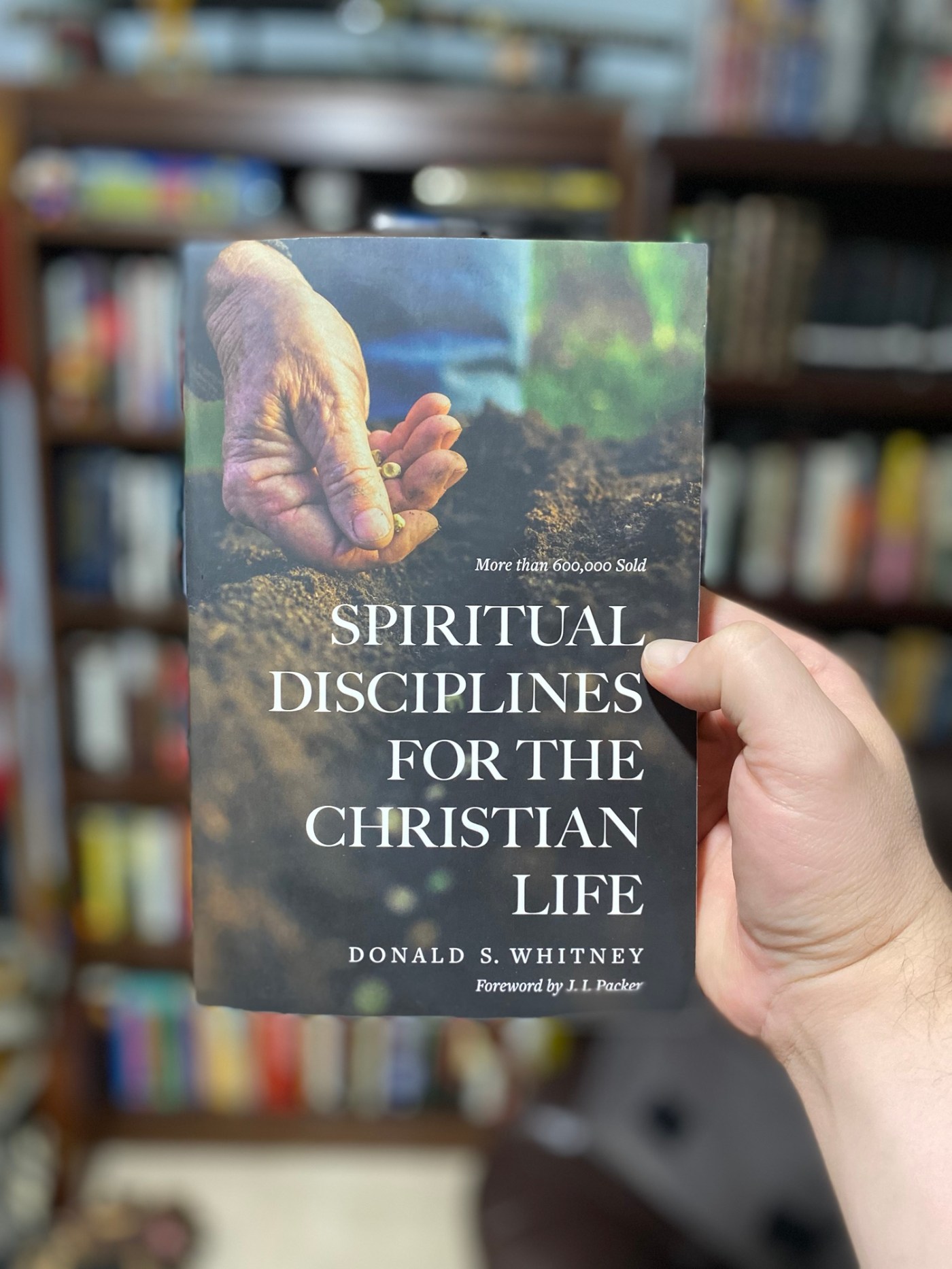
The book is Spiritual Disciplines for the Christian Life by Donald Whitney. It was originally published in 1991 by NavPress in alliance with Tyndale House Publishers. I read the 2014 paperback edition. I read it in August of 2024.
The title refers to the spiritual disciplines that Whitney examines throughout the book.
“I believe a case can be made—to a greater or lesser extent for each — that the following personal Spiritual Disciplines are commended in Scripture: Bible intake, prayer, worship, evangelism, service, stewardship, fasting, silence and solitude, journaling, and learning.” (p7)
Whitney lays out several spiritual disciplines and explains why they’re important and how to apply them to our life.
I read this in my discipleship group at church. We alternate between reading through a book of the Bible and a Christian book. This was the last one we read.
The checklist gets a bad rap. People say they don’t want their daily reading and praying to become a “check the box” mundane routine. They don’t want to just “go through the motions” with their Christianity. I say let’s get to that problem first and then deal with it.
The truth is most Christians aren’t dealing with that problem because they’re not even reading and praying routinely every day. Get to that state and then we can work on the heart being present and active in the daily reading and praying.
Whitney is right in calling it spiritual disciplines. We are disciples. We should practice discipline.
Tonight after reading our chapter of the Bible as a family Audrey asked, “What will we do when we finish the Bible?” I said “We’ll go back to the beginning and start it over.” She looked at me like that’s crazy. She was probably thinking, “After we finished Charlotte’s Web or Charlie and the Chocolate Factory we didn’t reread it. And she’s right. But I said “We’re Christians. That’s what we do. We read the Bible and pray every day.” I want to normalize that for my kids from an early age.
Part of being a Christian means you read the Bible every day, pray, and go to church. I want to lay that precedent. That’s what is at the heart of Donald Whitney’s book. What does it mean to actually be a Christian day in and day out?
A lot of people can go to church on Easter because a relative invited them, and get swept up in the plucking of their emotional heartstrings and cry at a music worship service and feel like they’re having a profound religious experience. But then when they get plugged into a regular community group and discipleship group and are expected to do daily or even weekly reading and praying, they get freaked out or burned out by all the “homework” of being a daily Christian disciple.
It made me think about how well or poorly I do these spiritual disciplines in my own life. The disciplines I struggle with most have to do with hanging out with other people. Most of these spiritual disciplines I can do on my own like reading and praying and fasting. These are individual things. But things like fellowship and evangelism are hard for me. I just feel like I have to be performing in some way or I’m worried I’ll say something that makes me seem like a tool.
Parties and get-togethers are hard for me because the things I’m most interested in talking about are the things you’re not supposed to talk about in polite company. Religion and politics. So that leaves me with very little to relate to people about. I’m not up-to-date on all the current pop culture.
People have a hard time thinking about spiritual growth and maturity as disciplines. It sounds too religious. If Christianity is supposed to be a relationship instead of a religion then why does it take discipline? If we really love Christ shouldn’t it come easy? Calling it a discipline requires us to get real with ourselves.
While we’re no longer sinners in our identity as in the essence of who we truly are, we are still in this sinful fallen world and attached to this sinful fallen flesh. That being the case, we will continue to struggle with sin and act like the pagan slave we used to be. And that means we bristle against things like reading the Bible and praying consistently. We know we should do it but we don’t. That’s why it’s a discipline.
In the part where he writes about the discipline of evangelism he says we don’t need a lot of Bible knowledge to start telling people about Christ. While that is true, it’s not something I would emphasize and encourage so much. I think part of the discipline of evangelism is training in apologetics. I think we do have a responsibility to know how to defend the faith we say we believe.
The problem with apologetics and probably why Whitney didn’t include it as a spiritual discipline is because of how apologetics is usually conducted. If it’s an evidentialist or intelligent design apologetic then that is not a spiritual discipline. But presuppositional apologetics is a gospel-centered apologetic. That’s evangelism.
I thought this was an interesting factoid.
“that recorded readings of the Bible have proven that you can read through the entire Book in seventy-one hours? That’s less time than the average American spends in front of the television every month.” (p29)
When this book was written in 1991 TV watching was a big time waster. Today it’s our phones. I sometimes fall into the trap of thinking that because I don’t watch a lot of TV that I’m not wasting my time or procrastinating. I just googled it and apparently we spend about 60 hours per week of screentime. So we’re getting better and we have the Bible on our phones so maybe it’s less bad. But I know I’m way less productive overall because of my phone and it’s convicting.
I’d recommend this book for Christian book study groups. It’s highly applicable and convicting. It was great for my discipleship group. We’ve really taken some of these disciplines to heart and have made changes in our Christian walk. It’s a must-read for every Christian.
****************************************************
Notable Quotables
“”””
I will emphasize that godliness is the goal of the Disciplines, and when we remember this, the Spiritual Disciplines become a delight instead of drudgery. P4
“”””
I believe a case can be made—to a greater or lesser extent for each — that the following personal Spiritual Disciplines are commended in Scripture: Bible intake, prayer, worship, evangelism, service, stewardship, fasting, silence and solitude, journaling, and learning. P7
“”””
If your picture of a disciplined Christian is one of a grim, tightlipped, joyless half-robot, then you’ve missed the point. P19
“”””
No Spiritual Discipline is more important than the intake of God’s Word. P22
“”””
that recorded readings of the Bible have proven that you can read through the entire Book in seventy-one hours? That’s less time than the average American spends in front of the television every month. P29
“”””
Any financial reward would be minimal when compared to the accumulating value of the treasure of God’s Word deposited within your mind. P39
“”””
The general rule, then, in your personal, daily intake of Scripture is to both read and meditate. Read at length-such as a chapter or more-then go back over what you’ve read and select something specific from that as the focus of your meditation. Read big; meditate small. P56
“”””
meditation should ultimately lead to application, to Christlike obedience. P71
“”””
The less we think of the nature and character of God, and the less we are reminded of what Jesus Christ did for us on the cross, the less we want to pray. P84
“”””
We learn to pray by meditating on Scripture, for meditation is the missing link between Bible intake and prayer. P93
“”””
Perhaps God has indeed answered, but not in an obvious way. And possibly our prayers show nothing amiss, but we don’t yet see the answer only because God intends for us to persevere in praying about the matter awhile longer. Still, we must learn to examine our prayers. Are we asking for things outside the will of God or that would not glorify Him? Are we praying with selfish motives? Are we failing to deal with the kind of blatant sin that causes God to put all our prayers on hold? P95
“”””
The natural, unplanned flow of spiritual life sinks to the lowest ebb of vitality. P97
“”””
At other times God wants us to persist in prayer in order to strengthen our faith in Him. Faith would never grow if all prayers were answered immediately. P98
“”””
The word worship descends from the Saxon word weorthscype, which later became worthship. To worship God means to ascribe the proper worth to God, to magnify His worthiness of praise, or better, to approach and address God as He is worthy. p103-104
“”””
So we must worship in both spirit and truth, with both heart and head, with both emotion and thought. If we worship with too much emphasis on spirit we will be mushy and weak on the truth, worshiping mainly according to feelings. P109
“”””
Some believe they need months of specialized training to witness effectively. They fear speaking with someone about Christ until they feel confident in the amount of their Bible knowledge and their ability to deal with any potential question or objection. That confident day, however, never comes. What if the blind man whom Jesus healed in John 9 had thought that way? Would he ever have felt ready to witness to the scholarly, critical Pharisees? And yet within hours, perhaps minutes, of meeting Jesus, he bravely told them what he knew of Jesus. P122
“”””
We need to learn that sharing the gospel is successful evangelism.
In this regard we are like the postal service. They measure success by the careful and accurate delivery of the message, not by the response of the recipient. Whenever we share the gospel (which includes the summons to repent and believe), we have succeeded. In the truest sense, all biblical evangelism is successful evangelism, regardless of the results. (p124)
“”””
But as we think again about the blind man Jesus healed in John 9:25, we realize that we cannot attribute our failure to witness to a lack of training. Though he had been a believer in Jesus only for a few minutes and obviously had no evangelism training at all, he was willing to tell others what Jesus had done for him (“One thing I do know, that though I was blind, now I see”). So any Christian who has heard biblical preaching, participated in Bible studies, and read the Scriptures and Christian literature for any time at all should have at least enough understanding of the basic message of Christianity to share it with someone else. Surely if we have understood the gospel well enough ourselves to be converted, we should know it well enough (even if as yet we know nothing else about the faith) to tell someone else how to be converted. (p128)
“”””
Unless we discipline ourselves for evangelism, we can easily excuse ourselves from ever sharing the gospel with anyone.
evangelism is a Spiritual Discipline.
For me that means I discipline myself to be with unbelievers. (p130)
“”””
The practice of consistent Christian living does empower evangelism, but a Christian recovery from your own unchristian living confirms your witness in another, very believable way. Through your failures and weaknesses, the life-changing power of Christ can be made visible and strong. (p137)
“”””
How would you recruit volunteers for this hazardous job? Bolivar Roberts, superintendent for the western end of the Express, is said to have placed this ad in a San Francisco newspaper in March 1860: “Wanted-young, skinny, wiry fellows not over 18. Must be expert riders willing to risk death daily. Orphans preferred.”
Those were the honest facts of the service required, but the Pony Express never suffered a shortage of riders.
It’s costly service. God asks for your life. (p142)
“”””
The person who can’t serve the Lord with gladness contradicts with his heart what he professes with his lips. I can understand why the person who serves God only out of obligation doesn’t serve with gladness. I can understand why the person who serves God in an attempt to earn his way to heaven doesn’t serve with gladness. But the Christian who gratefully acknowledges what God has done for him or her for eternity should be able to serve God cheerfully and with joy. (p147)
“”””
As Proverbs 24:33-34 observes, “A little sleep, a little slumber, a little folding of the hands to rest, and poverty will come upon you like a robber, and want like an armed man.” Notice that it’s just a “little” sleep, a “little” slumber, a “little” folding of the hands to rest that brought the ruin of lost time and opportunity. It’s so easy to lose so much, just a little at a time. You don’t have to do anything to lose time. (p166)
“”””
That’s our task. God wants us to use and enjoy the things He permits us to have, but as stewards of them we must remember that they all belong to Him and should be used for His kingdom. (p170)
“”””
God does not send you a bill. The church does not send you a monthly statement. We don’t give to God and to the support of the work of His kingdom to fulfill some supposed “eleventh commandment.” Love to God should motivate giving to God. How much you give should reflect how much you love God. (p177)
“”””
The Bible sets no percentage goal in giving. Giving 10 percent of your gross income does not necessarily mean you have fulfilled the will of God. Ten percent does not make a ceiling of giving at which to stop, but a floor from which to grow. (p183)
“”””
When you fast you remind yourself that unlike many (see Philippians 3:19), your stomach is not your god.
Fasting must always have a spiritual purpose—a God-centered purpose, not a self-centered one-for the Lord to bless our fast. (p214)
“”””
what we are when we are alone is what we really are. If we habitually seek God and His perspective through His Word when we are alone—and not just at church or when with other Christians-then we may be hopeful that we do know God. (p235)
“””””
Missionary martyr Jim Elliot knew of the struggle: “I think the devil has made it his business to monopolize on three elements: noise, hurry, crowds. .. Satan is quite aware of the power of silence.” (p239)
“”””
One of the ways the “progress or decline of the inner man” can be noted through journaling is by the observation of previously undetected patterns in your life. When I review my journal entries for a month, six months, or a year, I usually see myself and events more objectively. I can analyze my thoughts and actions apart from the feelings I had at the time. From that perspective it’s easier to observe whether I’ve made spiritual progress or have backslidden in a particular area. (p253)
“”””
Without pen in hand or fingers on the keyboard, I can get so distracted in meditation that I begin tacking one unrelated thought to another until I’m shingling off into the fog of daydreams instead of thinking in the light of Scripture. The discipline of writing down my meditations in my journal helps me concentrate. (p254)
“”””
No matter how close the friendship or how intimate the marriage, we can’t always tell others what we think. And yet sometimes our Feelings are so strong and our thoughts so dominant that we must find some way to give them expression. Our Father is always available and willing to listen. “Pour out your heart before him,” says Psalm 62:8. A journal is a place where we can give expression to the fountain of our heart, where we can unreservedly pour out our passion before the Lord. (p255)
“”””
we tend to forget just how many times God has answered specific prayers, made timely provision, and done marvelous things in our lives. But having a place to collect all these memories prevents their being forgotten. (p257)
“”””
On his desk I found the devotional material he had used to begin his final broadcast. He had read the words to William Cowper’s hymn, “God Moves in a Mysterious Way.” Finding his initials and “8/19/85” written beside these lines of faith provided me with more comfort and spiritual strength than anything said to me by anyone else.
these scraps of my heritage and wept tears of thanksgiving to the Lord for this remnant of his life. How precious it would be if only more of his walk with God were recorded for me in some written, form. (p259)
“”””
And He who began this good work in the life of the believer “will bring it to completion at the day of Jesus Christ’ (Philippians 1:6). So it is the role of the Holy Spirit to produce within us the desire and the power for the Disciplines that lead to godliness. (p291)
“”””
the Disciplines comes through the practice of the Disciplines.
If we surrender to these enemies of our souls and forsake the Disciplines, victory will never come. But if we will utilize these spiritual weapons, God will give the grace and strength to conquer even more. (p299)
 Solomon White
Leave a comment