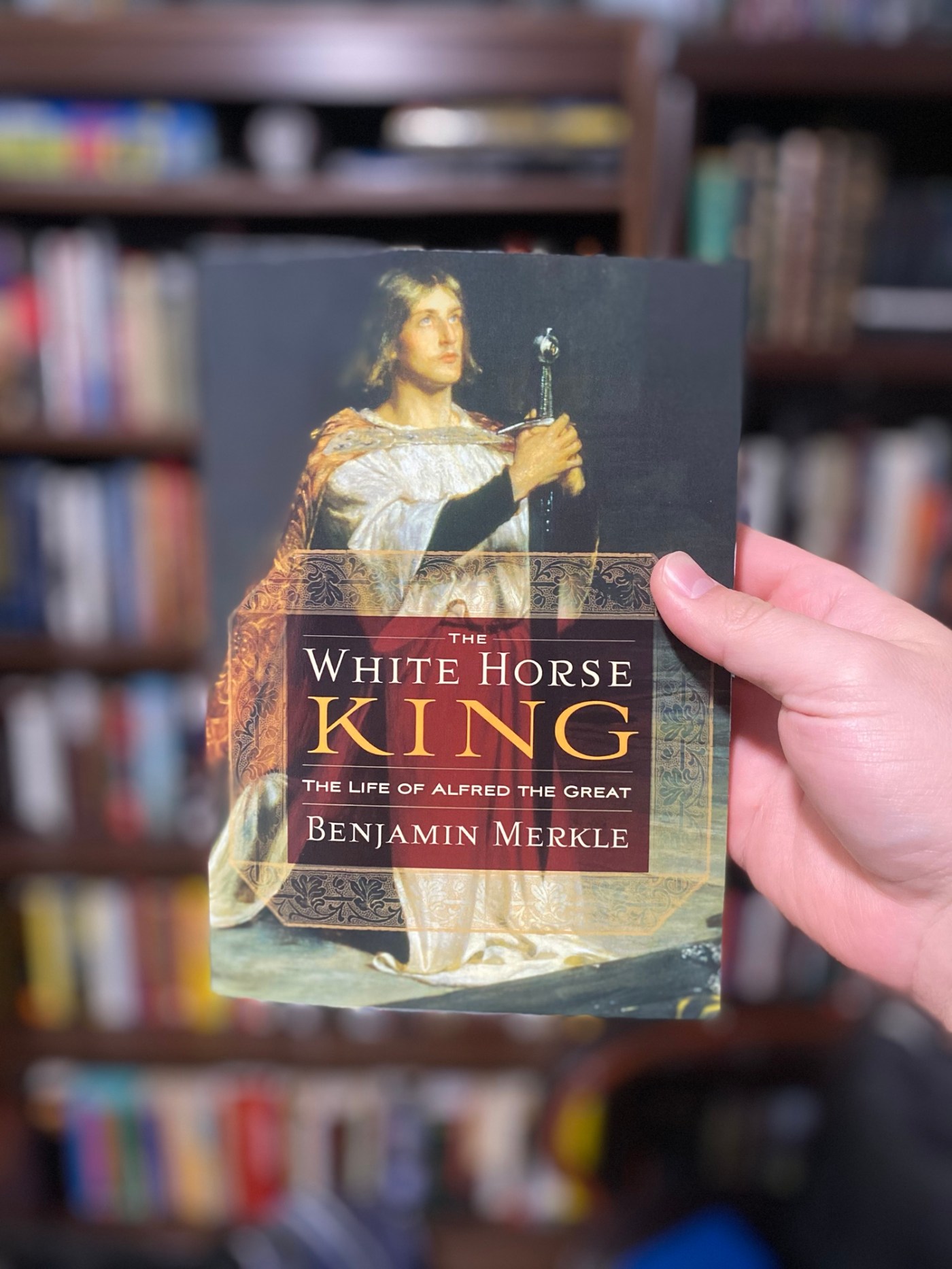
The book is The White Horse King by Ben Merkle. It was originally published in 2009 by Thomas Nelson. I read the 2009 paperback edition. I read it in June of 2024.
The title refers to Whitehorse Hill in England where there is a giant drawing of a horse etched into the hill with white chalk. This is supposed to be where Alfred the Great fought the battle of Ashdown.
“The most popular traditional account identifies Ashdown with what is now known as Whitehorse Hill, an imposing hill that looms over the low-lying Berkshire Downs. It stands around nine hundred feet above sea level, making it the tallest point from miles in every direction.” (p44)
This book is a biography of Alfred the Great by Doug Wilson’s son-in-law Ben Merkle.
I read this because I want to learn more about Alfred the Great. I watched The Last Kingdom on Netflix and read a couple of the books. I want to learn more about this period, of the construction of England in the middle ages.
Alfred the Great was the king of Wessex in the 9th century. He had the vision of a united England. At the time, there were several separate kingdoms on the island of Britain. I imagine it like several different native American tribes. Wessex, Wales, Mercia, Northumbria. It’s hard for us to tell them apart today, but they were really different. But one thing they all had in common, they were Christian.
And they all fought against the pagan Viking invaders. Alfred led that fight and had a greater vision for all the kingdoms to unite into one Christian England. He didn’t live to see this actually happen but he successfully passed down that vision to his children and grandchildren, and they eventually accomplished Alfred’s dream.
This is inspiring because it’s what I want to do with my legacy. My goal is that my great great grandchildren worship Christ and continue to build the kingdom of God.
It’s clear that Merkle is a fan of Alfred the Great. From what I’ve seen in his Canon Press material it’s evident that he has the same legacy mindset as Doug Wilson and Michael Foster. That’s where I got my perspective of Christian patriarchy and legacy.
My main takeaway is the tunnel vision of Alfred the Great. There’s “having goals” and then there’s kingdom building. I want to be about the business of building the kingdom of God on Earth. I know that sounds weird. But it’s not as hard as we think. The goal basically is just be normal. Get married, get a job, have kids, raise them in the Lord. Be a patriarch. My goal in life is to be the holiday house. I want a big house that I can host my big family for the holidays. If I could do that and all my big family are Christians, then my time here on earth would have been a success.
It sounds simple but it’s amazing to see how so many men can manage to screw this up so badly. Be normal. Follow Christ. Read the Bible to and pray with your family. Be their primary source of spiritual and theological education. Take your family to church. Work hard. Eat eggs. Take dominion. Build a life and work and keep it every day. That’s kingdom building.
My goal is easier than Alfreds. That’s for sure. Maybe God will use me to bring about some big significant change in the world. I don’t know. That’s his prerogative. I’m just going to do my best to keep it on all the rails, make disciples, be a patriarch, and leave a legacy.
This book made me think about the TV show The Last Kingdom. That’s the first place I heard of Alfred the Great. I’ll probably always picture Alfred as played by the British actor David Dawson.
The names were definitely hard to keep track of. All the aethels and all the stans. You have to pay attention to who is who.
I learned the etymology of town suffixes like burgh or bury.
“Next, Alfred ordered that each of these cities be fortified with a defensive wall capable of withstanding an assault by Danish attackers. The construction of these defenses transformed a selected city into a burh, the Anglo-Saxon word for a fortified dwelling. Many English towns still carry the remnants of this designation in their names; the suffixes -bourgh or -bury indicate their former classification as an ancient burh.” (p148)
One thing I think Merkle might be mistaken about is that Viking berserkers used drugs or mushrooms to go out of their minds in battle. Neil Price in his book Children of Ash and Elm writes this.
“There is no evidence whatsoever, in archaeology or text, for the berserkers’ use of hallucinogens, entheogens, or any other form of mind-altering drug or chemical, including the consumption of Ay agaric (despite the fact that Wikipedia’s entry for berserkers recommends the reader also look up ‘Dutch Courage’ and, indeed, ‘Going Postal’).” (p326)
I’d recommend this book to all Christian men. It’s good to know about our Christian forefathers. Alfred the Great is one of the most inspiring figures in world history. He is certainly worth studying more in depth. This definitely won’t be the last biography of the white horse king I will read.
****************************************************
Notable Quotables
“””””
It was the establishment of the Christian church that turned the Anglo-Saxons away from a worldview that had been every bit as ruthless and cruel as the worldview held by the Viking raiders. The missionaries sent by Rome to Christianize the various warring Anglo-Saxon tribes had preached against and even given their lives in the fight against this very worldview. (p11)
“”””
it was not until the age of twelve that Alfred learned to read in his native tongue, but he was still not able to understand anything in Latin, the language in which most literary works of the time were available. (p30)
“”””
Though the reputation of the Danes for ferocity in battle was well deserved, the true skill of the Viking forces was the ability to maximize their raping, pillaging, and plundering, while minimizing the chances of facing another army on the open field of battle. (p32-33)
“”””
The most popular traditional account identifies Ashdown with what is now known as Whitehorse Hill, an imposing hill that looms over the low-lying Berkshire Downs. It stands around nine hundred feet above sea level, making it the tallest point from miles in every direction. (p44)
“”””
The white horse has gathered many of the myths of history to itself, and those myths have grown more and more fantastical grazing on the green slopes of the vale. King Arthur, Saint George, and Alfred the Great are all claimed by the white horse, (p45)
“””””
Alfred joined the shieldwall, standing shoulder to shoulder with his men. The notion of being led into battle by a man who wasn’t willing to personally lead the charge would have been unthinkable to the men of Wessex. (p56)
“”””
But the men of Wessex who had fallen in battle were not professional soldiers. They were farmers and craftsmen. When they failed to return from battle, crops failed and villages went hungry.
The men of the raiding armies lived off theft and not labor. Their parasitic diet of pillage and plunder made it impossible to stay behind the walls of Reading for any period of time. Thus the livelihood of Wessex depended on its troops returning home to work, while the livelihood of the raiding army depended on their continued ravaging of the countryside. (p63)
“”””
For more than a century, however, the raiding armies of Northmen had cultivated a habit of searching out the path of least resistance to plunder. They had begun with the unguarded riches of monasteries and then moved on to the wealth easily extracted from weak kings and small nations on the brink of collapse. The campaign in Wessex had been too costly for the Danes, who preferred much more easily gotten spoils. (p77)
“”””
Understanding the weight of Alfred’s plight requires a bit of knowledge concerning the ideals of the Anglo-Saxon society: the king sat enthroned, not on a gaudy gold contraption that signaled the distance between his subjects and him, but on the mead bench, pushed up to a long table, surrounded on all sides by his faithful warriors, the men who stood next to him in the shieldwall throughout all of his campaigns, his thegns. (p93)
“”””
Before a battle, these men danced in small circles and, through great concentration and an occasional hallucinogenic mushroom, worked their minds into a murderous craze, a mental state they referred to as berserkergang. (p121)
“””””
Rather than vengeance, Alfred offered forgiveness, a forgiveness made clear through the great Saxon virtue of gift giving. Pattern-welded swords with their serpentine-etched blades, magnificent helms crested with fierce boars, gilded and jewelled, finely crafted brooches and pendants-all these and more were handed over to the Viking guests.
And here Guthrum sat, now a Christian named Ethelstan, receiving Alfred’s gifts and pledging faithfulness to the king of Wessex. (p136)
“”””
Next, Alfred ordered that each of these cities be fortified with a defensive wall capable of withstanding an assault by Danish attackers. The construction of these defenses transformed a selected city into a burh, the Anglo-Saxon word for a fortified dwelling. Many English towns still carry the remnants of this designation in their names; the suffixes -bourgh or -bury indicate their former classification as an ancient burh. (p148)
“”””
Alfred, until his death, regularly took his sword, shield, and spear into battle, standing shoulder to shoulder in the shieldwall with his countrymen. In the Anglo-Saxon world, combat was the duty of the ruling class; and the king, his thegns, the noblemen, and other rulers of the English people always filled the ranks of the Wessex shieldwall.
In Alfred’s day, no man could order another into combat to face a gory death in battle if he wasn’t prepared to stand next to him in that same perilous fight. (p154)
“”””
Frustrated that such a great heritage had been utterly lost, Alfred wondered why the Christians of the seventh and eighth centuries had not translated these works into the Anglo-Saxon vernacular. Had they done so, those books would have not passed beyond the reach of the British church. Then he realized that the Christians of the seventh and eighth centuries never thought it could be possible that the church would ever lose its ability to understand the Latin tongue. (p184-185)
“””””
By arguing throughout his preface that justice must be an eternal principle, handed down through both Scripture and the legal codes of the land, Alfred established the framework for what would later be known as “common law,” the foundation for the legal system of England for the following millennia, as well as for the legal systems of the former colonies of the British empire-including the United States, (p200)
“”””
Instead of a prohibition of murder, treason, or some other heinous crime, the king saw oath-breaking as the greatest threat to the endurance of his kingdom.
Similarly, one can remember the habitual treachery of the pagan Vikings, whose unctuous pledges of peace were disregarded by the Danes within hours of making the pledge. It seemed to Alfred that oath-keeping truly was the virtue that most clearly distinguished a Christian nation from a pagan nation. (p201)
“”””
Even though Ethelstan is often referred to as the first king of England because all of England was first united under his reign, the accomplishments of Athelstan and Edward were really just the natural culmination of the reforms first established during Alfred’s reign. (p233)
 Solomon White
Leave a comment