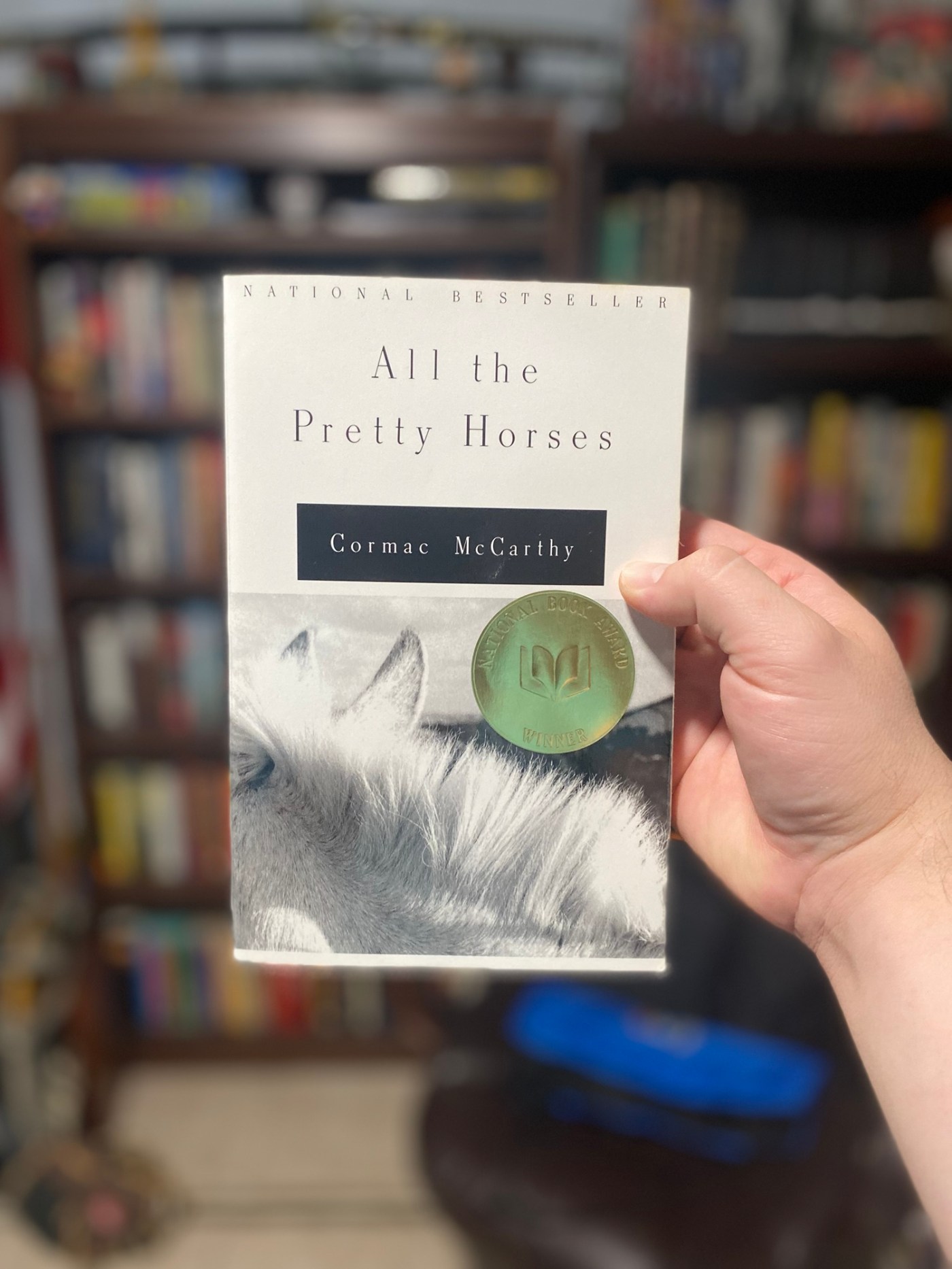
The book is All the Pretty Horses by Cormac McCarthy. It was originally published in 1992 by Alfred A. Knopf Inc. I read the 1993 Vintage International Edition. I read it in June of 2024.
I’m not sure what the title means. All the pretty horses. The main character loves horses. They are his motivation and passion. He wants to work on a horse ranch. But then he also loves the rancher’s daughter. He first sees her on a horse. But it’s a forbidden love. It almost seems like he can’t love her so he loves the next most beautiful thing, the horses and the land. All he wants to do is be a horse rancher. He loves Alejandra but he can’t have her.
There’s a line that says “he said that the souls of horses mirror the souls of men more closely than men suppose and that horses also love war. Men say they only learn this but he said that no creature can learn that which his heart has no shape to hold.”
John Grady has a heart shaped to hold Alejandra. He wants her, but his heart is with the horses and the land. His love for Alejandra disrupts his love for the horse ranch.
I read this because I’m reading through all of Cormac McCarthy’s bibliography and this was next in publication order. I had read it before but it was worth the reread.
There is an element of a coming of age story in that he has a mission in life, to work on a horse ranch, but then he falls in love with Alejandra and she becomes more important. Every man must struggle with this tension between his labor and his love. Every man must be on a mission and his wife is supposed to be someone that can come alongside him and help him with that mission. We see this modeled with our first parents, Adam and Eve in God’s original intent for creation. God gave Adam a job and then a wife. But like John Grady, most men make a woman their mission. Then when they finally obtain her they think the mission is over. This leads to discontentment and depression. Men lose sight of their mission and become useless.
Like the other McCarthy books I’ve read, he packs a lot of meaning and message into a short novel.
In this book McCarthy is commenting on the cruel way the world can keep young lovers away from each other. There are class and cultural walls that are harder to scale than we’d like to imagine.
Some prohibitions are legitimate. If a man wants to live the life of a penniless horse breaker without a scrap of provision to his name, then he is running the risk of meeting the love of his life and having nothing to offer her. “All you need is love” is a bunch of crap. You need a roof over your head and food to eat. Or rather, “all you need is love” is true and to truly love someone is to provide for them.
Either way, being a penniless horse rancher is not a wise mission for a man. It’s not only about what makes you personally happy and satisfied. We are supposed to take dominion and be fruitful and multiply. If a career choice does not provide for that then it’s not a wise career choice. I know I’m being completely unromantic but it’s what the book made me think about.
It’s hard to pinpoint a main takeaway from a Cormac McCarthy book. His books are never really about one thing. Maybe it’s about identity. John Grady Cole is trying to find out who he is, what he wants, and where he belongs. There was an interesting part when John Grady was trying to return Jimmy Blevins horse but then finds out that there are several Jimmy Blevins all over the country. Jimmy Blevins was the name of a radio preacher and many Blevins families named their sons after him.
This is the first love story from McCarthy. The romantic interest, Alejandra is almost just a set piece. Not a lot of character to her. I supposed the story is really more about John Grady.
The more interesting female character was Alejandra’s aunt. She has a fascinating exchange with John Grady towards the end of the novel.
I’ve never had a book cause my face to literally hurt from something I read. There is a passage where McCarthy describes someone getting struck by lightning and it causes their fillings in their teeth to weld his jaw shut. When I read that my jaw literally hurt from imagining it. I rarely ever have such a visceral physical reaction to reading something.
The tone was beautiful and brutal, as most McCarthy books are. There were Texas and Mexico landscapes. Horses running across ranches. Mexican deserts. Thunderstorms on the open range.
John Grady Cole isn’t so much a hero to emulate but rather a hero we already know. He’s so relatable in that he wants to follow his passions but his passion changes or expands along the way. He wants to do what’s right but isn’t always sure about what’s right in all cases.
There really aren’t any villains, so much as just people doing their job. Whether it’s a protective aunt, or a Mexican jailer, they’re just doing what they’re supposed to be doing. It’s not personal.
I’d recommend this to a female reader for her first Cormac McCarthy novel. So far I think this would be the book to introduce a woman to the world of Cormac McCarthy. It is romantic and beautiful in a McCarthy sort of way. It’s a great novel. I recommend everyone to read it.
****************************************************
Notable Quotables
What he loved in horses was what he loved in men, the blood and the heat of the blood that ran them. All his reverence and all his fondness and all the leanings of his life were for the ardent hearted and they would always be so and never be otherwise. (p6)
“”””
The Good Book says that the meek shall inherit the earth and I expect that’s probably the truth. I aint no freethinker, but I’ll tell you what. I’m a long way from bein convinced that it’s all that good a thing. (p13)
“”””
He’d the notion that there would be something in the story itself to tell him about the way the world was or was becoming but there was not. There was nothing in it at all. (p21)
“”””
To the west a mile away ran a wire fence strung from pole to pole like a bad suture across the gray grasslands and beyond that a small band of antelope all of whom were watching them. (p38)
“”””
You think God looks out for people? said Rawlins. Yeah. I guess He does. You?
Yeah. I do. Way the world is. Somebody can wake up and sneeze somewhere in Arkansas or some damn place and before you’re done there’s wars and ruination and all hell. You dont know what’s goin to happen. I’d say He’s just about got to. I dont believe we’d make it a day otherwise. (p92)
“”””
He is campaigns in the deserts of Mexico and he told the horses killed under him and he said that the souls of horses mirror the souls of men more closely than men suppose and that horses also love war. Men say they only learn this but he said that no creature can learn that which his heart has no shape to hold. His own father said that no man who has not gone to war horseback can ever truly understand the horse and he said that he supposed he wished that this were not so but that it was so.
Lastly he said that he had seen the souls of horses and that it was a terrible thing to see. He said that it could be seen under certain circumstances attending the death of a horse because the horse shares a common soul and its separate life only forms it out of all horses and makes it mortal. (p111)
“”””
But there were two things they agreed upon wholly and that were never spoken and that was that God had put horses on earth to work cattle and that other than cattle there was no wealth proper to a man. (p127)
“”””
Beware gentle knight. There is no greater monster than reason. (p146)
“”””
What do you want to know? he said.
Only what the world wants to know.
What does the world want to know.
The world wants to know if you have cojones. If you are brave. (p193)
“”””
There can be in a man some evil. But we dont think it is his own evil. Where did he get it? How did he come to claim it? No. Evil is a true thing in Mexico. It goes about on its own legs. Maybe some day it will come to visit you. Maybe it already has.
Maybe. (p194-195)
“”””
He would not think about Alejandra because he didnt know what was coming or how bad it would be and he thought she was something he’d better save. So he thought about horses and they were always the right thing to think about. (p204)
“”””
He asked that God remember those who had died and he asked that the living gathered together here remember that the corn grows by the will of God and beyond that will there is neither corn nor growing nor light nor air nor rain nor anything at all save only darkness. (p221)
“”””
He’d dreamt of him one night in Saltillo and Blevins came to sit beside him and they talked of what it was like to be dead and Blevins said it was like nothing at all and he believed him. (p225)
“””””
They were saddened that he was not coming back but they said that a man leaves much when he leaves his own country. They said that it was no accident of circumstance that a man be born in a certain country and not some other and they said that the weathers and seasons that form a land form also the inner fortunes of men in their generations and are passed on to their children and are not so easily come by otherwise. (p226)
“””””
The example he gave was of a tossed coin that was at one time a slug in a mint and of the coiner who took that slug from the tray and placed it in the die in one of two ways and from whose act all else followed, cara y cruz.
It’s a foolish argument. But that anonymous small person at his workbench has remained with me. I think if it were fate that ruled our houses it could perhaps be flattered or reasoned with. But the coiner cannot. Peering with his poor eyes through dingy glasses at the blind tablets of metal before him. Making his selection. Perhaps hesitating a moment. While the fates of what unknown worlds to come hang in the balance. (p230-231)
“”””
By the time I was sixteen I had read many books and I had become a freethinker. In all cases I refused to believe in a God who could permit such injustice as I saw in a world of his own making. I was very idealistic. (p232)
“”””
I wanted very much to be a person of value and I had to ask myself how this could be possible if there were not something like a soul or like a spirit that is in the life of a person and which could endure any misfortune or disfigurement and yet be no less for it.
I was seeking to discover was a thing I’d always known. That all courage was a form of constancy. That it was always himself that the coward abandoned first. (p235)
“”””
The closest bonds we will ever know are bonds of grief. (p238)
“”””
Between the wish and the thing the world lies waiting. (p238)
“”””
It is supposed to be true that those who do not know history are condemned to repeat it. I dont believe knowing can save us. What is constant in history is greed and foolishness and a love of blood and this is a thing that even God-who knows all that can be known-seems powerless to change. (p239)
“”””
Sometimes I think we are all like that myopic coiner at his press, taking the blind slugs one by one from the tray, all of us bent so jealously at our work, determined that not even chaos be outside of our own making. (p241)
“”””
He stood at the window of the empty cafe and watched the activities in the square and he said that it was good that God kept the truths of life from the young as they were starting out or else they’d have no heart to start at all. (p284)
“””””
This is still good country. Yeah. I know it is. But it aint my country. He rose and turned and looked off toward the north where the lights of the city hung over the desert. Then he walked out and picked up the reins and mounted his horse and rode up and caught the Blevins horse by its halter.
Catch your horse, he said. Or else he’ll follow me. Rawlins walked out and caught the horse and stood holding it.
Where is your country? he said.
I dont know, said John Grady. I dont know where it is. I dont know what happens to country. (p299)
“”””
put on his hat and turned his wet face to the wind and for a moment he held out his hands as if to steady himself or as if to bless the ground there or perhaps as if to slow the world that was rushing away and seemed to care nothing for the old or the young or rich or poor or dark or pale or he or she. Nothing for their struggles, nothing for their names. Nothing for the living or the dead. (p301)
 Solomon White
Leave a comment