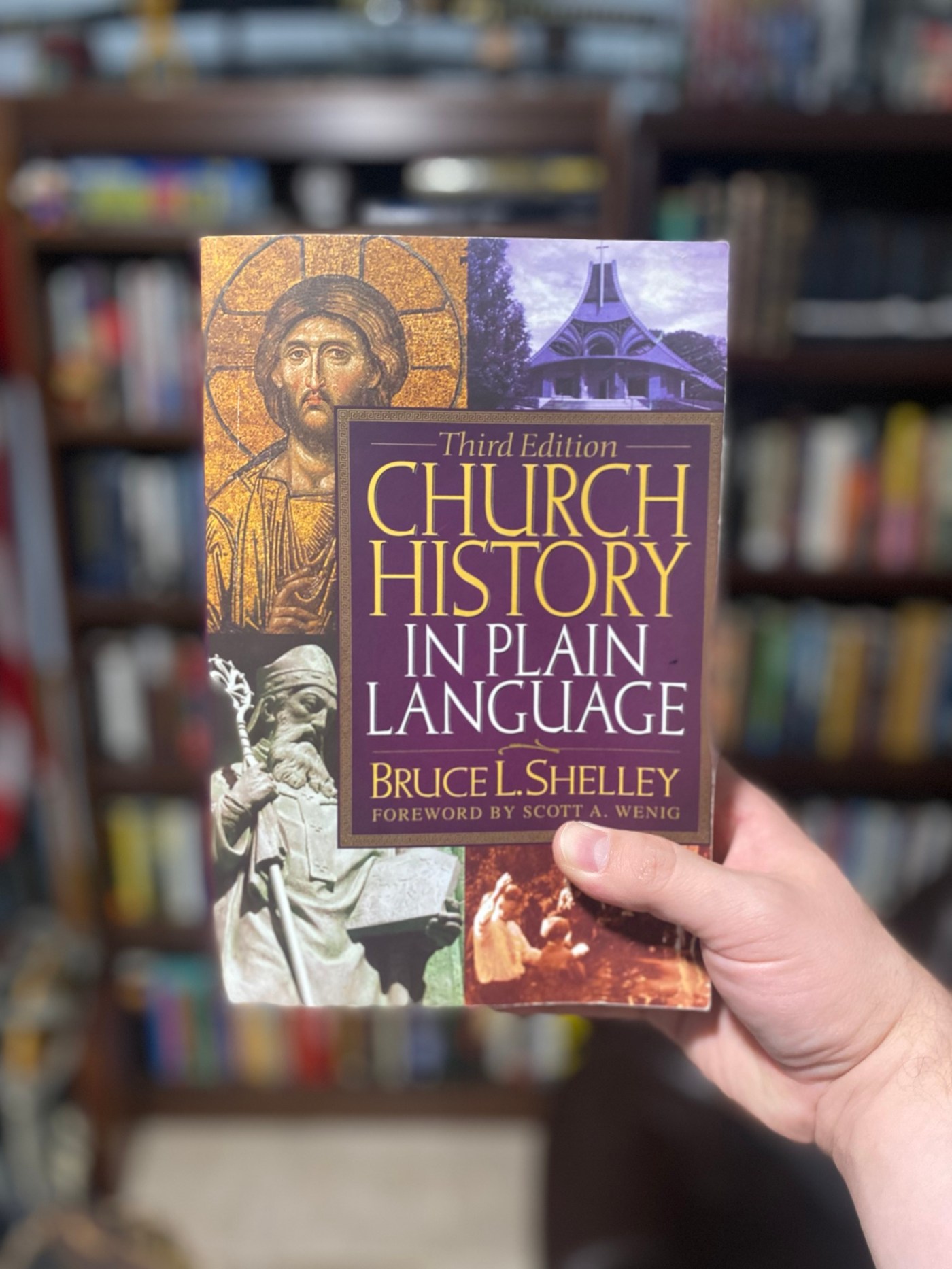
The book is Church History in Plain Language by Bruce Shelly. It was originally published in 2008 by Thomas Nelson books. I read the third paperback edition. I read it in June of 2024.
The title is accurate in that this book explains Christian Church history at a conversational level. It’s not too heady or academic. You don’t need a seminary degree to understand it. Very accessible but at 500 pages it’s very informative.
It takes you through the history of Christianity from Jesus and his apostles to current American evangelicalism.
I read this because I want to learn more about Church history. Too many Christians, including myself, are way too ignorant about our own history.
People think the Catholic church has a monopoly on Christian Church history. It doesn’t. Catholics take historical Church traditions like the doctrines of Mary and make it a divine doctrine. We can read through and learn Church history without taking everything our spiritual forefathers did as correct practices.
It’s rare that I can’t pinpoint where an author is coming from. But after reading Shelly, I really don’t know what his denomination is. I would guess protestant evangelical. But that’s it. He’s not liberal, and I’m pretty sure he’s not Catholic. But his tone stays neutral throughout the book. I didn’t feel like he had an agenda or heavy bias. I could tell he was a Christian but that’s about it.
My biggest takeaway from this book was learning how connected Christianity was to Judaism at the beginning. It was another denomination of Judaism just like Pharisee, or Sadducee. Until the Romans destroyed the temple. That’s when it became its own separate religion.
“In A.D. 70 Emperor Vespasian’s forces, led by Titus, broke through the walls of Jerusalem, looted and burned the temple, and carried off the spoils to Rome. The Holy City was totally destroyed. In the reprisals that followed, every synagogue in Palestine was burned to the ground.
“At the start of the revolt, the leaders of the Jerusalem church were advised in a vision to flee the city.” Pious Jews considered the Christian flight an act of treason, and it sealed the fate of the church in the Jewish world. With the decision to bar Christian Jews from synagogue services some years later, the break was complete. Any Jew who wished to remain faithful to his religion could not also be a Christian. The new faith had become and would remain a gentile movement. The old wineskin was irreparably torn.” (p23)
This book also answered questions I had about Church history. I’m very interested in turning points in history. How does Christianity go from persecution and being fed to lions to a bejeweled pope on a throne? I like seeing the throughline of change over time. This book explained those connections. For example, that particular question about shifting from persecution to political dominance. Apparently after Rome fell it was the Christians who were the only ones left standing after the dust settled. It was up to them to rebuild.
A lot of the clothing and pomp and circumstance that became Roman Catholic regalia came from the clothes the Romans wore before they fell. The Christians assumed the roles of government officials. That’s why there was no separation of Church and State, because there was no separation between pagan belief and Roman government. The emperor was seen as divine. Things like the pope being Christ’s vicar on earth and praying to a pantheon of saints and angels came more from the residue of pagan culture and customs than from Christian belief or scripture.
It was also fascinating to learn that the evolution of monks and monasteries came from more biblically minded Christians rebelling against the materialist pits that the popes and bishops had fallen into. It started with hermits following in the footsteps of John the Baptist wandering out into desert/cave hermit life.
This is noteworthy because another question I had was, were there no faithful true Christians during the height of Roman Catholicism? Apparently there was always a tension against the superstitious, materialist Roman Catholicism of the middle ages. Doug Wilson says that asking where true Christianity was during the height of Roman Catholicism, is like asking where your face was when was covered in mud.
I was pleasantly surprised that Shelley seemed to be a faithful Christian. He wasn’t cynical or biased in his perspective. I wasn’t familiar with him at all. Usually Church historians are liberal academics or Catholic zealots.
Reading this book made me want to read the other unread books that have been sitting on my shelf for years. What other gems have I been putting off?
The dates and places got a little confusing. But Shelly is a great writer so it wasn’t too difficult keeping up.
I’m so glad I read this book. I can’t believe it was sitting on my shelf for years and I was missing out. I’d definitely recommend this book to all Christians who want to learn more about church history. It’s extremely important.
****************************************************
Notable Quotables
Peter’s announcement of the resurrection was an astounding development. How could he ever substantiate such a claim? He appealed to the Jewish Scriptures, which said that the Messiah would not be abandoned in death but would be enthroned at God’s right hand until universal victory was his (Psalm 16:10 and 110:1).
From the beginning, then, the apostles preached the resurrection of Jesus as the fulfillment of God’s purpose announced in the Old Testament. (p15)
“”””
It was quite a beginning. Stephen knew the story well and Christians ever since have insisted that the death of Jesus on the cross, his resurrection from the grave, and the empowering mission of the Holy Spirit are the foundational realities of Christianity. The first forty years saw the infant church spread at a phenomenal rate. It sprang up in most of the major cities in the Roman Empire and was transformed from a tiny Jewish sect into a fellowship of many different peoples. (p16)
“”””
Although their central beliefs were based on the fertility cycle of nature, the mystery cults embraced a number of sophisticated ideas, including those of immortality, resurrection, and the struggle between good and evil. This superficial similarity to Christian belief was useful to Paul in explaining the message of Jesus to pagans. (p21)
“”””
In A.D. 70 Emperor Vespasian’s forces, led by Titus, broke through the walls of Jerusalem, looted and burned the temple, and carried off the spoils to Rome. The Holy City was totally destroyed. In the reprisals that followed, every synagogue in Palestine was burned to the ground.
“At the start of the revolt, the leaders of the Jerusalem church were advised in a vision to flee the city.” Pious Jews considered the Christian flight an act of treason, and it sealed the fate of the church in the Jewish world. With the decision to bar Christian Jews from synagogue services some years later, the break was complete. Any Jew who wished to remain faithful to his religion could not also be a Christian. The new faith had become and would remain a gentile movement. The old wineskin was irreparably torn. (p23)
“”””
We have no firm idea how Christianity first entered Britain. It may have been through some Roman soldier or merchant. All that we know for certain is that three bishops from Britain attended a church council at Arles in southern France in A.D. 314. Beyond this we have only imagination and hearsay. (p31)
“”””
Many people came to see that what the Stoics aimed for, the Christians produced. (p35)
“”””
The Christians, on the other hand, were always talking about their Jesus. They were out to make Christians of the entire population of the empire, and the rapidity of their spread showed that this was no idle dream. Not only did they, like the Jews, refuse to worship the emperor as a living god, but they were doing their utmost to convince every subject of the emperor to join them in their refusal. From time to time, then, Christians felt the wrath of the empire and its people. (p38)
“””””
A mason might be involved in building the walls of a heathen temple, a tailor in making robes for a heathen priest, an incense-maker in making incense for the heathen sacrifices. Tertullian even forbade a Christian to be a schoolteacher, because such teaching involved using textbooks that told the ancient stories of the gods and called for observing the religious festivals of the pagan year. (p40)
“”””
Christians were accused of atheism. The charge arose from the fact that many within the empire could not understand an imageless worship. Monotheism held no attraction for such people. As a result they blamed Christians for insulting the gods of the state. (p42)
“”””
Since the first Christians were all Jews, Christianity was never without a canon, or as we say, Scripture. (p 58)
“”””
The evidence seems to indicate that neither Jesus nor his apostles ever quoted from the Apocrypha as Scripture.
During Jesus’ life on earth they had the Word made flesh, and after Jesus departure they had the living leadership of the apostles. The reverence for the apostles’ message, whether oral or written, as the authentic channel to the will of the Lord Jesus, is reflected throughout early Christian literature.
During the days of the apostles congregations often read letters from the companions of the Lord. Some of these letters were obviously intended to be read in public worship, probably alongside some portion of the Old Testament or with some sermon.
Churches also relied on accounts about the life of the Lord Jesus. The first Gospels were not written before A.D. 60 or 70 but their contents were partly available in written form before this. Luke tells us that many had undertaken some account of the events of the life of Jesus. (p60)
“”””
Scripture and are truly the Word of God have about them a self-evidencing quality.
certain Christian books were added to Scripture because they were used in Christian worship.
The apostle Paul urged the Colossians: “After this letter has been read to you, see that it is also read in the church of the Laodiceans and that you in turn read the letter from Laodicea” (Col. 4:16, NIV). (p61)
“”””
It was not that the church had ceased to believe in the power of the Holy Spirit. The difference was that in the first days the Holy Spirit had enabled men to write the sacred books of the Christian faith; in the later days the
Holy Spirit enabled men to understand, to interpret, and to apply what had been written. (p66)
“”””
The first to accept repentant sinners as a matter of policy was the bishop of Rome. Callistus (217-222) readmitted penitent members who had committed adultery. He argued that the church is like Noah’s ark. In it unclean as well as clean beasts can be found. Then he defended his actions by insisting that the church of Rome was the heir of Peter and the Lord had given keys to Peter to bind and to loose the sins of men. This marks the first time a bishop of Rome claimed this special authority. (p74)
“””””
Prior to Constantine’s conversion, the church consisted of convinced believers. Now many came who were politically ambitious, religiously disinterested, and still half-rooted in paganism. This threatened to produce not only shallowness and permeation by pagan superstitions but also the secularization and misuse of religion for political purposes. (p96)
“”””
Edward Gibbon, in his memorable history of the fall of the Roman Empire, passed on a sneer that, in this struggle, Christians fought each other over a diphthong. Well, so it was—a diphthong. But that diphthong carried an immense meaning. In one of his books, William Hordern tells a story about a woman touring in Europe, who cabled her husband: “Have found wonderful bracelet. Price seventy-five thousand dollars. May I buy it?” The husband promptly cabled back, , “No, price too high.” The cable operator in transmitting the message, missed the signal for the comma. The woman received a message which read, “No price too high.” She bought the bracelet; the husband sued the company and won. (p104)
“”””
Whatever Constantine’s motives for adopting the Christian faith, the result was a decline in Christian commitment. The stalwart believers whom Diocletian killed were replaced by a mixed multitude of half-converted pagans. Once Christians had laid down their lives for the truth; now they slaughtered each other to secure the prizes of the church. Gregory of Nazianzus complained: “The chief seat is gained by evil doing, not by virtue; and the sees belong, not to the more worthy, but to the more powerful.” The hermit often fled, then, not so much from the world as from the world in the church. His protest of a corrupt institution led him into the dangers of a pronounced individualism. (p118)
“”””
Leo is a major figure in that process because he provides for the first time the biblical and theological bases of the papal claim. That is why it is misleading to speak of the papacy before his time.
The term pope itself is not crucial in the emergence of the doctrine of papal primacy. The title “papa” originally expressed the fatherly care of any and every bishop of his flock. It only began to be reserved for the bishop of Rome in the sixth century, long after the claim of primacy. (p133)
“”””
Irenaeus in the second century, referred to Peter and Paul as founders of the church in Rome and to subsequent bishops as successors of the apostles. These roots in the apostolic age were important in a day when gnostic teachers appealed to a secret tradition arising from Christ. Many catholic Christians felt that a list of bishops traced back to Peter and Paul was a sure means of safeguarding the apostolic message. (p134)
“””””
The year 476 usually marks the end of the Christian Roman Empire in the West. That is the year the long line of emperors inaugurated by Augustus (27 B.C. A.D. 14) ended, and the undisguised rule by German leaders began.
Who were these new masters of Europe? The Romans had called them “barbarians” because during early contact with the Romans they spoke no Greek and no Latin. But for the most part they were tribes from the north, originally in or near Scandinavia-Vandals, Franks, Angles, Saxons, Goths, Lombards, Burgundians, and others. (p153)
“”””
Terrified at the prospect of conquest by the advancing Huns, the Visigoths (or West Goths) petitioned the Romans to allow them to settle as allies inside the empire. Rome granted the request and in 376 the entire tribe crossed the Danube into Roman territory.
Theodosius I held back the Visigoths, but after his death in 395 they began to
migrate and pillage under their leader, Alaric. He invaded Italy, and in 410
his followers sacked Rome.
Burgundians settled in the Rhone valley, the Franks gradually spread across northern Gaul, and the Angles, Saxons, and Jutes invaded Britain. (p154)
“”””
converts brought with them into the church their superstitions and behavior.
This is evident in many instances, starting with Clovis himself. Jesus was for him a tribal war-god. The Franks especially admired Saint Peter, whose noblest exploit in their eyes was his eagerness to wield his sword to protect the Lord Jesus and to slice off the ear of the high priest’s servant. (p158)
“”””
Rome was a symbol of the continent. What we now call Europe arose than any other force, it was Christianity that brought life and order out of the chaos. (p163-164)
“”””
In medieval theory church and state were but two aspects of Christendom; the one representing Christian society organized to secure spiritual blessings, the other the same society united to safeguard justice and human welfare. Theoretically church and state were in harmonious interplay, each aiming to secure the good of mankind. (p177)
“”””
Innocent was like Gregory VII, however, in holding an exalted view of his office. “The successor of Peter,” he announced, , “is the Vicar of Christ: he has been established as a mediator between God and man, below God but beyond man; less than God but more than man; who shall judge all and be judged by no one. Innocent III told the princes of Europe that the papacy was like the sun, while kings were like the moon. As the moon received its light from the sun, so kings derived their powers from the pope. (p185)
“””””
The inception of the Crusades ignited horrible attacks against the Jews, and even fellow Christians were not exempt from rape and plunder. Incredible atrocities befell the Muslim foes. Crusaders sawed open dead bodies in search of gold, sometimes cooking and eating the flesh—a delicacy they found “better than spiced peacock,” as one chronicler chose to describe it. (p189)
“”””
If the primary purposes of the Crusades were to win the Holy Land, to check the advance of Islam, and to heal the schism between the Eastern and Western Churches, then the Crusades failed miserably. (p191)
“”””
The curriculum of the cathedral school was limited to grammar, rhetoric, logic, arithmetic, geometry, music, and astronomy-the seven liberal arts, so called because in ancient Rome their study had been reserved for liberi, “freemen.” (p196)
“”””
Aquinas made a clear distinction between philosophy and theology,
reason and revelation, but there is no contradiction between the two. Both are fountains of knowledge; both come from the same God
Reason, for example, can prove God’s existence. Accepting Aristotle’s principle every effect has a cause, every cause a prior cause, and so on back to the First Cause-Thomas declared that creation traces back to a divine First Cause, the Creator.
However, the full knowledge of God-the Trinity, for example-comes only through revelation. From this knowledge we discover man’s origin and destiny.
Christ won grace; the church imparts it. Aquinas taught that Christians need the constant infusion of “cooperating grace,” whereby the Christian virtues above all, love are stimulated in the soul. Assisted by this cooperating grace a Christian can do works that please God and gain special merit in God’s sight. (p200-201)
“”””
This saving grace, said Aquinas, comes to men exclusively through the channel of divinely appointed sacraments placed in the keeping of the church, the visible, organized Roman body, led by the pope. So convinced was Aquinas of the divine sanction of the papacy that he insisted that submission to the pope was necessary for salvation.
Following earlier scholar Peter Lombard, Aquinas held to seven sacraments: baptism, confirmation, the Lord’s Supper, penance, extreme unction, marriage, and ordination. (p202)
“”””
In one important respect Zwingli followed the Bible even more stringently than did Luther. The Wittenberger would allow whatever the Bible did not prohibit; Zwingli rejected whatever the Bible did not prescribe. For this reason the reformation in Zurich tended to strip away more traditiona symbols of the Roman church: candles, statues, music, and pictures. Later, in England, men called this spirit “Puritanism.” (p250)
“”””
While Calvin did not profess to know absolutely who were God’s chosen-—the elect-he believed that three tests constituted a good yardstick by which to judge who might be saved: participation in the two sacraments, Baptism and the Lord’s Supper; an upright moral life; and a public profession of the faith.
Man is not justified by works, yet no justified man is without works. (p261)
“”””
missionaries must always decide what heathenism is. Is it mankind stumbling in uncertain quest of the true God? Or is it humanity organized in hardened resistance to the gospel? Should the Christian ambassador seek the good in heathen religions and use this as a foundation for building a Christian community? Or should he suppressdestroy if necessary-all forms of heathen religion in order to plant the true faith? We can call one approach the policy of adaptation and the other the policy of conquest. (p280-281)
“”””
Their work met with remarkable success. In 1577 one Jesuit wrote optimistically, “In ten years all Japan will be Christian if we have enough missionaries,” Two years later the Jesuits did establish a new town as a home for Christian converts. They called it Nagasaki. (p287)
“”””
John Smyth, studied his Greek New Testament with unusual care and discovered that the practice of baptizIng babies never appeared in its pages. If babies were not included in the covenant of grace only mature believers in Jesus Christ-then shouldn’t churches be constituted by confession of faith rather than ties of covenants? Smyth and forty members of the Amsterdam congregation answered, , “yes,” and were baptized upon the profession of their personal faith in Jesus Christ. Thus, the first English Baptist church was born. The year was 1609. (p296)
“”””
Jacob Arminius (1560-1609), a Dutch professor who tried to modify the Calvinism of his time. Wesley felt no special debt to Arminius, but he did staunchly oppose Calvin’s doctrine of predestination. He thought the belief made God an arbitrary devil. He insisted that God willed the salvation of all men and that men had enough freedom of will to choose or refuse divine grace. (p338)
“”””
No one expressed the irony of liberalism better than H. Richard Niebuhr when he said in liberalism “a God without wrath brought men without sin into a kingdom without judgment through the ministrations of a Christ without a Cross.” (p395)
“””””
As we have seen, after the Civil War, Southern Evangelicalism was battered by defeat and a sense of hopelessness. Much of the Northern wing turned to premillennialism, the belief that Christ’s return was imminent and that society would inevitably get worse before it occurred. By the late 180os, the great evangelist Dwight L. Moody literally preached a lifeboat ethic: “I look on the world as a wrecked vessel. God has given me a lifeboat and said, ‘Save all you can.” Thus, many conservatives withdrew from the social arena. Evangelical historian Timothy Smith describes this as the Great Reversal.
The roots of fundamentalism lie in this surrender of social concern. In the 1880s and 1890s Bible study and personal holiness seemed more rewarding than the reform of American life.
While increased attention both to the end times and to personal Christian living had firm biblical roots, it also gave traditional evangelicals a way of maintaining their faith in a culture over which they were steadily losing control. If they could not shape the affairs of men, they could find comfort in the world of the spirit. (p432)
“”””
Darrow, at the height of his powers as a courtroom artist, confused and embarrassed the aging Bryan’s attempts to defend the biblical record. A press corps overwhelmingly hostile to Bryan’s point of view disgorged millions of words of coverage to a watching nation. The image of a sweatstreaked Bryan wilting before the searing rational assault from Darrow maintains its overrated and largely undeserved place as a symbol of the stupidity of Bible-believing American Christians. (p435)
 Solomon White
Leave a comment