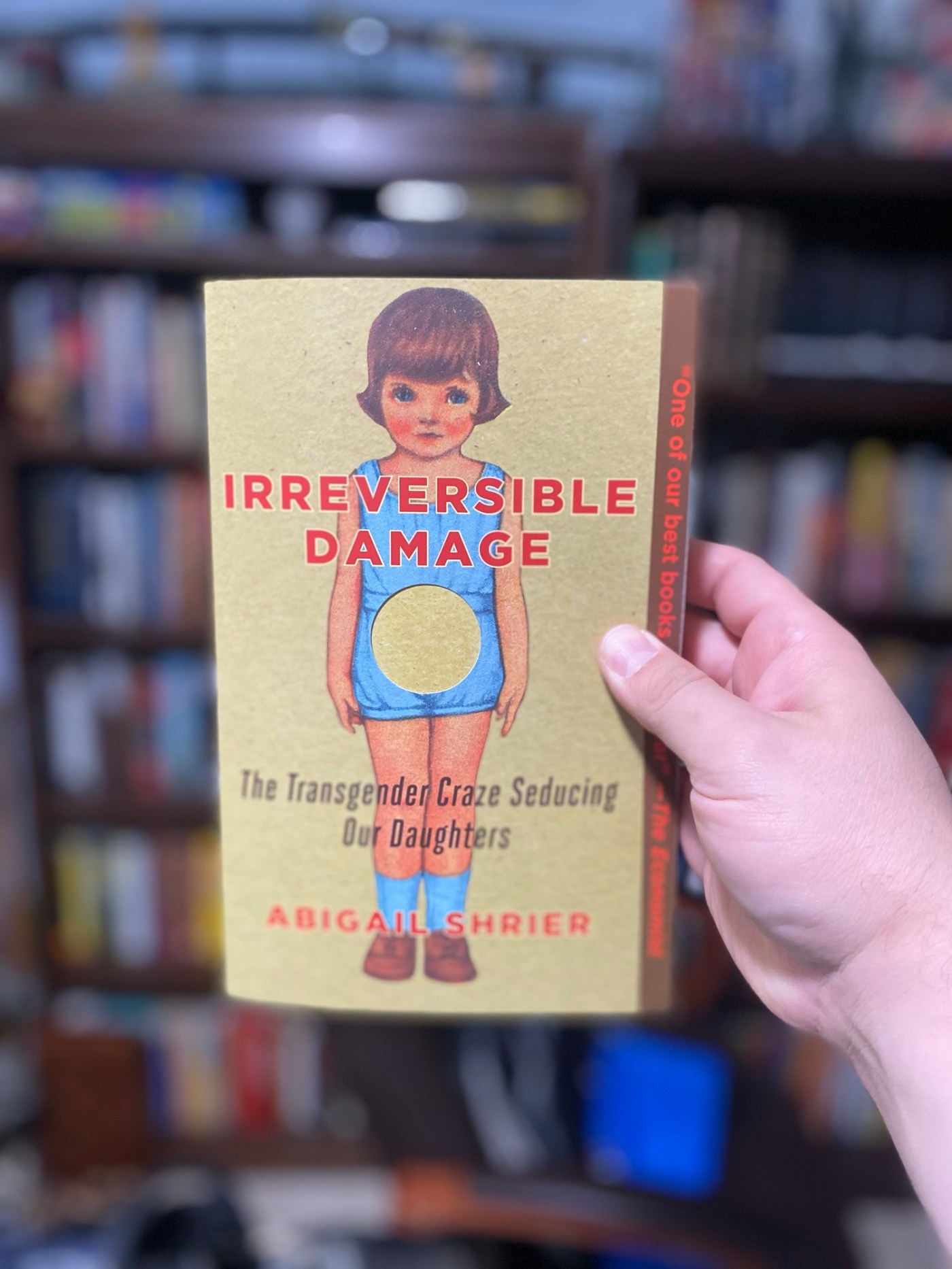
The book is Irreversible Damage by Abigail Shrier. It was originally published in 2020 by Regnery Publishing. I read the 2021 paperback edition. I read it in April of 2024.
The title refers to the irreversible damage that is being done right now to girls all over America. The subtitle is “The Transgender Craze Seducing Our Daughters.” Shrier focuses on girls and the transgender revolution that is convincing them to use drugs and surgery to turn themselves into boys.
I read this book because I want to understand our current culture. It’s important to understand what’s going on in our culture and to know how to engage with it with Christian answers. We have the light of truth and it must be shed on these dark corners of our society. I first heard about Abigail Shrier on Joe Rogan’s podcast in 2020. I’ve been wanting to read it ever since. Finally getting around to it.
In this book, Shrier does a deep dive investigation into the community of transgender girls in America. She’s researching where these girls come from, what sort of homes and families they are living in, and how they are being influenced towards transgenderism.
Not surprisingly, it is mostly happening online on social media. Essentially her research shows that these girls who are depressed or anxious are finding YouTubers and social media influencers who are transgender, load up on all the influencing content, and then they diagnose themselves with gender dysphoria.
And they are truly diagnosing themselves. They walk into doctor’s offices and just tell the doctor that they have gender dysphoria and the doctors rarely ever do anything to confirm that diagnoses for themselves. By most accounts, the doctors jump immediately to affirmation and prescription of hormones.
My main takeaway from this book is that the internet is a world and people are living there. If we’re not careful, our children will invest their hearts and minds into the influencing world of social media and it will win their hearts.
The common factor in all the stories of families losing their daughters to the transgender revolution is that the daughter had a place of deep influence that the parents had no idea about. And I get it. It’s getting harder and harder as more and more of our lives are lived online. Parents don’t know what we don’t know. You can talk to strangers on video games? That wasn’t a thing when we were little kids. But now it is and we have to be more aware of how and who is reaching our kids. And what are they telling them?
We must win our children’s hearts first. We’re pointing them to Christ and if we want our children to listen to us and value what we say, their hearts have to be with us.
In Richard D. Philips’ book The Masculine Mandate, he gives sage advice of how we can win our children’s hearts for the Lord. Work, Play, Read, Pray. From day one as fathers we must do these four things with our kids.
Work with them. Build something. Create something. Fix something. Do chores together. Work with them.
Play with them. Play games. Play outside. Play with their toys with them. Have fun with them.
Read to them when they’re very little. Teach them to read and read with them. Keep them in daily reading of the Bible and read the Bible to them with your family regularly.
Pray for them. Pray over them. Teach them to pray and pray with them.
Do these four things regularly. Work Play Read Pray. If we make these things normal rhythms and routines in our household as we raise our kids, then we will win their hearts. Then they’ll care what we have to teach them. They’ll follow us when we point them to God’s word and his will and ways.
This book made me think about how I’m going to raise my kids in the world of social media. When should we give them a smartphone? Should we give them a smart phone? What example am I showing them with how much I’m on my phone doom scrolling?
My kids are already obsessed with screens and video games. That’s mainly because we hardly ever let them have them. So are we creating the desire by prohibiting it too much? These are the concerns every parent faces and we have to figure it out.
Our approach so far has been balance. Right now they can only have screens if they’ve cleaned their rooms (their hardest chore to keep up with) and if they’ve done their daily Bible reading. And even then the screentime is limited. I know it will change as they grow especially when they start driving. We’ll cross those bridges when we get there.
Something that surprised me in Shrier’s book is that she’s completely fine with transgenderism in adults. It’s the classic libertarian view of “to each their own.” The dividing line seems to be consent. Kids can’t consent but adults can. Shrier feels that if an adult woman wants to transition to be a man then there is nothing wrong with that.
This is completely off-base. It’s the adult trannies that are influencing the kids to transition. She’s essentially saying, it’s okay to keep all the teachers as long as they don’t have any students. The queer adults will pursue the human penchant for progeny, but they can’t procreate in the bedroom so they’ll recreate in the classroom. And I don’t mean classroom literally. If you’re homeschooler is spending an inordinate amount of time on social media, then they’re being taught something by someone.
Other than that, this book is spot on. Shrier is a good writer and she’s done her research well. This is a real danger facing our kids. As parents we have to know the lives of our kids. Who are their friends? What are they watching and listening to? Who or what is winning their hearts? Whoever has their hearts is who they’re going to listen to.
I’d recommend this book to all parents, especially Christian parents to be informed of a cultural contagion that is out there. We have to inoculate our kids before they enter the world on their own.
****************************************************
Notable Quotables
“”””
The Salem witch trials of the seventeenth century are closer to the mark. So are the nervous disorders of the eighteenth century and the neurasthenia epidemic of the nineteenth century.’ Anorexia nervosa,? repressed memory, bulimia, and the cutting contagion in the twentieth. One protagonist has led them all, notorious for magnifying and spreading her own psychic pain: the adolescent girl. (pxxv)
“”””
They make little effort to adopt the stereotypical habits of men: They rarely buy a weight set, watch football, or ogle girls. If they cover themselves with tattoos, they prefer feminine ones—flowers or cartoon animals, the kind that mark them as something besides stereotypically male; they want to be seen as “queer,” definitely not as “cis men. ” They flee womanhood like a house on fire, their minds fixed on escape, not on any particular destination. (p7)
“”””
She began talking to her mother about gender identity. The conversations had a loose, hypothetical feel, and her parents had no idea her thoughts had anything to do with her time on the internet. (p20)
“”””
I wonder things I don’t say aloud, too: Whether this transgender craze isn’t partially the result of over-parented, coddled kids desperate to stake out territory for rebellion. Whether it is no coincidence that so many of these kids come from upper-middle-class white families, seeking cover in a minority identity? Or is it the fact that they overwhelmingly come from progressive /families—raised with few walls, they hunt for barriers to knock down? (p31)
“”””
Jett Taylor has a message: “True love is unconditional love. Love without restrictions. For you not to accept someone as they truly are—is you not truly loving them.”
Parents of suddenly trans-identifying teens beware: he’s talking about you. (p50)
“”””
Very often non-binary teens seem to resist playing your game or speaking your language. They want to topple the board, send the pieces flying, rewrite all the rules, eliminate rules altogether. They don’t want to “pass,” and they don’t want your categories. They are “genderfluid”-and reserve the right to change their minds.
It is worth noting that non-binary identity “affirmation” and surgeries threaten to dismantle the rationale for transgender body alterations in the first place. The underlying rationale for gender surgeries has always been that this is dysphoria-discomfort in a particular “wrongly sexed” body—not discomfort with both sexes or hatred of one’s body altogether. (p54)
“”””
“I think that society looks to schools—because we have access to children—to be able to address a lot of social issues.” School violence and school shootings are two examples she gave me. “Not that we’re replacing family. But things that used to be the exclusive domain of family or society, we’re now asking schools to look at those a little more intentionally.” (p61)
“”””
The proof is simply how bullying would be handled in any other context. If a Thai kid were being picked on because she arrived to school wearing a panung sash across her torso and those traditional® blousy pants, it’s inconceivable that the school board would mandate that every student learn the wai pressed-palms greeting. (p73)
“”””
The mothers had worked so hard to meet their daughters where they were—to share their fads and enthusiasms, from emo to anime. They embraced their daughters’ announcements of allegiance to atheism, communism, and their epiphanies about being gay. They needed their daughters to be happy and successful-and maybe, looking back, they needed this too much. (p88)
“”””
By the time they reached adolescence, self-focus and self-diagnosis had become an ingrained habit, a way to handle feelings that confused them. With the rest of the culture, they had been reared to participate in a therapy language game, in which everyone has some mental illness and the only question is what code to offer insurance. (p94)
“”””
Imagine we treated anorexics this way. Imagine a girl—5’6″ tall, 95 pounds—approaches her therapist and says: “I just know I’m fat. Please call me ‘Fatty.” Imagine the APA encouraged its doctors to “modify their understanding” of what constitutes “fat” to include this emaciated girl. Imagine the APA encouraged therapists to respond to such patients, “If you feel fat, then you are. I support your lived experience. Okay, Fatty?” (p99)
“”””
It’s a gun to the head: do as your kid says, or she just might take her own life. Again and again, I heard this question from gender therapists and also from parents to whom they had spoken: “Would you rather a dead daughter or a live son?” (p107)
“”””
In the case of gender dysphoric adolescents, the perception that a teen is “born in the wrong body” is the very reason for seeking therapy in the first place. It is the cause of distress. One would think that if there were any aspect of the patients’ assessment about which a therapist should maintain objective detachment, it would be the nature of the ailment that led the patients to seek therapy in the first place. (p115)
“”””
In order to justify the peculiar mandate that therapists immediately accept patients’ self-diagnosis when presented with someone claiming gender dysphoria, we must answer two questions: 1) Is the gender dysphoria causing the suicidal ideation? And 2) Do we have any evidence that affirmation ameliorates mental health problems? The answer to both questions, it seems, is no. (p117)
“”””
Many of the desisters and detransitioners believe that they were influenced by their peers to identify as transgender. Later, once peer influence subsided or their own sense of self matured, they realized that they weren’t actually transgender at all. (p119)
“”””
“I can’t think of any branch of medicine outside of cosmetic surgery where the patient makes the diagnosis and prescribes the treatment. This doesn’t exist. The doctor makes the diagnosis, the doctor prescribes the treatment. Somehow, by some word magic or word trickery, gender [activists] have somehow made this a political issue,” he says. (p131)
“”””
“If I work with someone who’s really suicidal because his wife left him, I don’t call the wife up and say: Hey, you just have to come back!’ That’s not the way we treat suicide, ” she said. “We don’t treat suicide by giving people exactly what they want. We treat suicide first of all by keeping people safe, and by helping them to become more resilient.” We ought to treat gender dysphoria that way, too. (p137-138)
“”””
But Dr. McHugh believes the transgender craze will likely end as the multiple personality craze did: in the courts, with patients suing their doctors. Some of these teenage girls, he says, “will wake up at age twenty-three, twenty-four, and say, ‘Here I am. I’ve got a five-o’clock shadow, I’m mutilated and I’m sterile, and I’m not what I ought to be. How did this happen?'” (p142)
“”””
So he wanted to be a woman. So what? What was so wrong with that? Americans couldn’t come up with a good answer. Maybe there isn’t one. Maybe, in the scheme of things, transgender is a great thing to be. (p150)
“”””
Postmodern queer theory regards experience as more valid than fact, she said, and her generation imbibes endless streams of this ideology from the internet. (p186)
“”””
This is the circular logic that pervades trans ideology: if you desist, you were never trans to begin with. Thus, no real transgender people ever desist. It’s an unfalsifiable proposition.
…How is it possible for any medical condition that every single person who walks in the door definitely has it?” (p192)
“”””
“There’s so much depression, self-harm, and drug abuse in the trans community. They’re all goddamn miserable. And it’s just like this misery fest. … I mean, there’s obviously the people who put up a face and act like ‘I’m super trans but I’m really happy about it, but even those people, once you talk to them, you see their lives are catastrophes.” (p200)
“”””
This notion that men have it easy may have occurred to Eve, who ate from the Tree of Knowledge only to be punished with labor pains and a domineering husband. Adam’s sin saddled him only with the burden of having to work for a living. (Big deal.) (p209)
“”””
Our true sexuality is not an identity we choose online, but a feeling of attraction that emerges and even evolves over time. Understanding it requires us to go into the world, to have in-person experiences with other people. (p213)
 Solomon White
Leave a comment