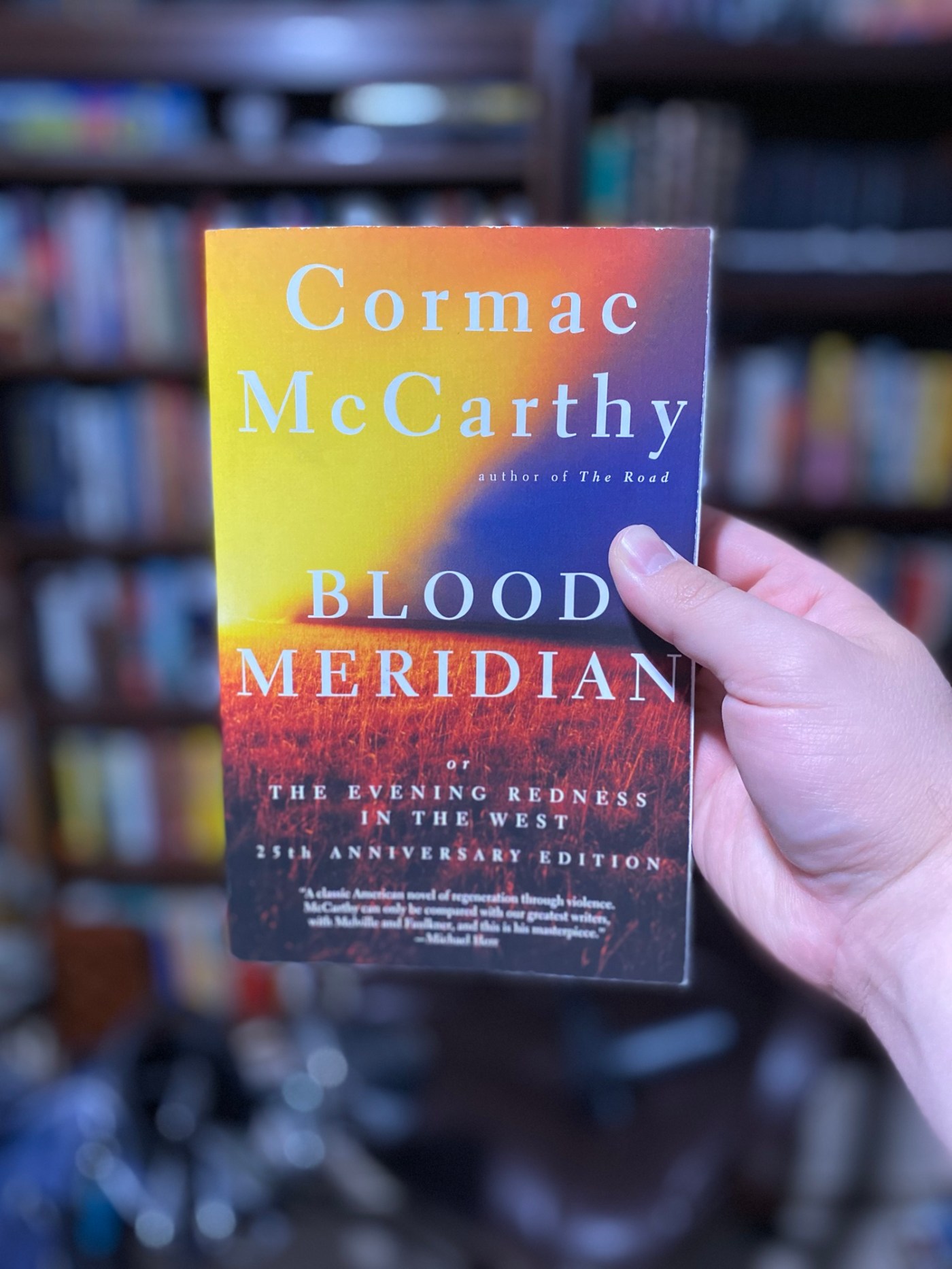
The book is Blood Meridian by Cormac McCarthy. It was originally published in 1985 by Penguin Random House. I read the Vintage International 1992 paperback edition. I read it in April of 2024.
The phrase blood meridian is never specifically mentioned, but there are allusions to it.
“The sun was just down and to the west lay reefs of bloodred clouds up out of which rose little desert nighthawks like fugitives from some great fire at the earth’s end.” (p23)
“Then about the meridian of that day we come upon the judge on his rock there in that wilderness by his single self.” (p131)
The title refers to the border between many things. A meridian being an imaginary dividing line. Between America and Mexico. Between good and evil. Between life and death. Between wasteland and civilization. And it’s covered in blood. The red blood seems to get into everything, the ground and even the sky. That’s the “Evening Redness in the West” from the subtitle.
I read this because I’m going through all of McCarthy’s bibliography and this was next. It’s his first Texas book. Before, they’ve all taken place in Tennessee.
In this novel McCarthy is commenting on good and evil. He does it in both a cosmic and grounded way.
It’s a gnostic message. The world and man are evil. But hopefully one day we can transcend into a spiritual world where there is good. The good is shown in just a glimmer. McCarthy makes you dig for it and that’s the point. The good does not come naturally. You have to work for it. It’s the same way the reader finds the beauty in his novels. It’s covered in layers of depravity and violence, but it’s there.
I had two main takeaways from this book. One is that the good, beautiful, and true things of civilization are forged in fire and baptized in blood.
All the progress and prosperity we take for granted in the civilized West did not just come naturally and peacefully. It was obtained through pain and suffering. McCarthy writes about this as an inevitable fact of life.
The second takeaway is that we as Christians do not wrestle enough with theodicy. The theological problem of evil.
McCarthy focuses heavily on a gnostic philosophy to deal with the problem of evil.
The Gnostics taught that the God of the old testament was actually an evil deity called the demi-urge. He blinded us and we have to figure out a secret knowledge to work our way out of this material world and transcend to the real good God.
The Gnostics see Jesus as a savior showing us how to get out of the demi-urge’s material world. There are bits of the real God within us but it’s been hidden from us and we have to receive the secret knowledge of how to transcend.
The Gnostics taught a radical dualism between the spiritual world of the good God and the material world of the evil demi-urge. This idea is very clear in all of McCarthy’s writings, most notably (as far as I’ve read) in The Road. There’s a theme of carrying the light in a dark world. Being the one good person, maybe the last good person in human existence. This is the gnostic idea of a secret knowledge of the “good God” that is within us all.
Aside from the heretical gnostic philosophy underlying this novel, the problem I take away as a biblically based orthodox Christian, is that we need to get a handle on the problem of evil and pain.
The main thing to wrestle with is the fact that God is not the author of evil, and yet is sovereign over evil. All things exist by his ordination and his will, including the bad things.
This is hard to deal with and I’d say the majority of Christians don’t believe that God is in control of evil. As such, most Christians unknowingly fall into a heretical Gnostic or dualist mindset. It’s because this issue isn’t discussed enough. We need to deal with this.
McCarthy’s answer is a gnostic philosophy. This world and all material is evil but there is a touch of godly goodness inside us, and we just need to uncover the secret knowledge and then we will be set free.
This book made me think about more seriously learning about Texas history. I live in San Antonio Texas, around where much of the novel takes place. I should know more about this area than I do. I should know more about the Alamo and Texas history than I do. Apparently the gang of scalpers in Blood Meridian, the Glanton Gang, was a real gang in Texas history. I want to learn more.
I was surprised at how layered this book is. Not only do I need to learn more about the gnostic philosophy but I need to read more literature like Paradise Lost. I’ve read Moby Dick which this novel alludes to, but there’s just so much more reading I need to do.
I’d recommend this book to readers with a strong stomach. It’s not for the faint of heart. A lot of shocking gore and violence. It’s a disurbing book. It actually gave me nightmares and I hardly ever get mentally or emotionally affected by a book like that. Truly great writing.
I’ll go ahead and say it’s my new favorite novel. It’s so beautifully written and it has set me on a path of further reading of history and literature. It’s an American masterpiece easily on par with Moby Dick.
****************************************************
Notable Quotables
“””
No. It’s a mystery. A man’s at odds to know his mind cause his mind is aught he has to know it with. He can know his heart, but he dont want to. Rightly so. Best not to look in there. It aint the heart of a creature that is bound in the way that God has set for it. You can find meanness in the least of creatures, but when God made man the devil was at his elbow. A creature that can do anything. Make a machine. And a machine to make the machine. And evil that can run itself a thousand years, no need to tend it. You believe that?
I dont know.
Believe that.
(p20)
“”””
The sun was just down and to the west lay reefs of bloodred clouds up out of which rose little desert nighthawks like fugitives from some great fire at the earth’s end. (p23)
“”””
There is no government in Mexico. Hell, there’s no God in Mexico. Never will be. We are dealing with a people manifestly incapable of governing themselves. (p36)
“”””
They followed the trampled ground left by the warparty and in the afternoon they came upon a mule that had failed and been lanced and left dead and then they came upon another. The way narrowed through rocks and by and by they came to a bush that was hung with dead babies. They stopped side by side, reeling in the heat. These small victims, seven, eight of them, had holes punched in their underjaws and were hung so by their throats from the broken stobs of a mesquite to stare eyeless at the naked sky. Bald and pale and bloated, larval to some unreckonable being. The castaways hobbled past, they looked back. (p60)
“”””
The judge like a great ponderous djinn stepped through the fire and the flames delivered him up as if he were in some way native to their element. (p101)
“”””
He looked up. Blood, he said. This country is give much blood. This Mexico. This is a thirsty country. The blood of a thousand Christs. Nothing.
He made a gesture toward the world beyond where all the land lay under darkness and all a great stained altarstone. (p108)
“”””
Then about the meridian of that day we come upon the judge on his rock there in that wilderness by his single self. (p131)
“”””
Where for aught any man knows lies the locality of hell. For the earth is a globe in the void and truth there’s no up nor down to it and there’s men in this company besides myself seen little cloven hoofprints in the stone clever as a little doe in her going but what little doe ever trod melted rock? I’d not go behind scripture but it may be that there has been sinners so notorious evil that the fires coughed em up again and I could well see in the long ago how it was little devils with their pitchforks had traversed that fiery vomit for to salvage back those souls that had by misadventure been spewed up from their damnation onto the outer shelves of the world. Aye. It’s a notion, no more. But someplace in the scheme of things this world must touch the other. And somethin put them little hooflet markings in the lava flow for I seen them there myself. (p136)
“”””
He had the pistols stuck in his belt at the back and he drew them one in each hand and he is as eitherhanded as a spider, he can write with both hands at a time and I’ve seen him to do it, and he commenced to kill indians. We needed no second invitation. God it was a butchery. (p140)
“”””
Then he sat with his hands cupped in his lap and he seemed much satisfied with the world, as if his counsel had been sought at its creation. (p146)
“”””
But no man can put all the world in a book.
…My book or some other book said the judge. What is to be deviates no jot from the book wherein it’s writ. How could it? It would be a false book and a false book is no book at all
…The judge smiled. Whether in my book or not, every man is tabernacled in every other and he in exchange and so on in an endless complexity of being and witness to the uttermost edge of the world. (p147)
“”””
They wandered the borderland for weeks seeking some sign of the Apache. Deployed upon that plain they moved in a constant elision, ordained agents of the actual dividing out the world which they encountered and leaving what had been and what would never be alike extinguished on the ground behind them. (p179)
“”””
Whatever exists, he said. Whatever in creation exists without my knowledge exists without my consent.
…A keeper. A keeper or overlord.
…Because he is a special kind of keeper. A suzerain rules even where there are other rulers. His authority countermands local judgements.
…The judge placed his hands on the ground. He looked at his inquisitor. This is my claim, he said. And yet everywhere upon it are pockets of autonomous life. Autonomous. In order for it to be mine nothing must be permitted to occur upon it save by my dispensation.
…The freedom of birds is an insult to me. (p207-208)
“”””
Among their barbarous hosts they had met with neither favor nor discrimination but had suffered and died impartially. (p237)
“”””
That night Glanton stared long into the embers of the fire. All about him his men were sleeping but much was changed. So many gone, defected or dead. The Delawares all slain. He watched the fire and if he saw portents there it was much the same to him. He would live to look upon the western sea and he was equal to whatever might follow for he was complete at every hour. Whether his history should run concomitant with men and nations, whether it should cease, He’d long forsworn all weighing of consequence and allowing as he did that men’s destinies are given yet he usurped to contain within him all that he would ever be in the world and all that the world would be to him and be his charter written in the urstone itself he claimed agency and said so and he’d drive the remorseless sun on to its final endarkenment as if he’d ordered it all ages since, before there were paths anywhere, before there were men or suns to go upon them. (p254)
“”””
war is the truest form of divination. It is the testing of one’s will and the will of another within that larger will which because it binds them is therefore forced to select. War is the ultimate game because war is at last a forcing of the unity of existence. War is god
Brown studied the judge. You’re crazy Holden. Crazy at last. The judge smiled
Might does not make right, said Irving. The man that wins in some combat is not vindicated morally.
Moral law is an invention of mankind for the disenfranchisement of the powerful in favor of the weak. Historical law subverts it at every turn. A moral view can never be proven right or wrong by any ultimate test. (p261)
“”””
he stepped into the river and seized up the drowning idiot, snatching it aloft by the heels like a great midwife and slapping it on the back to let the water out. A birth scene or a baptism or some ritual not yet inaugurated into any canon. (p270)
“”””
It was the judge and the imbecile. They were both of them naked and they neared through the desert dawn like beings of a mode little more than tangential to the world at large, their figures now quick with clarity and now fugitive in the strangeness of that same light. Like things whose very portent renders them ambiguous. Like things so charged with meaning that their forms are dimmed. The three at the well watched mutely this transit out of the breaking day and even though there was no longer any question as to what it was that approached yet none would name it. They lumbered on, the judge a pale pink beneath his tale of dust like something newly born, the imbecile much the darker, lurching together across the pan at the very extremes of exile like some scurrilous king stripped of his vestiture and driven together with his fool into the wilderness to die. (p294)
“”””
There’s a flawed place in the fabric of your heart. Do you think I could not know? You alone were mutinous. You alone reserved in your soul some corner of clemency for the heathen. (p312)
“”””
You sat in judgement on your own deeds. You put your own allowances before the judgements of history and you broke with the body of which you were pledged a part and poisoned it in all its enterprise. Hear me, man. I spoke in the desert for you and you only and you turned a deaf ear to me. If war is not holy man is nothing but antic clay. (p319)
“”””
Watching him across the layered smoke in the yellow light was the judge.
He was sitting at one of the tables. He wore a round hat with a narrow brim and he was among every kind of man, herder and bullwhacker and drover and freighter and miner and hunter and soldier and pedlar and gambler and drifter and drunkard and thief and he was among the dregs of the earth in beggary a thousand years and he was among the scapegrace scions of eastern dynasties and in all that motley assemblage he sat by them and yet alone as if he were some other sort of man entire and he seemed little changed or none in all these years. (p338)
“”””
A man seeks his own destiny and no other, said the judge. Will or nill.
The straight and the winding way are one and now that you are here what do the years count since last we two met together? Men’s memories are uncertain and the past that was differs little from the past that was not. He took up the tumbler the judge had poured and he drank and set it down again. He looked at the judge. I been everwhere, he said. This is just one more place.
The judge arched his brow. Did you post witnesses? he said. To report to you on the continuing existence of those places once you’d quit them?
That’s crazy.
Is it? Where is yesterday? Where is Glanton and Brown and where is the priest? (p344)
 Solomon White
Leave a comment