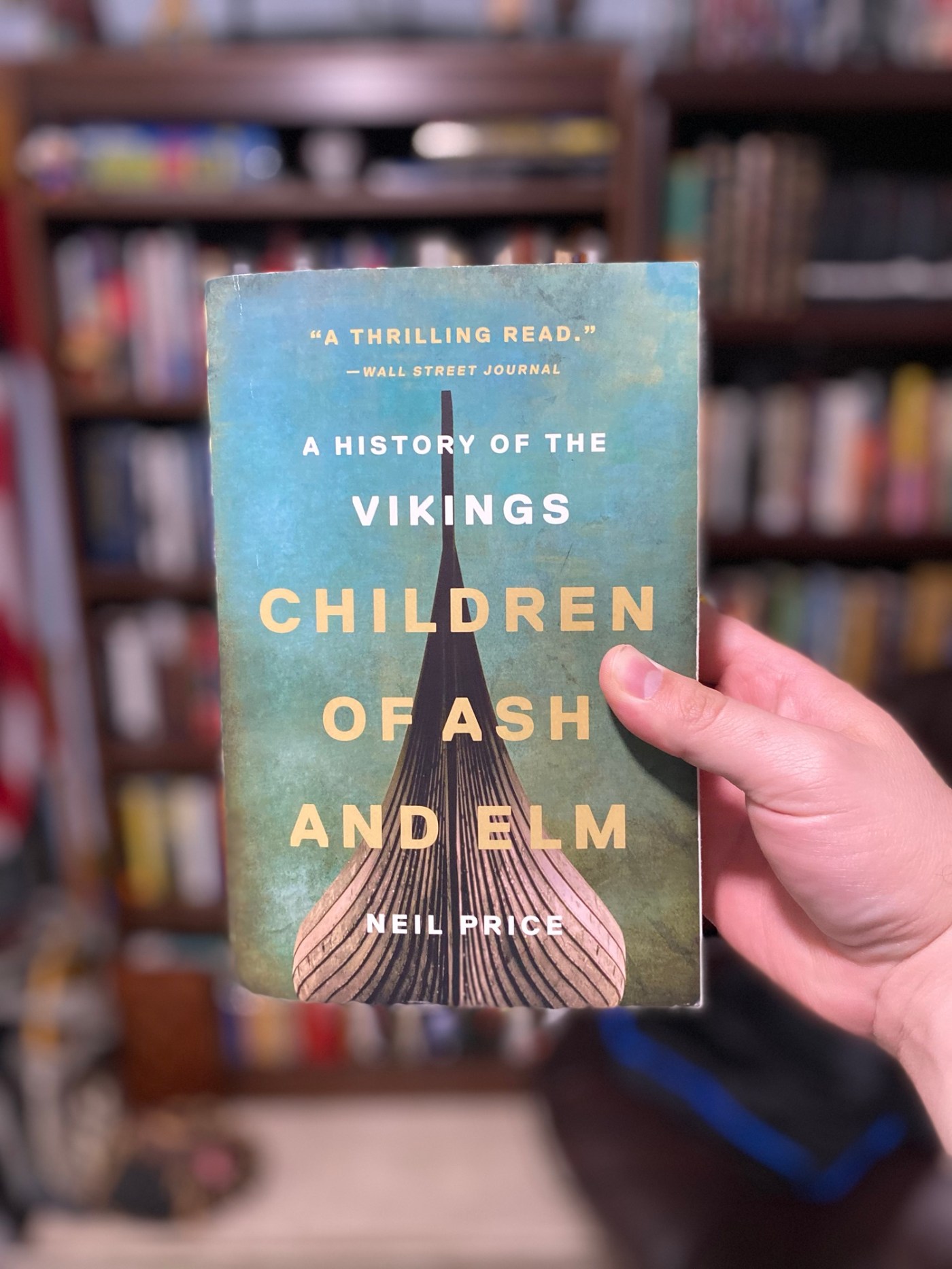
The book is Children of Ash and Elm by Neil Price. It was originally published by Basic Books in 2020. I read the 2022 paperback edition. I read it in February of 2024.
The title refers to the creation of the Viking people by the gods. “The man is Askr, the ash tree. The woman is Embla, the elm. (p2)” These are the Adam and Eve, if you will, of the Viking people.
The term Viking apparently is not really accurate. They would not have referred to themselves as Vikings.
“the word-vikingr in Old Norse when applied to a person-but they would not have recognized themselves or their times by that name. For them it would perhaps have meant something approximating to pirate’, defining an occupation or an activity (and probably a relatively marginal one); it was certainly not an identity for an entire culture.” (p7)
The word Viking was more of a verb like raider. They were raiders when they were raiding but only then.
I read this because I want to learn more about the medieval wars between the Christians and the pagans. I find this history analogous to our current time. The fight between Christians and non-Christians (pagans) is becoming more and more explicit. The lines are being drawn clearer every day between believers and non-believers. The history of the medieval Christians is inspiring and I want to learn more. So of course this would involve learning more about their Viking enemy.
Price is a very judgmental historian. He projects today’s cultural and moral standards onto the Vikings. He does not view the Vikings only in the time in which they lived. Historians should keep their subjects in the context of their time. Price does not always do this throughout the book.
He often leads to a modern judgement of the Vikings from today’s standards.
“Homophobic insults are employed so numerously in the sagas and poems, and are addressed so frequently in the laws that they must have been relatively common.” (p170)
The charge of homophobia is ridiculous because the personal identity of homosexual is a modern invention. In the time of the Vikings, homosexuality was not an orientation of your personhood, it was at most an activity in which you partook. It was merely something you did, not who you were. Price is deploying a high amount of chronological snobbery.
Price’s anachronistic writing doesn’t stop at judgment. He also tries to project current cultural norms onto the Vikings. He is desperate to make them queer. In one section he writes this.
“Perhaps the greatest potential for the recovery of Viking-Age queerness lies in the analysis of magic and its roles in Viking-Age society.” (p172)
Why is he trying to recover Viking-Age queerness? Queerness is a modern invention and he is desperately trying to find it in the Vikings. But it wouldn’t make any sense for him to find queerness in the Vikings because they were reprehensible oppressive people.
Price sees queerness as a perfectly acceptable identity and would applaud someone for expressing their queerness in their life because the alphabet people are seen as a victim oppressed class. But this was not the Vikings. The intersection of barbarous rapers and pillagers, and queer victim does not make sense. You cannot be an oppressor with a marginalized oppressed identity.
As a Christian I can judge the sins of the past and the sins of the present with the same standard. That standard is found in God’s Word and it does not change with the shifting sands of the culture. Slavery was wrong then and it’s wrong now. Raping was wrong then and is wrong now. Sodomy was wrong then and is wrong now.
Price has no such solid ground from which to cast judgment on the past or present. Even more, Price is not making an error that even other modern historians make. Other modern historians might look back without judgment and say something like “well, that was morally right back in their time. It’s wrong now but it was seen as right back then.”
This is also incorrect, but Price doesn’t even make that mistake. His mistake is adhering to the current false moral acceptability of queerness and then judging the Vikings for not also adhering to it and calling them homophobic. It’s really astonishing.
In another section, Price writes something that reveals more than he intended. In writing about how archeologists use DNA of buried Vikings to determine their sex (which he is quick to note “is reliable, though not certain”) he writes the following.
“This provides sex determination of male and female bodied individuals, but it is not at all the same as gendering them: this is beyond the reach of science.” (p175)
He says that gendering someone is “beyond the reach of science.” Of course he’s saying this in light of today’s gender queer revolution where we’ve arbitrarily decoupled sex from gender. But if gendering someone goes “beyond the reach of science,” then within what reach does it remain?
How should we determine gender? If not scientifically then within what realm should we investigate and determine gender? Psychology? No, we’ve left that behind in science. So then what do we have left? Religion.
What he’s saying is that gender has been jettisoned from the reach of natural science into the supernatural realm of religion and the spirit. It’s true that this is how gender and the alphabet queerness is seen today. Indeed the alphabet moniker includes “2S” which is a Native American personhood identity called “Two Spirit.” All of it can best be understood as an immaterial or spiritual aspect of yourself.
What would happen if a man said he is a woman and you asked him to prove it. Could he? He’s making a claim that he cannot prove empirically. To the ears of the empirical naturalist (which I assume Price is) that would sound like religious faith.
As a religious Christian I would say there are other realms besides material nature in which truth claims can be made and substantiated, ie. my soul, immaterial logic itself, and the necessary existence of God. But that’s me speaking as a religious Christian. My presuppositions allow me to go “beyond the reach of science.” I highly doubt Price has such presuppositional grounds to make such claims, and yet he’s doing so. This is very revealing of what the queer left really think about gender and what realm to find it.
I’ve heard Abigail Schrier say something to the effect of queerness being the new religion and gender is the soul. What other conclusions can we come to when Price says things like the truth of gender goes “beyond the reach of science.”
In comparing the Viking pagans with modern pagans, I found something very interesting. Price explains that Viking sorcerers were primarily women. And that the main tool they used was a metal pole.
“The main tool of the sorcerer was a metal staff that was probably held between the legs and rotated.” (p172)
What is the only modern context in which you’d find a woman ritualistically rotating a metal pole between her legs? A stripper.
There was and is a lot of sexuality in pagan magic. I don’t think much has changed in the realm of sin. Sexual lust is hypnotic. I believe it has powers of a demonic stronghold that has entranced many men into a snare. It sounds like the Vikings were just more straight forward about their supernatural dark powers but it seems they deploy them in much the same way today.
My main takeaway is that Neil Price is not a great historian. He has an agenda and that is to show that queerness and feminist thinking of our postmodern world today has been around for a long time. I’d say he failed in this attempt to make the Vikings like us. They weren’t, and thank God for the change that brought the West out of that dark paganism. Although as much of that darkness has simply taken a different shade, we still have work to do.
That being said I did learn a lot from this book. Price is honest about the atrocities of the Vikings. He’s a good writer if not a good historian. He keeps the reader captivated and interested in the subject.
I would recommend this book to Christians who want to learn more about this time period, and who can see through the queer propaganda. A pagan reconning is coming and it would do us good to learn more about the origins of the enemy.
****************************************************
Notable Quotables
“”””
Last of all, the gods give them names, their substance transformed into sound. The man is Askr, the ash tree. The woman is Embla, the elm. (p2)
“”””
the word-vikingr in Old Norse when applied to a person-but they would not have recognized themselves or their times by that name. For them it would perhaps have meant something approximating to pirate’, defining an occupation or an activity (and probably a relatively marginal one); it was certainly not an identity for an entire culture. (p7)
“”””
Their respective settlement histories stretch so deeply into the Stone Age past as to make any modern discussion of ‘who came first’ absurd. (p24)
“”””
His children are Freyja and Freyr, and their mother was Njörd’s own sister. In turn, they, too, were rumoured to be lovers as well as twin siblings. While open carnality was certainly a Vanir trait, the notion that it was a negative one may well be a Christian intervention in the sources. Freyja, in particular, was exactly the sort of sexually independent woman that terrified the Church. (p41)
“”””
It may be that this multiplicity of Norns is the truer Norse picture and that the idea of a primary trinity is influenced by classical models, perhaps filtered through Christian writers. (p52)
“”””
How marvelous, and how utterly subversive of the male-focused stereotype, that every single Viking man literally had a spirit-woman inside him. (p62)
“”””
When it comes to Viking food culture, somehow we still seem stuck with the tavern scenes of medieval movies, where everybody is roaring drunk or laughing heartily, tearing at hunks of meat with their teeth while a fight breaks out in the background. The reality was very different and included a varied and sophisticated cuisine.
Table manners were respected. Everybody in the Viking world carried a pocket knife—a small utilitarian item for everyday needs and especially for eating. (p117)
“”””
The grooves were probably coloured in with resin, visible as red lines across the teeth. A Viking grin would have been something to behold.
What it meant is another matter about which we can only speculate, but it does seem likely that dental modification was in some way reflective of a particular lifestyle and, perhaps, of achievements within it. (p125)
“”””
At first, the Revninge figure was almost universally described as female, and often as either a fertility goddess or a Valkyrie-the usual go-to clichés in the rush to label. But doubts soon crept in; in fact, there is little to indicate whether this individual is male, female, or beyond such binaries. (p129)
“”””
By definition, a slave-owner could not be charged with raping his own slave because, as property, she had no rights within his household, and her body was his to treat as he wished.
At least part of the Viking slave trade explicitly depended on sex trafficking, especially in the East. Settlements were specifically targeted for the enslavement of women, while their menfolk were often killed on the spot. Young women were transported long distances to be sold as sex slaves and were routinely assaulted by their captors along the way. (p145-146)
“”””
There is a sense of an outdoor realm for men, while women’s domain was inside the dwelling, but both these spheres were perceived as places of genuine power and authority. This distinction was not a literal one but instead referred to arenas of responsibility— thus ‘the house, in practice, meant the management of the entire farm, both economically and socially. A wide range of indoor and domestic tasks were also the province of women, including kitchen and food-related activities of all kinds, textile work (a major endeavour, as we have seen), and the daily round of agricultural life. None of this was devalued through patronising notions of women’s work’; by contrast, these were vital skills and activities in which ability carried respect. (p156-157)
“”””
In the Viking Age, homosexual men were treated with extreme disdain and a complex kind of moral horror, especially those who allowed themselves to be penetrated. Such a man was ragr, not only homosexual by inclination and action, but also inhabiting a state of being that extended to ethical and social qualities. This complex of concepts has been extensively studied, and in the words of its leading scholar, “the unmanly man is everything that a man should not be with regard to morals and character. He is effeminate and he is a coward, and consequently devoid of honour”.
Homophobic insults are employed so numerously in the sagas and poems, and are addressed so frequently in the laws that they must have been relatively common. (p170)
“”””
Perhaps the greatest potential for the recovery of Viking-Age queerness lies in the analysis of magic and its roles in Viking-Age society. Every level of communication between the community and the other powers was implicated in the practice of sorcery, which only women could acceptably perform. Men could and did practise magic, but at the cost of entering a state of ergi-becoming ragr and taking upon themselves its full freight of unmanly connotations. There is a broad terminology of male sorcerers, as for their female counterparts, but some of the words are derogatory. There are references to female animals (cows, mares, bitches, and so on)
The main tool of the sorcerer was a metal staff that was probably held between the legs and rotated. (p172)
“”””
These themes and connections can be pursued in the study of graves. Archaeologists determine the sex of the buried dead through analysis of their bones (which is reliable, though not certain) or DNA (which uses a chromosomal definition that is generally uncontroversial, although one should be aware that there are also other ways of making sex based on the genitalia or internal organs). This provides sex determination of male and female bodied individuals, but it is not at all the same as gendering them: this is beyond the reach of science. (p175)
“”””
At this point it is also appropriate to remember the distinctly porous border between the nature of humans and the nature of animals, manifested in the potentially shifting qualities of the hamr, the ‘shape’. Today we recognise and support LGBTQI+ identities, and try to extend that sensitivity to the people of the past, but it is thrilling to consider that the Viking mind went even beyond the boundaries of the human in this respect. (p179)
“”””
The girl is then held down on the bed beside the ten-day-old corpse of the chieftain, and raped by six of the dead man’s kinsmen. After this, while four of the men hold her arms and legs, the other two strangle her with a twisted veil. At the same time, the Angel of Death’ stabs her repeatedly between the ribs “in place after place”.
When the living have left the ship, the pyre is then lit by a naked man walking backwards around the vessel; (p250)
“”””
In practice, the Viking raiders were never a bolt from the blue, unknown barbarian sails on a North Sea horizon. Their victims had encountered Scandinavians many times before, but as traders rather than agents of chaos; the surprise was in the violence, not the contact. (p274)
“”””
There is no doubt that the berserkir were a Viking-Age reality, but almost every other aspect of their nature is open to interpretation. The word itself refers to a shirt (serk) with either a bear-or bareprefix, thus giving an image either of an ursine warrior or a man shirtless in the sense of being unarmoured or even naked That the bear connection may be the more relevant of the two is reinforced by a lupine counterpart to the berserkers in the form of the ulfheonar, meaning wolfskins. (p324)
“”””
There is no evidence whatsoever, in archaeology or text, for the berserkers’ use of hallucinogens, entheogens, or any other form of mind-altering drug or chemical, including the consumption of Ay agaric (despite the fact that Wikipedia’s entry for berserkers recommends the reader also look up ‘Dutch Courage’ and, indeed, ‘Going Postal’). (p326)
“”””
With renewed strength, in 871 the Vikings invaded Wessex itself, where they were reinforced by a second Viking fleet-the ‘Great Summer Army’, as the Chronicle calls it. King Aethelred of Wessex, and his young brother, Alfred, led the English levies in eight or nine battles with the Vikings over the following months, with neither side gaining the upper hand through a succession of defeats and victories. Three months after a Wessex triumph at Ashdown, Aethelred died, and Alfred was crowned. (p348)
“”””
There are also indications that not everyone was happy with the spread of the new faith. Several runestone texts incorporate invocations to Thor, and there is even an example where the usual central motif of the cross has been replaced with a large hammer: no doubt a deliberate response to Christian custom. (p463)
“”””
The killing of cattle seems to have come to an end at the same time as the adoption of Christianity, suggesting an obvious link between the introduction of the new faith and the decline of such public pagan events (even if non-Christian rites continued behind closed doors for a time). (p481)
“”””
Excavation of a grave in the Western Settlement of Greenland has revealed a man who died as a result of an arrow wound; the tip was still embedded in his body and was of First Nations manufacture. He had presumably been shot over there but made it home before succumbing to his injury. In another Greenland grave, traces have been found of a robe made from the hide of a North American buffalo — a species native to the plains. (p492)
 Solomon White
Leave a comment