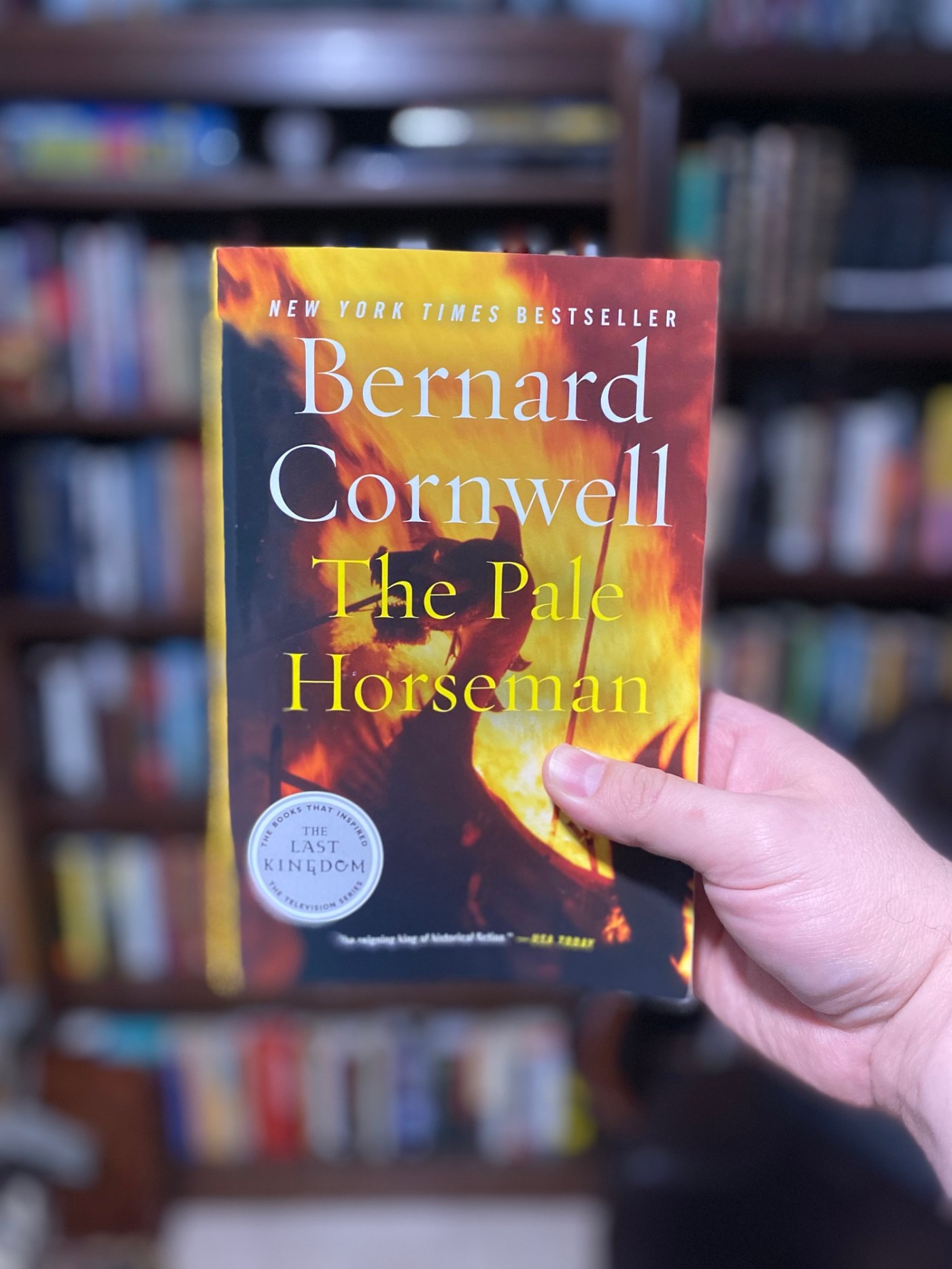
The book is The Pale Horseman by Bernard Cornwell. It was originally published in 2006 by Harper Collins. I read the 2007 paperback edition. I read it in January of 2024.
The title refers to a Viking character named Svein. He’s the main villain of this installment of Cornwell’s Last Kingdom series.
I’m reading this book series because I saw the TV show on Netflix. The show was great and the books are too. The books are definitely more historical and serious than the show which I like. The show got too entertainment-ish. Like a Marvel movie. Maybe this pinpoints the difference between reading a book and watching a movie. Attention span is different. But the book is not always better than the movie. I love the Shining movie way more than the book. Also the movie Wanted was better than the comic.
As with all these books, Cornwell does a fantastic job of setting the historical scene of the wars between the pagan Vikings and the Christian Anglo Saxons. What gets highlighted in this book is how Alfred the Great’s kingdom of Wessex gets reduced to a few dozen people hiding out in a marsh. Alfred was the one with the singular vision of uniting the Christian people into one nation called England.
It is absolutely incredible and inspiring to learn about the vision and drive that Alfred the Great had for a creating a Christian nation. He would not see it accomplished in his lifetime. But that’s even more incredible because it means he was not only able to maintain the vision for himself but was able to pass down that dream to his children and grandchildren. And they cared about seeing it through. It would have been easier in many cases for Alfred’s ancestors to just give up on the dream. But they fought. They fought for Alfred’s England. At a certain point the incredibleness of how England was formed goes beyond what is reasonably acceptable to be attributed to human will or effort. It crosses into the realm of a miracle.
Cornwell writes this in an epilogue.
“For a few months in early 878 the idea of England, its culture and language, were reduced to a few square miles of swamp. One more defeat and there would probably never have been a political entity called England. We might have had a Daneland instead, and this novel would probably have been written in Danish. Yet Alfred survived, he won, and that is why history awarded him the honorific “the Great.” (p349)
This was my main takeaway. Cornwell is a good writer and the history is amazing to learn. But to think of how close the Christian West came to being blotted out but lived on and thrived and conquered is so encouraging and inspiring.
It’s inspiring because (if I may be so bold) kingdom building is the work in which I’m interested.
Our family verse is Matthew 6:33 “But seek first the kingdom of God and his righteousness, and all these things will be added to you.” I am seeking the kingdom and doing what I can in my own small way to redeem this world for Christ. My family, my home, my church, my work. I’m doing what I can to bring these things under the lordship and sovereignty of Christ. Alfred is an historical inspiration for this type of effort.
There was a section that raised a big question for me. Uhtred asks Alfred to burn him on pyre in a pagan funeral if he dies, and Alfred agrees.
“If you can,” I said, “don’t bury me. Burn my body on a pyre, and put a sword in my hand.”
He hesitated, then nodded, knowing he had agreed to a pagan funeral. “I never told you,” he said, “that I am sorry about your son.” (p279)
The question this raised for me is, is it okay for Christians to support non-Christians in their false religions? For example, if a Christian and a Muslim become friends, should the Christian remind the Muslim to say his prayers?
Another example I remember from the Last Kingdom show is when a Viking was dying and his Christian friend put a sword in the dying pagan’s hand because they believe that this is how to enter Valhalla. Was that right for the Christian to do? It’s played as compassionate in the story, but is it?
In the quoted section above, Uhtred knows that Alfred does not believe in pagan pyres but he appreciates the gesture. Is that what it’s about, the human-to-human compassion? Is there such thing as human-to-human compassion out of the context of God’s truth? I don’t know how to answer this question but my feeling is no.
The names definitely got confusing. I know I’m not racist because a lot of the white Danes and Saxons look so familiar in the show and I forget who is who sometimes.
The tone of the book feels foreboding. The dread of the vicious Danes is felt throughout. It felt hopeless at times.
I think I’ve said it before but Alfred the Great is one of the best heroes in history to try and emulate. To be so driven by one singular vision and goal in life, you can’t help but be inspired.
The villains to avoid are of course the pagan Danes. But there are backstabbing traitors and villains amongst the Saxons as well. Humans are humans and that’s expressed well in Cornwell’s characters. They are complex and multidimensional.
I’d like to avoid saying something as cliché as “Cornwell makes history come alive.” But sometimes the cliches work. Cornwell puts in you the world of the Vikings and Christians. It’s a historical fiction book that reads like a fantasy thriller. I’ve really enjoyed reading these so far. I’d recommend them to fantasy fans who want a little more substance to what they’re reading.
****************************************************
Notable Quotables
“””
“They’re pagans! My son won’t grow up a pagan!”
“He’s my son, too,” I said, “and he will worship the gods I worship.” (p28)
“”””
The Danes could always remove the dragon or beast heads from the bows and sterns of their ships because they did not want the horrid-looking creatures to frighten the spirits of friendly lands and so they only displayed the carved monsters when they were in enemy waters. (p39)
“”””
none of us knew how to find Callyn, whom we later learned was King Callyn, which did not mean much, for any man with a following of more than fifty armed men called himself a king in Cornwalum, (p48)
“”””
They have made her into a”—he paused, not knowing the Danish word-“a gwrach,” he said, a word that meant nothing to me. “Dewines,” he said irritably and, when I still showed incomprehension, he at last found a word. “A sorceress.”
“A witch?”
“And Peredur married her. Made her his shadow queen. That is what kings did with such girls. They take them into their households so they may use their power.” (p55)
“”””
The Britons have never learned to love the Saxons. Indeed they hate us, and in those years when the last English kingdom was on the edge of destruction, they could have tipped the balance by joining Guthrum.
the Britons might have taken back much of their lost lands if they had allied themselves with the pagan Northmen. Religion makes strange bedfellows. (p57)
“”””
Shadow queens were valued among the Britons for they were part of the old mysteries, the powers that had brooded over the land before the monks arrived, (p76-77)
“”””
“Svein of the White Horse did this,” they were told, and made to repeat the words. It was a Danish custom to leave some witnesses to their horror, so that the tales would spread fear and make cowards of other folk who might be attacked, (p86)
“”””
I paid a man from Exanceaster to carve the doorposts and lintels with writhing wolves, for the banner of Bebbanburg, my banner, is a wolf’s head. Mildrith wanted the carving to show saints, but she got wolves. (p88)
“”””
A trial relied heavily on oaths, but both sides would bring as many liars as they could muster, and judgment usually went to the better liars or, if both sides were equally convincing, to the side who had the sympathy of the onlookers. (p98)
“”””
To be called a coward and a liar is to be invited to do battle, (p112)
“”””
Saxon people gathered under one king. A king of Wessex. Alfred’s piety hid a monstrous ambition. (p121)
“”””
“And men would have called me a coward,” I said. And that, too, was the truth, that a man cannot step back from a fight and stay a man. (p124)
“”””
Go into battle without anger and hate and you’ll be dead. You need all the blades, anger, and hate you can muster if we’re to survive.” (p157)
“”””
Thegns were noblemen, men of property, men who could bring scores of well-armed followers to a fight, and every shire had its thegns who ranked just below the reeve and ealdorman, who were themselves thegns. Thegns were the power of Wessex, (p188)
“”””
There is such joy in chaos. Stow all the world’s evils behind a door and tell men that they must never, ever, open the door, and it will be opened because there is pure joy in destruction. (p222)
“”””
Steapa was silent until, in a river meadow, we rode past a ring of stone pillars, one of the mysteries left behind by the old people. Such rings stand all across England and some are huge, though this one was a mere score of lichen-covered stones, none taller than a man, standing in a circle some fifteen paces wide. Steapa glanced at them, then astonished me by speaking. “That’s a wedding,” he said.
“A wedding?”
“They were dancing,” he growled, “and the devil turned them to stone.”
“Why did the devil do that?” I asked cautiously.
“Because they wed on a Sunday, of course. Folk never should wed on a Sunday, never! Everyone knows that.” We rode on in silence, (p242)
“”””
Alfred had given me a scrap of parchment on which he had written words commanding Odda to greet me peaceably, but what force did writing have against hatred? (p245)
“”””
I could not cope with Mildrith crying or with the thought of a dead son. Such things are difficult, much more difficult than making war, and so I buckled on my swords, picked up my shield, and put on my splendid wolf-crested helmet (p255)
“”””
Yet there was more than mere pride making me fight in the hall that day. There was a belief, deep in my soul, that somehow Alfred would survive. I did not like him, I did not like his god, but I believed fate was on his side. (p263)
“”””
“Life is simple,” I said. “Ale, women, sword, and reputation. Nothing else matters.” (p278)
“”””
“If you can,” I said, “don’t bury me. Burn my body on a pyre, and put a sword in my hand.”
He hesitated, then nodded, knowing he had agreed to a pagan funeral. “I never told you,” he said, “that I am sorry about your son.” (p279)
“”””
She was also instructed to take with her whatever books she could find in Scireburnan, for Alfred reckoned the Danes would burn every book in Wessex and so Alswith was to rescue the gospel books and saints’ lives and church fathers and histories and philosophers and thus raise her son Edward to become a learned king in exile. (p281)
“”””
We had to fight, because to decline battle was a defeat. (p303)
“”””
For a few months in early 878 the idea of England, its culture and language, were reduced to a few square miles of swamp. One more defeat and there would probably never have been a political entity called England. We might have had a Daneland instead, and this novel would probably have been written in Danish. Yet Alfred survived, he won, and that is why history awarded him the honorific “the Great.” (p349)
 Solomon White
Leave a comment