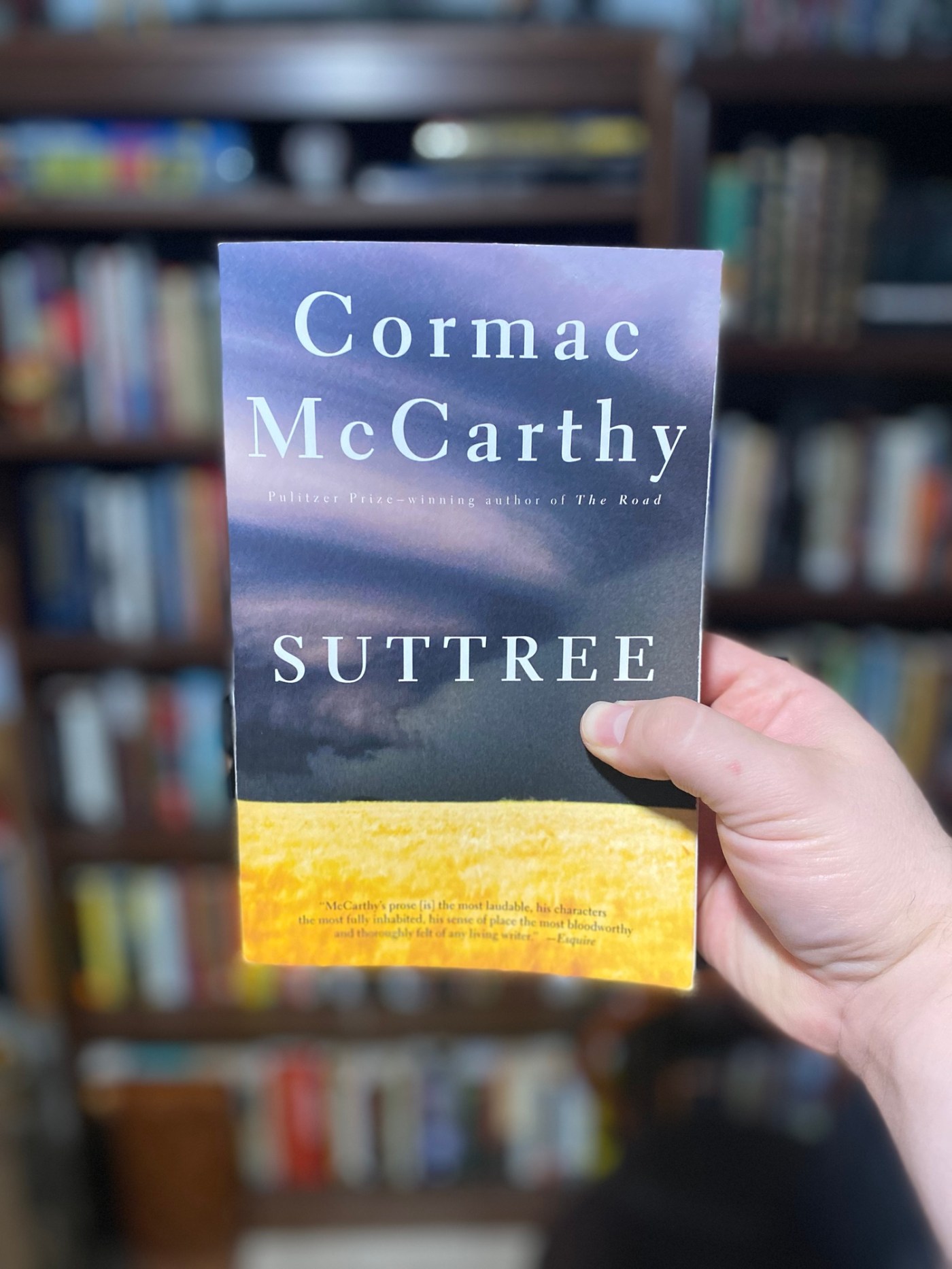
The book is Suttree by Cormac McCarthy. It was originally published by Random House in 1979. I read the paperback edition. I read it in January of 2024.
The title refers to the main character Cornelius Suttree. He’s a man who lives in Knoxville Tennessee. He lives on a little house boat on the river as a fisherman. He came from money and had a wife and baby, but he left them all to live as a drifter fisherman/street person in Knoxville. Real piece of shit.
I read this because I’m reading through all of Cormac McCarthy’s novels in publication order. Next is Blood Meridian.
I have no idea what McCarthy is trying to say in this novel. He says so much with so few words. It’s confusing but beautiful.
What I really like about McCarthy is how he describes things. His vocabulary is off the charts. His exposition is otherworldly. It’s a little spiritual. But his work is not supernatural. Characters have visions or hallucinations, but there is not really anything obviously supernatural.
This novel made me think of the hopelessness of small towns. I don’t know much about Knoxville but it seems like a small town in this book with a lot of drifters and lowlifes. Suttree seems to prefer suffering with the dregs of humanity rather than living the wealthy life he was born into.
But then when he inherits a sizable bit of money he spends it on drinks and partying. He first wads up the check and throws it away which fits with his character. But then he says fuck it, and spends it all. This is surprising because it would seem to be a point of pride to throw away inheritance money. That seems to be a defining characteristic for him. But then he spends it. Is it because misusing money is more spiteful than not using the money?
I would say Suttree is free, but it’s a pretty miserable existence. He almost freezes to death one winter. He’s frequently getting beat up or thrown in jail.
In one way it’s the classic “rebel without a cause” story. The life he is born into is comfortable and privileged , but he sees the hypocrisy of this wealthy family and chooses to run away and live with the poor and real people who are living more authentically. But the street people in Knoxville are bigger assholes than the rich people. They are more real but they are in no way morally superior. Yet this is where Suttree chooses to live. Is he afraid of failing? So he just chooses to live as a failure so he can’t fail?
McCarthy isn’t trying to tell the reader anything. He’s just showing a very real depiction of the lives of “river rats” in the streets of Knoxville.
There is some dialogue about all souls being one and that’s shown in the street people of Knoxville. But then one of his profound insights is this. “I learned that there is one Suttree and one Suttree only,”
Suttree does stand out as an individual and he seems to have a philosophical arrogance. Like he has seen behind the curtain and knows the truth. I hate these kind of characters. The tortured genius. The character who is miserable because he just understands too much. If you were as smart as him you’d be just as miserable. If you’re happy it’s because you’re ignorant and naïve. That kind of character is annoying.
But Suttree is holding on just a little bit. He says he is “not unhappy.” A lot of the drama happens around him. He doesn’t do the worst or best things in the novel. He’s a conduit through which the reader can get a glimpse of the river rat street life of Knoxville. And the genius of McCarthy is the Suttree seems to know he’s a conduit for the reader or some other cosmic watcher. It doesn’t get meta or anything corny like that. But it’s almost like Suttree knows he’s being watched. Maybe he wants to be a watcher. I can’t put my finger on it. But that’s another great thing about McCarthy’s writing. He doesn’t provide answers even to his own questions he raises in his books. See the notable quotables below for examples.
There were no heroes to emulate. Everyone is pretty shitty. Not really any villains either. The characters are way too complex for that kind of categorization.
McCarthy is always a pure joy to read. He is challenging. He doesn’t give the reader anything. You have to pay attention. I’d recommend this to readers who like reading for the sake of reading. It’s not a plot book at all. But it’s the best writing.
****************************************************
Notable Quotables
“”””
Suttree coming up out of this hot and funky netherworld attended by gospel music. Dusky throats tilted and veined like the welted flanks of horses. He has watched them summer nights, a pale pagan sat on the curb without. One rainy night nearby he heard news in his toothfillings, music softly. He was stayed in a peace that drained his mind, for even a false adumbration of the world of the spirit is better than none at all. (p21)
“”””
Between the mad hag’s face and this young girl a vague stellar drift, the wheeling of planets on their ether trunnions. Likenesses of lost souls haunt us from old chromos and tintypes brown with age. Bloodless skull and dry white hair, matriarchal meat drawn lean and dry on frail bone, a bitter refund ashen among silk and lilies by candlelight in a cold hall, black lacquered bier on sawhorses wound with crepe. I would not cry. My sisters cried. (p130)
“”””
What deity in the realms of dementia, what rabid god decocted out of the smoking lobes of hydrophobia could have devised a keeping place for souls so poor as is this flesh. This mawky wormbent tabernacle. (p130)
“”””
Suttree held his face in his hands. Child of darkness and familiar of small dooms. (p149)
“”””
Inside there is nothing. No bones, no dust. How surely are the dead beyond death. Death is what the living carry with them. A state of dread, like some uncanny foretaste of a bitter memory. But the dead do not remember and nothingness is not a curse. Far from it. (p153)
“”””
Were you in terror, did you know? Could you feel the claw that claimed you? And who is this fool kneeling over your bones, choked with bitterness? And what could a child know of the darkness of God’s plan? Or how flesh is so frail it is hardly more than a dream. (p154)
“”””
You told me once you believed in God.
The old man waved his hand. Maybe, he said. I got no reason to think he believes in me. Oh I’d like to see him for a minute if I could.
What would you say to him?
Well, I think I’d just tell him. I’d say: Wait a minute. Wait just one minute before you start in on me. Before you say anything, there’s just one thing I’d like to know. And he’ll say: What’s that? And then I’m goin to ast him: What did you have me in that crapgame down there for anyway? I couldnt put any part of it together. Suttree smiled. What do you think he’ll say? The ragpicker spat and wiped his mouth. I dont believe he can answer it, he said. I dont believe there is an answer. (p258)
“”””
With the change he bought a candy bar and he sat alone on a bench in the empty waiting room in his blanket eating the candy in micesized bites and reading from a black leatherette copy of the Book of Mormon he found in a pamphlet rack. The candy he managed to get down but the words of the book swam off the page eerily and he thought he’d never read a stranger tale. (p294)
“”””
A dark hand had scooped the spirit from his breast and a cold wind circled in the hollow there. He sat up. Even the community of the dead had disbanded into ashes, those shapes wheeling in the earth’s crust through a nameless ether no more men than were the ruins of any other thing once living. Suttree felt the terror coming through the walls. He was seized with a thing he’d never known, a sudden understanding of the mathematical certainty of death. He felt his heart pumping down there under the palm of his hand. Who tells it so? Could a whole man not author his own death with a thought? Shut down the ventricle like the closing of an eye? (p295)
“”””
Suttree moved down to the gravelbar on the river and spread his blanket there under the gauzy starwash and lay naked with his back pressed to the wheeling earth.
The enormity of the universe filled him with a strange sweet woe. (p353)
“”””
Suttree stood among the screaming leaves and called the lightning down. It cracked and boomed about and he pointed out the darkened heart within him and cried for light. If there be any art in the weathers of this earth. Or char these bones to coal. If you can, if you can. A blackened rag in the rain.
He sat with his back to a tree and watched the storm move on over the city. Am I a monster, are there monsters in me? (p366)
“”””
A clear night over south Knoxville. The lights of the bridge bobbed in the river among the small and darkly cobbled isomers of distant constellations. Tilting back in his chair he framed questions for the quaking ovoid of lamplight on the ceiling to pose to him: Supposing there be any soul to listen and you died tonight?
They’d listen to my death.
No final word?
Last words are only words.
You can tell me, paradigm of your own sinister genesis construed by a flame in a glass bell.
I’d say I was not unhappy.
You have nothing.
It may be the last shall be first.
Do you believe that?
No.
What do you believe?
I believe that the last and the first suffer equally. Pari passu.
Equally?
It is not alone in the dark of death that all souls are one soul.
Of what would you repent?
Nothing.
Nothing!
One thing. I spoke with bitterness about my life and I said that I would take my own part against the slander of oblivion and against the monstrous facelessness of it and that I would stand a stone in the very void where all would read my name. Of that vanity I recant all. (p414)
“”””
He lay with his feet together and his arms at his sides like a dead king on an altar. He rocked in the swells, floating like the first germ of life adrift on the earth’s cooling seas, formless macule of plasm trapped in a vapor drop and all creation yet to come. (p430)
“”””
I was drunk, cried Suttree. Seized in a vision of the archetypal patriarch himself unlocking with enormous keys the gates of Hades. A floodtide of screaming fiends and assassins and thieves and hirsute buggers pours forth into the universe, tipping it slightly on its galactic axes. The stars go rolling down the void like redhot marbles. These simmering sinners with their cloaks smoking carry the Logos itself from the tabernacle and bear it through the streets while the absolute prebarbaric mathematick of the western world howls them down and shrouds their ragged biblical forms in oblivion. (p458)
“”””
As we watched there reared out of the smoking brine a city of old bone coughed up from the sea’s floor, pale attic bone. delicate as shell and half melting, a chalken shambles coralgrown that, slewed into shape of temple, column, plinth and cornice, and across the whole a frieze of archer and warrior and marblebreasted maid all listing west and moving slowly their stone limbs. As these figures began to cool and take on life Suttree among the watchers said that this time there are witnesses, for life does not come slowly. It rises in one massive mutation and all is changed utterly and forever, We have witnessed this thing today which prefigures for all time the way in which historic orders proceed. (p459)
“”””
Are you feeling better?
Yes.
God must have been watching over you. You very nearly died,
You would not believe what watches.
Oh?
He is not a thing. Nothing ever stops moving.
Is that what you learned?
I learned that there is one Suttree and one Suttree only,
I see, said the priest.
Suttree shook his head. No, he said. You dont. (p461-462)
 Solomon White
Leave a comment