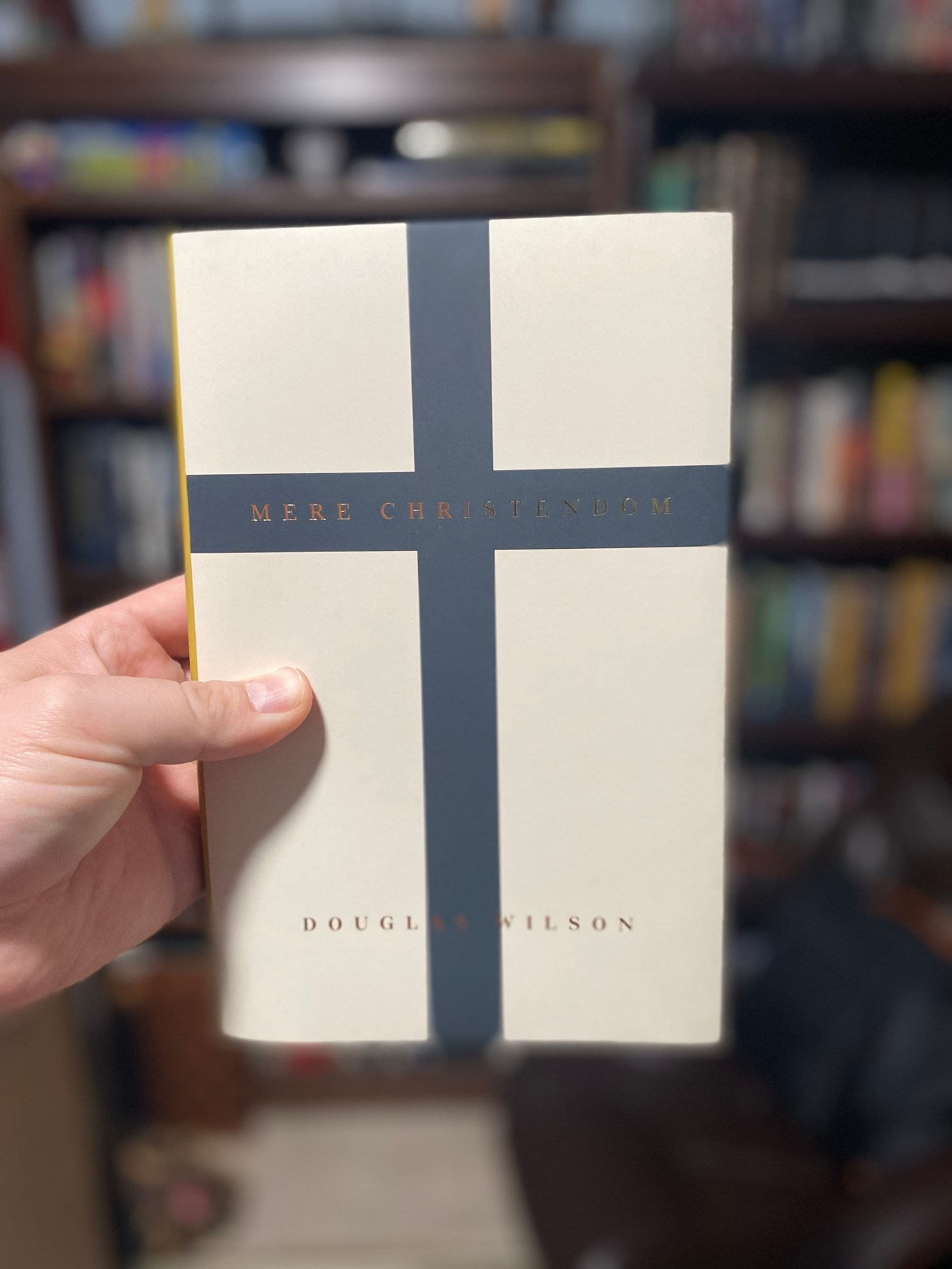
The book is Mere Christendom by Douglas Wilson. It was originally published in 2023 by Canon Press. I read the 2023 hardcover. I read it in January of 2024
Doug Wilson has been writing and speaking in his blogs about “mere christendom” (his term for Christian Nationalism) for many years. He finally wrote a book about it. I see the title as an homage to Lewis’ Mere Christianity. There Lewis gives an apologetic for Christianity. Here Wilson gives an apologetic for Christian Nationalism.
I read this book because I read The Case for Christian Nationalism by Stephen Wolfe. I heard that Mere Christendom is a good counter balance for understanding Christian Nationalism from a biblically faithful perspective. Wolfe didn’t use scripture at all in his thesis. He’s also not a pastor but more of a church historian. I trust Doug Wilson on most things and I wanted to get his explanation of Christian Nationalism.
Wilson usually buries his thesis under a couple layers of metaphorical prose. But sometimes he’s more straight forward.
“So what do I mean by mere Christendom exactly? I mean a network of nations bound together by a formal, public, civic acknowledgment of the Lordship of Jesus Christ, and the fundamental truth of the Apostles’ Creed. I mean a public and formal recognition of the authority of Jesus Christ that repudiates the principles of secularism, and that avoids both hard sectarianism and easy latitudinarianism both. Easier said than done, but there it is. That is what we have to do, and we have to do it because secularism has run its course and does not have the wherewithal to resist the demands of radical Islam. Or a radical anything else, for that matter.” (p69)
It doesn’t get any clearer than that.
I had a lot of questions about Christian Nationalism that were answered in this book. My questions were mainly about what the legal system would look like in a Christian nation. But honestly, I don’t think it would look much different than it does now.
Our current laws were modeled after a biblical moral ethic. “Do not steal” and “do not murder” are Christian laws. But that’s because the only real laws are God’s laws. Man cannot make up laws that mean anything. We can adjudicate and hold each other accountable to what God’s law says, but we can’t make up the laws. Our rights do not come from us. Our rights pre-exist any sort of government.
This book made me think about the future and where we are going as a society. The clown world crazies are starting to see that they are living on borrowed capital of Christianity. They’re getting to the bottom of the apple basket and still don’t believe in apple trees. But we do. This is part of why I think Christians are the future. We’re outbreeding them, but not only that, we’re now educating our kids ourselves. It does no good to have ten kids and then hand them over to the government schools for godless indoctrination. We need to have kids and keep them.
One thing that became very clear for my questions on the law was when Doug says this.
“And so here let me say that two things are crucial. The first is that Christians who believe the Bible must acknowledge that the death and resurrection of Jesus transformed our applications of biblical law. That is the first thing. It is crucial. But the second is that our understanding of this will never be advanced by denying the essential goodness of the Old Testament law, dead teens and all, slavery and all, stoning for adultery and all.” (p149)
The key point is “the death and resurrection of Jesus transformed our applications of biblical law.”
This is why we are not striving for Jewish Nationalism. We (or at least most of us) do not want to rebuild the temple and reinstate the sacrificial system as part of the law. Christ did change things. We can say the temple and sacrificial system were beautiful and good, but only because they pointed towards Christ.
This is an area I need to learn more about. Theonomy. The practical application of God’s law for a Christian nation instead of a Jewish nation or even a Baptist nation. I feel like I’ve been saying that for years. Rushdoony seems to be the guy for that. And Greg Bahnsan and Joe Boot. See the notable quotables below for more clarifying passages from Doug Wilson’s book.
Wilson was pretty clear in this book. Not as much flowery metaphor as usual.
I’d recommend this to all Christian men. It will be Christian fathers and husbands that pave the way towards a Christian nation. We need to read up.
****************************************************
Notable Quotables
“”””
The public square cannot be neutral. If Jesus is Lord, then Caesar isn’t. (p4)
“”””
This is why it is important that we have certain inalienable rights that our Creator gave us, and not rights that were bequeathed by the latest referendum, or by the kindness of the king. If the Lord gives, only the Lord can take away. If the state gives, then the state can take away, and blessed be the name of the state.
God outranks the king. The king is to do what God says, not the other way around. (p8)
“”””
As Chesterton points out somewhere, sexual license is the first and most obvious bribe to be offered to a slave. (p9)
“”””
This is also why it is possible to say that Jesus hates socialism. He hates statism. He hates crony crapitalism. Why? Because it doesn’t run on love. Love is obligatory, but it is not coercive. Coercion, masked as it is by the lies of modern statist theory, is their great counterfeit of love. (p11)
“”””
They don’t want any limiting principle, in principle. Thus far, and no farther, is not a phrase that they like to find in the mouths of the voting public. It reminds them too much of that flag with the rattlesnake on it.
But in order to have a genuine limiting principle, one that works, it has to be grounded in the work and words of the God who made us all. (p42)
“”””
Christians tend to think that the devil simply wants to tempt us with variations on the orgy porgy debauch. But the devil is actually parsimonious—he hates pleasure and only uses it to bait the hook. If he can get us to take the naked hook, so much the better. (p39)
“”””
So what do I mean by mere Christendom exactly? I mean a network of nations bound together by a formal, public, civic acknowledgment of the Lordship of Jesus Christ, and the fundamental truth of the Apostles’ Creed. I mean a public and formal recognition of the authority of Jesus Christ that repudiates the principles of secularism, and that avoids both hard sectarianism and easy latitudinarianism both. Easier said than done, but there it is. That is what we have to do, and we have to do it because secularism has run its course and does not have the wherewithal to resist the demands of radical Islam. Or a radical anything else, for that matter. (p69)
“”””
A free civilization is necessarily larger than any of the Christian denominations within it, but at the same time a free civilization will have to be Christian. So I propose no single established church, no tax-supported denominations, but I do propose the formal adoption of the Apostles Creed, and without any hermeneutical funny business. (p72)
“”””
There is no neutrality. So I don’t want liberty for secularists because secularism is true—it isn’t. Secularism is an opium dream, complete with flashing eyes and floating hair. I want liberty for secularists because Jesus is Lord. Because Jesus is Lord, the right of fallen sinners to wield coercive power must be strictly limited. One of the toughest lessons for sinners to learn is the necessity of leaving other sinners alone. When we do not leave them alone— in cases of rape and murder, for example–we have express warrant from God to do so. We do not have express warrant from God to make secularists confess something they don’t believe. (p74-75)
“”””
I am a Christian, and 1 am not a globalist. I am a Christian, and I am not a tribalist. I am a Christian, and I have to live somewhere. What shall we call that? (p84)
“”””
Driving your pick-up around town with that huge Trump flag flapping on one side and the Let’s Go Brandon in the original Greek waving on the other… isn’t helping anything.
A Christian nation should never be mistaken as being the same thing as a chosen nation. There is no exceptionalism in it.
So the “American exceptionalism” of the neocons is actually the idolatrous construct. What we are urging is simply one more Christian nation among many, and to God be the glory. (p85)
“”””
The sanctuary influences the auto shop without becoming the owner or proprietor of it. When the Church is healthy, and doing what it ought to be doing, it is establishing, promoting, and edifying entities that are distinct from itself. (p110)
“”””
Republics do not exist without republican virtue. And virtue does not exist apart from the grace of God, as offered in the message of the death and resurrection of Jesus Christ. This is why, if our freedoms are to return, secularism has to go. (p114)
“”””
Without an exhaustive rule through the predestinating love of the Father, unbelieving men will always see a job opening. They will want to fill that gap. They mimic the Father’s omnipotence, which is where we get the totalitarian part. They also try to mimic His love, which is how we get the tolerance farce. And so it is that we find ourselves suffocating under this totalitolerance. (p118)
“”””
One of the things I learned from Rushdoony is the idea of the inescapable concept-not whether but which. It is not whether we will impose morality, but rather which morality we will impose. As a confessing Christian, it is my desire to impose a Christian morality. (p143)
“”””
The reason why the post-Christian secularists could applaud free speech and the anti-Christian secularists cannot is the same reason why the prodigal son could buy free beer for all the ladies. He was using his father’s money. Post-Christian secularists were using Christian capital. (p146)
“”””
And so here let me say that two things are crucial. The first is that Christians who believe the Bible must acknowledge that the death and resurrection of Jesus transformed our applications of biblical law. That is the first thing. It is crucial. But the second is that our understanding of this will never be advanced by denying the essential goodness of the Old Testament law, dead teens and all, slavery and all, stoning for adultery and all. (p149)
“”””
I have often argued that Christian parents ought to accept the fact that their job is not to get their children to simply conform to the standard, but rather to get their children to love the standard. (p225)
“”””
all of their idols have to be overthrown. That is what true Christian cultural engagement is. That is the only thing that Christian cultural engagement can ever possibly be. Disciple the nations, Jesus said. He didn’t say to exegete Beyoncé songs in our sermons. But neither did He call upon the Church to pull a “brave, brave, Sir Robin” move. He didn’t say copy the nations, and He didn’t say run from the nations. He said disciple the nations. (p230)
 Solomon White
Leave a comment