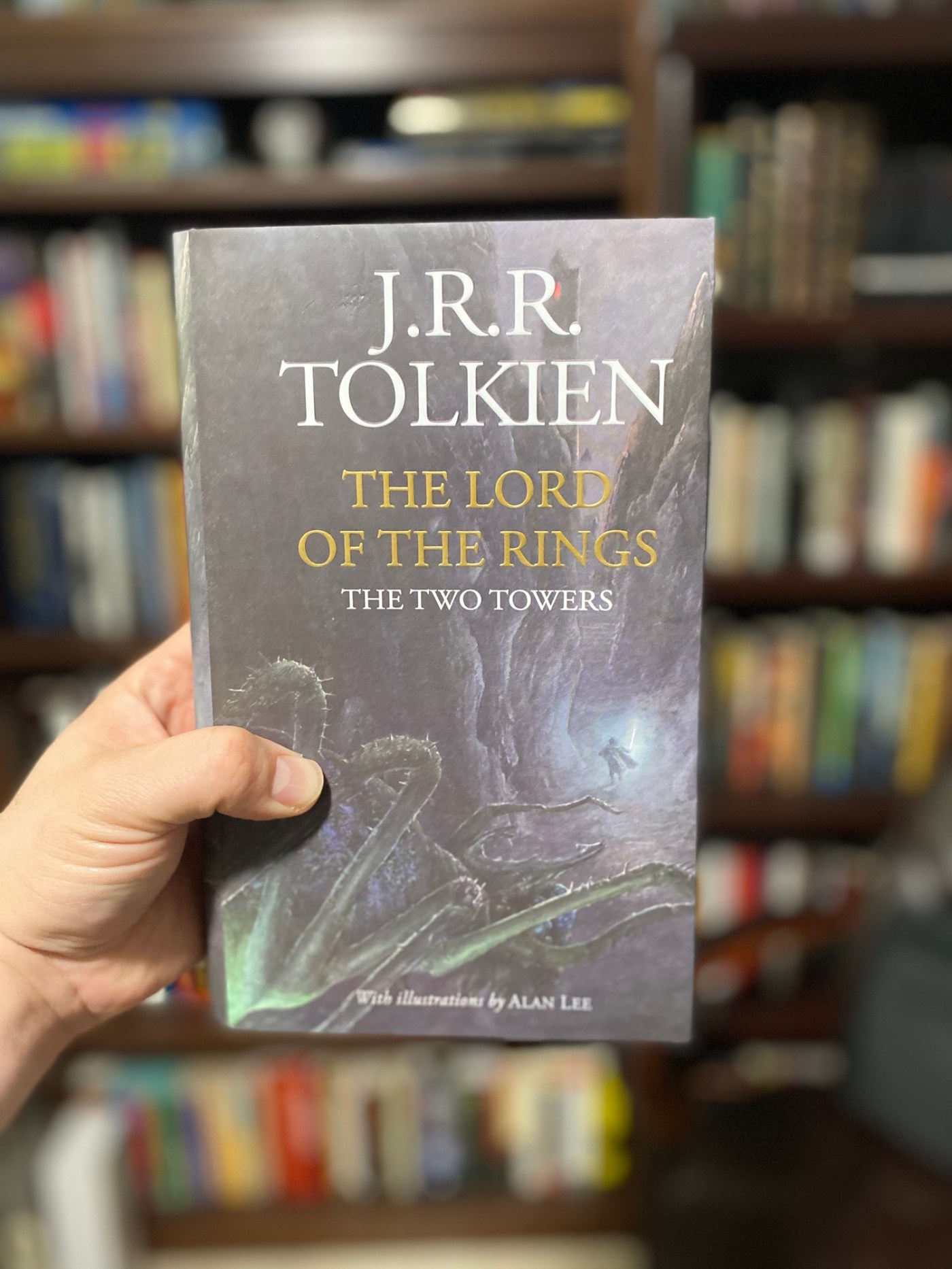
The book is The Two Towers by J.R.R. Tolkien. It was originally published in 1954 by George Allen & Unwin. I read the 2020 Harper Collins illustrated hardback edition with illustrations by Alan Lee. I read it in December of 2023.
According to Tolkien’s own illustration for the cover the two towers are depicted to be Minas Morgul and Orchanc.
I read this because I’m rereading through Lord of the Rings. It’s been a long time.
The Two Towers is when Tolkien really gets into the medieval history and lore of his created world, with Rohan and Gondor and stories of Numenor, we meet a lot of new characters. I remember when I was reading this as a kid being really confused because Frodo and Sam aren’t in it at all until part two of Two Towers.
A lot happens in this book. The Ents. Helms Deep. Gollum enters the story. So much good stuff. Fellowship felt more like a kids adventure story, whereas Two Towers feels more like medieval history. More grown up. The fellowship is separated. As a kid I hated that they split up.
This book gets dark. Fellowship got dark in a monstrous way with the mines and the Balrog. But Two Towers gets dark in a human way. The ring is weighing heavier and heavier on Frodo. Theoden’s mind is poisoned by Wormtongue. There’s a fear and hopelessness at Helms Deep. It felt more grown up.
The Two Towers is act two of Tolkien’s epic. Act two is supposed to be the dark valley. Act two is when the villains strikes back. The hopelessness and despair are at the highest. I definitely felt that tone throughout the book.
My biggest takeaway was how the kingdoms of men are struggling to rebuild their kingdoms. They made many mistakes that lead to their ruin and downfall.
“Death was ever present, because the Númenóreans still, as they had in their old kingdom, and so lost it, hungered after endless life unchanging. Kings made tombs more splendid than houses of the living, and counted old names in the rolls of their descent dearer than the names of sons. Childless lords sat in aged halls musing on heraldry; in secret chambers withered men compounded strong elixirs, or in high cold towers asked questions of the stars. And the last king of the line of Anárion had no heir.” (p680)
This made me think of how we can look back at the past with a romantic longing, thinking things were better “back in the day.” But our predecessors had problems too, and their failures are why things aren’t good anymore. It sounds like the Numenoreans put too much emphasis on the glory of the past and not enough on building up the next generation to keep the good civilization going.
We get more cities and names in this book. It got a little confusing keeping track of who is who and where they are.
There are so many heroes to emulate. Theoden breaks the shackles of Wormtongue’s evil influence and saves his people. Total Chad king.
It was interesting how Treebeard was indifferent to the wars of humans until he saw all the trees cut down at Isengard. He went into a righteous fury and it was awesome. That was good and correct for him to respond that way.
The villains to avoid are mostly obvious. Evil is just evil for evil’s sake. There is no sympathy for Saruman or Sauron. They are just rebelling against order and light. It is interesting how Tolkien depicts two kinds of evil, the evil that is obviously dark and the bright evil of Saruman who looks like and once was a good hero. But he gave up and gave in to the threat of a seemingly greater power. Was he always power hungry? Does he know what real power is?
I recommend The Lord of the Rings to all young men. It’s required reading.
****************************************************
Notable Quotables
“”””
‘He fled, certainly,’ said Aragorn, ‘but not, I think, from Orcs?’ What he thought was the cause of Frodo’s sudden resolve and flight Aragorn did not say. The last words of Boromir he long kept secret. (p419)
“””
‘They are proud and wilful, but they are true-hearted, generous in thought and deed; bold but not cruel; wise but unlearned, writing no books but singing many songs, after the manner of the children of Men before the Dark Years. (p431)
“”””
‘Halflings! But they are only a little people in old songs and children’s tales out of the North. Do we walk in legends or on the green earth in the daylight?’ “A man may do both,’ said Aragorn. ‘For not we but those who come after will make the legends of our time. (p434)
“”””
But when the great fall, the less must lead. (p436)
“”””
How shall a man judge what to do in such times?’ “As he ever has judged,’ said Aragorn. ‘Good and ill have not changed since yesteryear; nor are they one thing among Elves and Dwarves and another among Men. It is a man’s part to discern them, as much in the Golden Wood as in his own house?’ (p438)
“”””
There are some things that it is better to begin than to refuse, even though the end may be dark. (p441)
“”””
‘Good! Good!’ said Treebeard. ‘But I spoke hastily. We must not be hasty. I have become too hot. I must cool myself and think; for it is easier to shout stop! than to do it? (p474)
“”””
It was Sam’s first view of a battle of Men against Men, and he did not like it much. He was glad that he could not see the dead face. He wondered what the man’s name was and where he came from; and if he was really evil of heart, or what lies or threats had led him on the long march from his home; and if he would not really rather have stayed there in peace all in a flash of thought which was quickly driven from his mind. (p663)
“”””
But it’s a pity that folk as talk about fighting the Enemy can’t let others do their bit in their own way without interfering. (p667)
“”””
Death was ever present, because the Númenóreans still, as they had in their old kingdom, and so lost it, hungered after endless life unchanging. Kings made tombs more splendid than houses of the living, and counted old names in the rolls of their descent dearer than the names of sons. Childless lords sat in aged halls musing on heraldry; in secret chambers withered men compounded strong elixirs, or in high cold towers asked questions of the stars. And the last king of the line of Anárion had no heir. (p680)
“”””
“Then she must be lovely indeed,’ said Faramir. ‘Perilously fair? ‘I don’t know about perilous,’ said Sam. ‘It strikes me that folk takes their peril with them into Lórien, and finds it there because they’ve brought it.’ (p682)
 Solomon White
Leave a comment