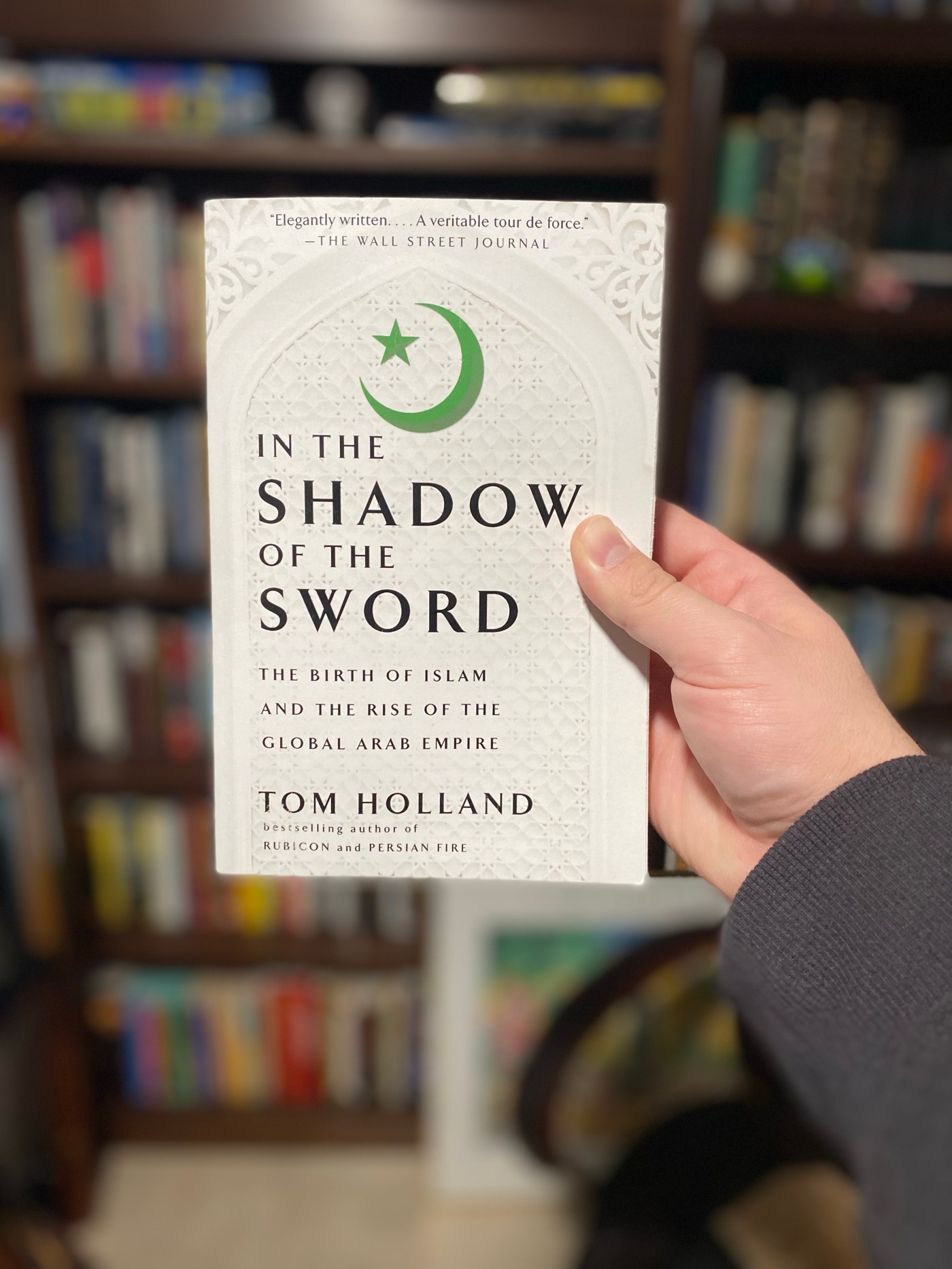
The book is In the Shadow of the Sword by Tom Holland. It was originally published in 2012 by Little Brown books. I read the paperback edition. I read this in October of 2023.
The title refers to the violence of the origin of Islam. This isn’t how Holland would frame it but what I got from this book regarding the title is that instead of there being a rich literary history or documented archeology that could account for the origins of Islam, there is violence and warfare.
Not all at the fault of Muslims but always involving them. Sometimes the Muslims were under the shadow of the sword and sometimes they wielded the sword. Either way, it’s not the pen that lies at the roots of Islam, but rather the sword.
I read this because on October 7th 2023 the Islamic terrorist group Hamas invaded Israel and killed over one thousand people. They are currently still at war as I write this.
It seems the conflict in the Middle East is reaching a fever pitch and I wanted to learn more about Islam. Tom Holland is my favorite historian so I thought this would be a good place to start.
In this book, Tom Holland is attempting to connect the dots in the origins of the Quran and Islam. He’s approaching it as an historian which means he’s looking for external literary or archaeological documentation of the start of this religion.
He points out that this is a massively difficult task as Muslims forbid any research in the origins of the Quran. It’s blasphemy to do so.
“Devout Muslims were no more likely to question the origins of the Quran than devout Christians were to start ransacking Jerusalem for the skeleton of a man with holes in his hands and feet.” (p31)
They view the Quran the way we view Christ. To look for Christ’s body in a tomb is to reject the resurrection, which is to reject Christianity.
To look for original manuscripts of the Quran is to reject it’s absolutely divine origination. Muslims don’t look into it.
However, Holland does piece together where he thinks Islam came from. He suggests that it’s an amalgamation of Zoroastrianism, Judaism, Paganism, and Christianity.
He shows the throughline historically how these other religions might have influenced Arabs centuries later to create the Quran and the religion of Islam around a man named Muhamad and his ideas about God.
My main takeaway from this book is that there is really nothing to the Quran or Islam as far as rationality or truth. I still need to read the Quran and I will, but it sounds like a joke.
The Arabs retrofitted their ideas into the teachings of Muhamad who died centuries earlier. It’s completely unreliable.
It made me think of modern cultists like David Koresh and Jim Jones. They claim to hear a new revelation from God and then make a bunch of rules and regulations that fit what they want to do.
This was easy because Islam and the Quran didn’t even start until 200 years after Muhamad had died.
It was surprising to read that the early Christian martyrs in Rome would not have compelled the onlookers to follow Christ.
“Nothing quite like the relish of Christians for dying in the cause of their God had ever been witnessed before. When martyrs were made “to run the gauntlet of whips, or to be savaged by wild beasts, or to be roasted in iron chairs, so that they were suffocated by the reek of their own flesh as it cooked,” the watching crowds were rarely impressed. Why should they be? A god best displayed his power by protecting those who worshipped him, not by demanding their deaths. The Romans knew this better than anyone.” (p173)
We often think that martyrs dying for their faith in Christ, would raise the level of authenticity. We think that because we are the product of the Christian west culture.
The Romans saw everything through a different worldview. Might made right, not sincerity and conviction. They respected and followed displays of power, not humble submission.
This reminds me of something Paul Washer said one time, something along the lines of how our Christian persecution today won’t be noble. We will be seen as bigots and harmful people when we’re arrested.
It’s emboldening if someone says “because you love Christ, we are killing you.” We can stand on that charge proudly. But that won’t be the charge.
We will be charged with being unloving and unchristian. The world today has gotten so upside down and backwards that the people standing on truly biblical principles in their Christianity are seen as the unchristian ones.
We’ve distorted what following Christ and being a Christian means so much in our culture that we’ll be seen as an unbelieving heretic. The dividing line between today’s woke “Christian” culture and true faithful Christianity is scripture. Sin always starts with questioning God’s word. Like the serpent asked Eve, we start asking ourselves “did God actually say…?”
The Arab names got a little confusing. Holland has so much information. He gets into the details of everything. It was a little difficult to follow along because the Muslims retcon things.
Placing Muhamad in “Islam” is technically incorrect because Islam didn’t come until 200 years after he died. But they still talk about Islam existing in the time of Muhamad. They backdate things. You need to pay attention while you read.
It was clear that Muslims have little to no historical verification of the Quran or the biographical details of Muhamad.
“Whatever else it may be, the Qur’an is no work of history.” (p40)
Holland is a tremendous historian. He puts your right in the time he’s writing about. He’s so well read and well researched and does not impose any judgement or agenda on ancient history.
I’d recommend this to serious readers who want to learn more about the origins of Islam and the Quran. It’s a great history book for understanding the context of the Arab peoples and how they interacted with all the movers and shakers of the ancient world.
****************************************************
Notable Quotables
“”””
Among the Arabs, the written word was on the verge of becoming a mania. One scholar, when he died in 822, left behind him a library that filled a whole six hundred trunks. Another was said to have been flattened to a pulp when a tower of books collapsed on top of him while he was drunk. (p15)
“”””
When the Jews of Yathrib, disconcerted by the transformation of their hometown into the “City of the Prophet,” presumed to maneuver against him, they were variously expelled, enslaved or massacred. (p21)
“”””
“We have made the Book to descend upon you, a clear explanation for all things. ” So God had assured Muhammad. The “Book” was, of course, the sum of all the many revelations granted to the Prophet over the course of his life; and these, written down by his followers, had then, after his death, been assembled to form a single “recitation”—a “Quran.” (p28)
“”””
Devout Muslims were no more likely to question the origins of the Quran than devout Christians were to start ransacking Jerusalem for the skeleton of a man with holes in his hands and feet. This was because the nearest Christian analogy to the role played in Islam by the Prophet’s revelations was not the Bible but Jesus the Son of God. The record of Christ’s life, for all that it lay at the heart of the Christian faith, was not considered divine unlike Christ Himself. Although Christians certainly believed it to be the word of God, (p31)
“”””
Context, for the historian, is all-and no Muslim scholar or lawyer who quoted the Prophet ever had the slightest interest in establishing what the original context of his sayings might authentically have been. (p37)
“”””
Whatever else it may be, the Qur’an is no work of history. (p40)
“”””
No empire can be raised amid a silence, of course; but what we chiefly hear now of the founding of the Caliphate is the merest sound and fury, tales told centuries later, and signifying, if not nothing, then very little. (p40)
“”””
A few decades on from Jesus’s crucifixion, a group of Christians in Asia Minor received a letter that positively seethed with scandalous notions. Its author, a one-time student of the Torah called Paul, was the most spectacular rebel that the famously prescriptive Jewish educational system had ever bred. (p155)
“”””
Little more than a generation after Jesus’s crucifixion, Christians had already grown obsessed with the need for disciplined book-keeping. The paperwork of each individual church had duly been entrusted to an official chosen by the local congregation to serve as an “overseer, or “episcopos”: a “bishop.” (p158)
“”””
Yet still, a hundred, two hundred, even three hundred years after the crucifixion, biographies of Christ continued to be cranked out. Of course, gospels such as these, composed at such a remove of time, could hardly have any great claims to biographical accuracy; but biographical accuracy, to those who composed them, was hardly the point. (p163)
“”””
Nothing quite like the relish of Christians for dying in the cause of their God had ever been witnessed before. When martyrs were made “to run the gauntlet of whips, or to be savaged by wild beasts, or to be roasted in iron chairs, so that they were suffocated by the reek of their own flesh as it cooked,” the watching crowds were rarely impressed. Why should they be? A god best displayed his power by protecting those who worshipped him, not by demanding their deaths. The Romans knew this better than anyone. (p173)
“”””
In 367, some four decades after the first formulation of the Nicaean Creed, a famously authoritarian bishop by the name of Athanasius had written to the churches under his jurisdiction. In these letters, he had prescribed the twenty-seven books that henceforward were to be considered as constituting the “New Testament.” The list had soon become canonical wherever Nicaea was accepted. (p190)
“”””
The Temple itself, though, had long since been obliterated: for in 586 BC, after some four hundred years of existence, all its gold and cedar-wood had gone up in flames, together with the rest of Jerusalem, when the King of Babylon had stormed the city. True, the return of the Jews from their exile in Mesopotamia had seen them build a second. and ultimately even more imposing, Temple; but this too, in AD 70, had been put to the torch, after the Jews, resolved to throw off Roman rule, had risen in revolt and been comprehensively flattened for their pains.
The Jewish homeland became, by imperial fiat, “Palestine” (p211)
“”””
The Jews of Palestine, confronted as they were by the monumental and menacing edifice of Christian orthodoxy, had grown increasingly fretful about what their own frameworks of authority, and their own orthodoxy, might be. Rather than have it defined for them by the Christian Church, they preferred to turn to the scholars whose massive achievement in compiling the Talmud had been preparation for precisely such a moment. (p215)
“”””
Between jinn and demons, it appeared, the boundaries were easily blurred.
Angels who manifested themselves in a Roman province, for instance, were as like as not to sport the medallions and “bright crimson belts* of imperial bureaucrats. Perhaps, then, in those reaches of Arabia as yet only semi-illumined by the blaze of Christ, it was only to be expected that they would adopt the look, and sometimes even the names, of pagan deities. (p283)
“”””
Given that the Prophet’s earliest biographers were writing almost two centuries after his death, how far can we legitimately accept their presumption that seventh-century Mecca was genuinely a place of great significance and wealth the “Mother of Cities” (p303)
“”””
The mystery seems only compounded by the complete absence of any commentaries on the Quran prior to the ninth Christian century, and by the fact that even then different communities of the faithful preserved different versions of the holy text. (p304)
“”””
How was it that a book so revered should simultaneously have been neglected for so long by so many Muslim jurists?
It remains the case, and disconcertingly so, that the earliest surviving biographies of the Prophet were written whole generations after his death. (p306)
“”””
Unlike the Bible, which name-checks any number of conveniently datable rulers-from Cyrus to Augustus the Qur’an betrays what is, to any historian, a most regrettable lack of interest in geopolitics. (p308)
“”””
It was this, in the decades prior to the great war with Persia, that had encouraged a major recruitment drive on the part of Roman strategists, as they sought to compensate for their relative lack of manpower along the frontier by hiring Arabs to patrol it in depth. This, in turn, encouraged mass emigration from all over Arabia, with entire tribes drifting steadily northwards from the Hijaz towards Palestine. (p333)
“”””
Kharijites, these deserters were called those who go out.” What they were decidedly not, however, were deserters from the teachings of the Prophet. Instead, it was Ali whom the Kharijites condemned as the unbeliever, as the man who had strayed from the Straight Path. The fact that he was Muhammad’s nephew only confirmed them in the militancy of their egalitarianism: that the true aristocracy was one of piety, and not of blood. (p363)
“”””
Whereas Constantine at Nicaea had been obliged to depend upon fractious and fallible bishops to stamp a particular brand of his chosen faith as orthodox, Ibn al-Zubayr had identified a far less troublesome sanction: for not only had Muhammad claimed to be a medium for divine revelation, but he was also safely dead. Ram home the point that he had authentically been a Messenger of God, and anything that could be attributed to him would perforce have to be accepted by the faithful as a truth descended from heaven. (p378)
“”””
Certainly, that Abd al-Malik’s reign had indeed seen the Quran subjected to a state-sponsored makeover was something that no Muslim scholar would subsequently think to deny.
as the Khalifat Allah, or “Deputy of God.” Just as Muhammad had been chosen to reveal the divine word, Abd al-Malik had been appointed to interpret it and broadcast it to humanity. (p390)
“”””
the Sunna was a monument to just what could be achieved by fashioning old fragments into something new and extraordinary. Shards gleaned from the Torah, and from Zoroastrian ritual, and from Persian custom: all featured in the edifice pieced together by the ulama. (p409)
“”””
Why, the Prophet himself, so it suddenly appeared from a flurry of hadiths brandished to triumphant effect by ibn al-Mubarak, had given Muslims explicit instructions not to copy monks. “Every community has its monasticism–and the monasticism of my comunity is jihad. ”
in the Quran reference to the jihad required of believers was as likely to imply a good argument with the Mushrikun, or the giving of alms, or perhaps the freeing of a slave, as it was any commitment to pious violence.
warfare in the cause of God. Riding to the frontiers of the embattled House of Islam and slaughtering stiff-necked Christians was cast not merely as an option for dutiful Muslims, but as a positive obligation. (p420)
“”””
The ulama, by tightly controlling what went into the history books, were able to propagate an understanding of their own dazzlingly rich and complex civilization that attributed almost every single thing of value within it to the Prophet, and the Prophet alone.
Submission to God was definitively cast as submission to the Sunna. (p431)
 Solomon White
Leave a comment