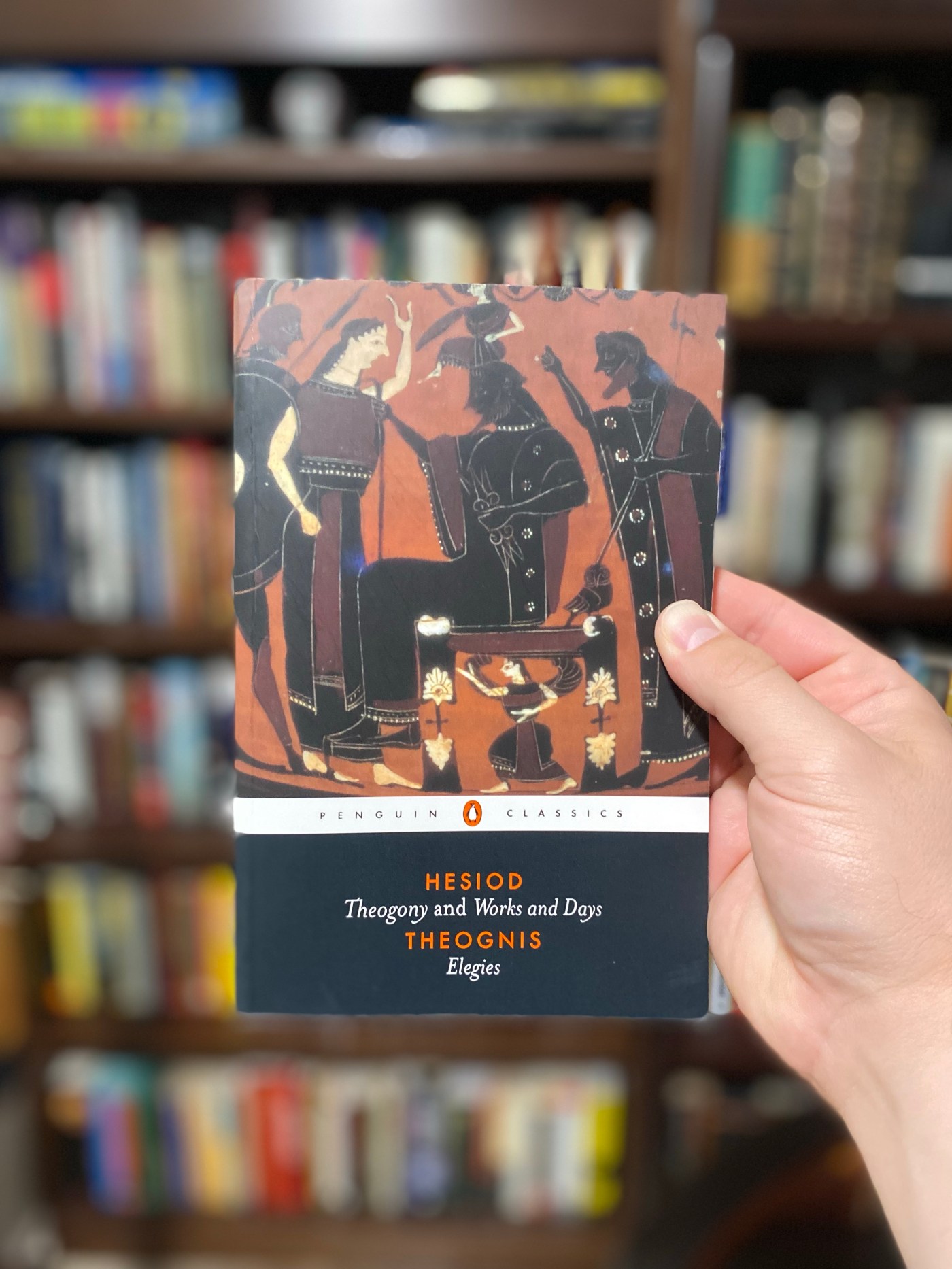
The books are Theogony and Works and Days by Hesiod. It was originally written long long time ago. I read the 1973 translation Penguin Classics edition. I read it in September of 2023.
Theogony means a lineage or system of gods. This book is the creation and origin story of the Greek gods. Works and Days is like practical advice and proverbs for ancient Greek life. They are two separate works, both written by Hesiod. Hesiod was a contemporary of Homer. Apparently all the ancient Greeks didn’t read one without reading the other.
I read this because I’m going to read the Iliad, the Odyssey, and the Aeneid. I wanted to read up more on the Greek gods as prep for those other books.
Theogony is really dull. It’s just the origins of how all the Greek gods came into being. Honestly it’s poorly written compared to Works and Days. I believe the theory that they actually were written by different authors.
This book was pretty unremarkable. Not a lot of takeaways. My one takeaway is how debased the Greek gods are. They’re horrible characters. They don’t give a crap about the people. They’re just amplified versions of despots. They supposedly embody characteristics like wisdom or nature.
These books made me think about the people who would have read them in the time. It seems like it would be entirely unhelpful as far as an explanation of why humans are here and what we’re supposed to do.
The names got confusing. Hard to pronounce old Greek names.
Works and Days was definitely better as far as how to practically live your life day to day.
I don’t recommend this book, not even as a primer on the Greek gods or classical literature.
****************************************************
Notable Quotables
“”””
Wise lords are wise in this: when public harm is being done to the people, they can set things straight with ease,
Advising with soft words. (p26)
“”””
He made a second evil as a price
Of fire, man’s blessing: if a man avoids
Marriage and all the troubles women bring
And never takes a wife, at last he comes
To miserable old age, and does not have
Anyone who will care for the old man. (p43)
“”””
A daughter of the Old Man of the Sea, Psamathe, shining goddess, through the work Of golden Aphrodite, fell in love
With Aeacus, and Phocus was her child. And Thetis, another child of Nereus,
The silver-slippered goddess, was subdued
By Peleus, and bore a son to him Lion-hearted Achilles, breaker of men.
And fair-crowned Cytherea felt sweet love
For the hero Anchises, and she lay with him
And bore Aeneas on the mountaintop,
In Ida, with its many wooded clefts.
And Circe, daughter of Helios, the son Or Hyperion, loved Odysseus, patient-souled, And bore great good Latinus and Agrius. And they, in the midst of holy islands, ruled The famous Tyrsenians, so far away. (p56)
“”””
Then, raging, spoke the Gatherer of Clouds: Prometheus, most crafty god of all,
You stole the fire and tricked me, happily,
You, plague on all mankind and on yourself. They’ll pay for fire: I’ll give another gift
To men, an evil thing for their delight, (p60)
“”””
The herald of the gods then named the girl Pandora, for the gifts which all the gods
Had given her, this ruin of mankind. (p61)
“”””
Be just among bad men: for it is bad
To be an honest man where felons rule; (p67)
“”””
That man is best who reasons for himself, Considering the future. Also good
Is he who takes another’s good advice.
But he who neither thinks himself nor learns
From others, is a failure as a man. (p68)
“”””
Unseemly, sleeping with his brother’s wife,
Or in his folly, hurts an orphan child,
Or he who picks rough quarrels, and attacks
His father at the threshold of old age,
He angers Zeus himself, and in the end
He pays harsh penalties for all his sins. (p69)
“”””
Don’t put off work until another day,
Or even till tomorrow; lazy men
Who put things off always have unfilled barns. Constant attention makes the work go well; Idlers wrestle with ruin all their days. (p72)
 Solomon White
Leave a comment