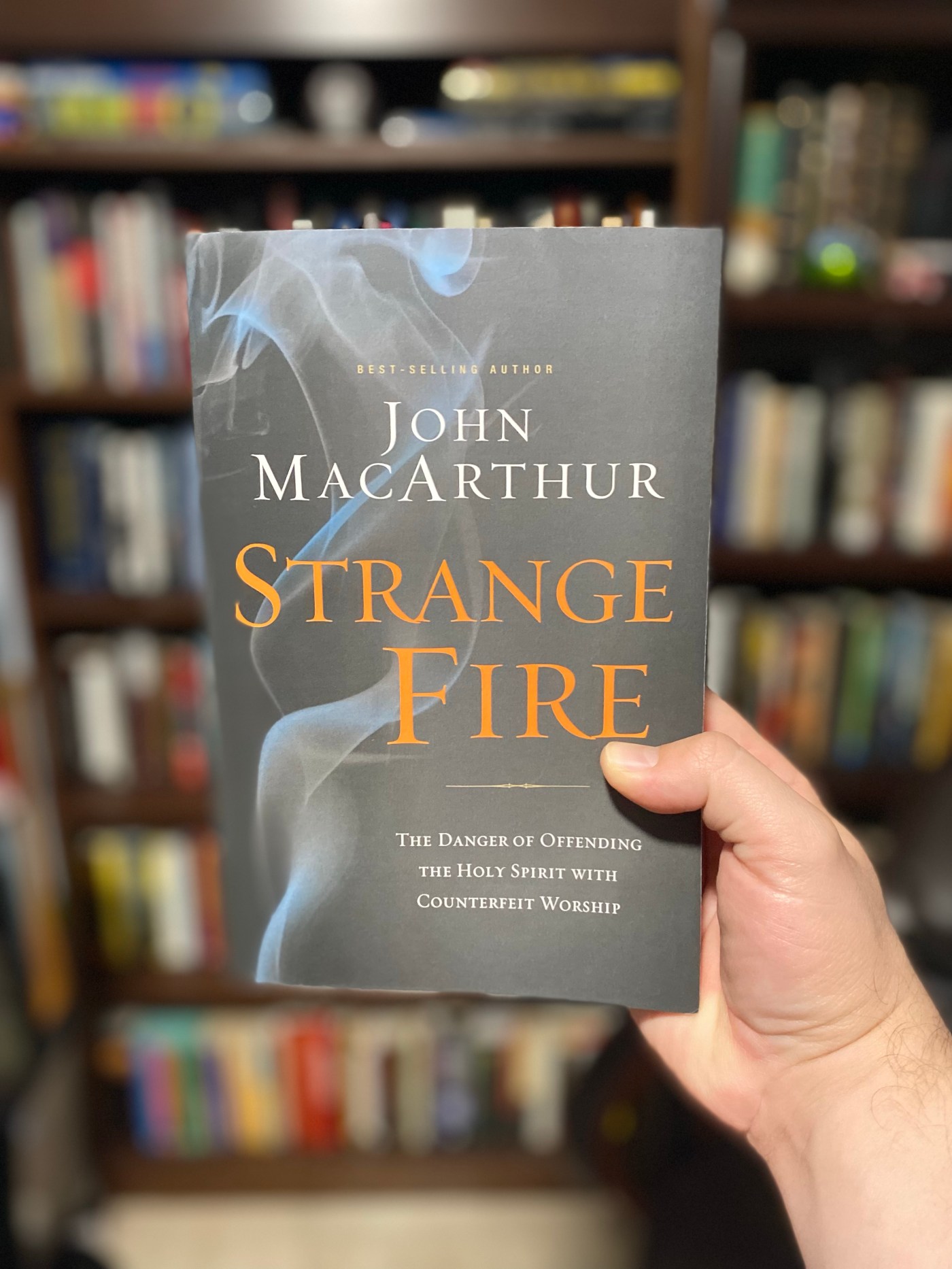
The book is Strange Fire by John MacArthur. It was originally published in 2013 by Nelson Books. I read the 2013 paperback edition. I read it in September of 2023.
The title refers to Lev. 10:1-3
“Now Nadab and Abihu, the sons of Aaron, took their respective firepans, and after putting fire in them, placed incense on it and offered strange fire before the LORD, which He had not commanded them. And fire came out from the presence of the LORD and consumed them, and they died before the LORD. Then Moses said to Aaron, “It is what the LORD spoke, saying, ‘By those who come near Me I will be treated as holy, and before all the people I will be honored.”
God cares how we worship him.
I read this book because I want to believe and worship rightly. The spiritual gifts in 1 Corinthians have always been problem passages for me.
The only expression of tongues, prophecy, and healing I’ve seen is from the obvious charlatan televangelists. Not that personal experience creates truth, I just have no experience with anything that even looks legitimate.
On this topic I start and stop with what I see in scripture.
This book actually turned out to be kind of a bust. MacArthur spends 80 percent of the book railing against the wacked out charismatic Pentecostal movement.
He goes after Benny Hinn, and Kenneth Copeland and all the TBN ilk. I already know they’re not legitimate. I already know those people do not faithfully represent the spiritual gifts of 1 Corinthians.
Every continuationist I know disagrees with those charlatan wackos. In that way, it wasn’t very helpful. But this book did help me frame what I believe about the spiritual gifts.
Regarding the sign gifts, prophecy, tongues, healing, miracles, I believe that the specific allocation of these gifts to specific people has ceased. The only way to say they’ve continued is to substantively change the gifting as it’s characterized in scripture.
For example, when you see a healing in the Bible it’s imminent and dramatic. A man has never walked before and now he’s dancing.
When we see a healing today, it usually looks like many people in a church praying for someone to get over a sickness or injury and then they do.
Now, I absolutely believe that that is a legitimate healing from God, but it’s not one specific person with the gift of healing who performs the healing like we see in the Bible.
I believe that healings and miracles still happen today, but they’re not exclusive to one person as a “gift” like we see in the Bible.
I don’t know of any cessationists that believe that God is not moving and active in the world today. He certainly is. But the exclusive personal allocation of specific sign gifts, this is what I believe has ceased.
This book made me think of Justin Peters who has several times gone to famous “faith healers” and asked them to heal him of his palsy.
I started to get a little confused when I was over halfway through this book and he still hadn’t mentioned 1 Corinthians. This book is not what I thought it’d be. It definitely wasn’t an echo chamber like I was afraid it would be, so that’s good.
I’d recommend this to anyone in the Pentecostal charismatic Christian movement. That’s who this book is for. There is a real darkness that’s going on in the world of the “word of faith” and “health wealth and prosperity” gospel. This book sheds biblical light on those lies.
****************************************************
Notable Quotables
“”””
Now Nadab and Abihu, the sons of Aaron, took their respective firepans, and after putting fire in them, placed incense on it and offered strange fire before the LORD, which He had not commanded them. And fire came out from the presence of the LORD and consumed them, and they died before the LORD. Then Moses said to Aaron, “It is what the LORD spoke, saying, ‘By those who come near Me I will be treated as holy, and before all the people I will be honored.” (Lev. 10:1-3 NASB)
Most likely Nadab and Abihu had taken fire from some source other than the brazen altar and used it to light their censers of incense. (pX)
“”””
Rather than instilling a greater appreciation for the Spirit-inspired Scripture, which God exalts as high as His own name (Ps. 138:2), the Charismatic Movement drives people to look for divine revelation in boundless places outside of the Bible. The ramifications of that faulty premise are disastrous–destroying the doctrine of Scripture’s sufficiency and effectively ignoring the close of the canon. (p68)
“”””
But what happened when it became obvious that their modern version of the “gift” did not consist of real languages? If Scripture had been their highest authority, they would have abandoned the practice altogether recognizing the fact that what they were doing did not match the biblical precedent. (p72)
“”””
Moreover, it seeks to edify others within the body of Christ. Such is certainly Paul’s point in discussing spiritual gifts in 1 Corinthians 12-14: the gifts were to be used within the church for the building up of other believers. His statement in 1 Corinthians 12:7 makes this point explicit: “The manifestation of the Spirit is given to each one for the profit of all.” This is echoed in 1 Corinthians 13:5, where Paul explains that true love “does not seek its own.”
But charismatics have turned this on its head, claiming certain gifts (in particular the gift of tongues) are to be used for self-edification. (p78)
“”””
While it is true the term apostle is sometimes used in the New Testament in a nontechnical generic sense to refer to “apostles [or messengers] of the churches” (2 Cor. 8:23), those individuals should not be confused with the Twelve or the apostle Paul. To be an apostle of the Lord Jesus Christ was a specific calling and a profound privilege something far different from merely being a messenger sent from a local congregation. To be an apostle of the Lord Jesus was to have been personally appointed by Him. It was the highest possible position of authority in the church, a unique office that encompassed a nontransferable commission from Christ to proclaim revelatory doctrine while laying the foundation of the church. (94-95)
“”””
Grammatically, however, the word “until” in verse 13 points back to the nearest participle in verse 12 (“building up”), and not to the distant verb “gave” in verse 11. Thus, Paul’s point is that those offices listed in verse 11 were given by Christ so that, according to verse 12, the saints might be equipped to build up the body of Christ (v. 12). (Eph. 4:11-13) (p100)
“”””
It is the building up of the body of Christ by the saints, then, that continues until the conditions in verse 13 are realized. Nothing in the text indicates That apostles and prophets will be present throughout the entire church age but only that the work they began (equipping the saints to build up the body of Christ) will continue. This grammatical conclusion is strengthened by the context of Ephesians, since Paul has already explained that apostles and prophets were limited to the foundation age of the church (Eph. 2:20). (p101)
“”””
Because Paul had already indicated that the apostles and prophets were for the foundation only, he did not need to reiterate that those offices were temporary. Though those two offices did not last beyond the first century of church history, the apostles and prophets still equip the saints through the Spirit-inspired writings they left for us (i.e., the Bible). (p101)
“”””
Paul’s point in Ephesians 4:11 is that apostles are given by Christ to His church. While it is true that apostleship was also an office, that does not preclude it from being a gift. Prophecy, for example, encompassed both an office and a gift, as did the gift of teaching.
In the end, despite the protests of some continuationists, there is no escaping the fact that one of the most significant features described in 1 Corinthians 12 (namely, apostleship) is no longer active in the church today. It ceased. (p103)
“”””
Wayne Grudem, for example, wrote his doctoral thesis at Cambridge University in defense of the idea that God regularly gives Christians prophetic messages by bringing spontaneous thoughts to mind. Strong impressions should be reported as prophecy, he says, though he freely admits that such prophetic words “can frequently contain errors.” (p114)
“”””
Biblically speaking, no distinction is made in Scripture between the prophets in either Testament. In fact, the New Testament uses identical terminology to describe both Old and New Testament prophets. In the book of Acts, Old Testament prophets are mentioned in Acts 2:16; 3:24-25; 10:43; 13:27, 40; 15:15: 24:14; 26:22, 27; and 28:23. References to New Testament prophets are interspersed using the same vocabulary without any distinction, comment, or caveat (cf. Acts 2:17-18; 7:37: 11:27-28; 13:1; 15:32; 21:9-11). (p119)
“”””
Furthermore, the word prophecy in this context does not necessarily refer to future predictions or new revelation. The word simply means “to speak forth,” and it applies to any authoritative proclamation of God’s Word where the person gifted to declare God’s truth “speaks edification and exhortation and comfort to men” (1 Cor. 14:3). So a fitting paraphrase of Romans 12:6 would be: “If your gift is proclaiming God’s Word, do it according to the faith.” Again, the idea is that whatever is proclaimed must conform perfectly with the true faith, being consistent with previous biblical revelation. (p121)
“”””
The key difference is that, whereas biblical prophets received new revelation directly from the Spirit of God, contemporary preachers are called to proclaim only that which the Spirit of God revealed in His inspired Word (cf. 2 Tim. 4:2). Hence, the only legitimate way anyone can say, “Thus says the Lord . . ” is if the next words that follow come directly from the biblical text. Anything other than that is blasphemous presumption, and certainly not prophecy.
At its core, it is the charismatic focus on receiving new revelation that makes their view of prophecy so dangerous. But the Bible is clear: the giving of new revelation through living prophets in the New Testament era was intended only for the foundation age of the church. As Paul stated definitively in Ephesians 2:20, the church was “built on the foundation of the apostles and prophets” (p129)
“”””
In defending nonsensical speech, most charismatics retreat to the book of 1 Corinthians-contending the gift described in 1 Corinthians 12-14 is categorically different from that of Acts. But once again, this assertion is not permitted by the text.
…In Acts, Luke uses laleo (“to speak”) in combination with glossa (“tongues” four different times (Acts 2:4, 11; 10:46; 19:6). In 1 Corinthians 12-14, Paul uses forms of that same combination thirteen times (1 Cor. 12:30; 13:1; 14:2, 4, 5 [2x], 6, 13, 18, 19, 21, 27, 39).
…Because he penned the book of Acts around AD 60, roughly five years after Paul wrote his first epistle to the Corinthians, Luke would have been well aware of their confusion regarding the gift of languages. (p140)
“”””
The fact that Paul noted “various kinds of tongues” in 1 Corinthians 12:10 (NASB) does not imply that some are real languages and others are merely gibberish. Rather, the Greek word for kinds is genos, from which we derive the word genus. Genos refers to a family, group, race, or nation. Linguists often refer to language “families” or “groups,’ and that is precisely Paul’s point: there are various families of languages in the world, and this gift enabled some believers to speak in a variety of them. (p141)
“”””
In both places, the resulting message can be translated and thereby understood, either by those who already know the language (as on the day of Pentecost Acts 2:9-11) or by someone gifted with the ability to translate (1 Cor. 12:10; 14:5, 13).
…with the gift of interpretation (1 Cor. 12:10; 14:27), Paul indicated that the gift consisted of rational languages. The word for interpretation is hermeneuo (from which we get hermeneutics), which refers to a “translation” or an “accurate unfolding of the meaning.” Obviously, it would be impossible to translate nonsensical gibberish, since translation requires concrete meanings in one language to be rendered correctly into another. (p141-142)
“”””
Paul explicitly referenced human languages in 1 Corinthians 14:10-11, where he wrote, “There are, it may be, so many kinds of languages in the world, and none of them is without significance. Therefore, if I do not know the meaning of the language, I shall be a foreigner to him who speaks, and he who speaks will be a foreigner to me.” (p142)
“”””
Of course, even if someone insists on taking the phrase “tongues of angels” literally, it is helpful to note that every time angels spoke in the Bible, they did so in a real language that was understandable to those to whom they spoke. Nothing about the phrase “tongues of angels” in 1 Corinthians 13:1 justifies the modern practice of irrational babble. (p148)
“”””
In 1 Corinthians 13:10, Paul noted that partial knowledge and partial prophecy would be done away with “when that which is perfect has come” But what did Paul mean by the perfect? The Greek word (teleion) can mean “perfect,” “mature,” or “complete,” and commentators have widely disagreed as to its precise meaning offering numerous possible interpretations. For example, F. F. Bruce suggests that the perfect is love itself; B. B. Warfield contends it is the completed canon of Scripture (cf. James 1:25); Robert Thomas argues it is the mature church (cf. Eph. 4:11-13); Richard Gaffin asserts iris the return of Christ; and Thomas Edgar concludes it is the individual believer’s entrance into heavenly glory (cf. 2 Cor. 5:8). (p148)
“”””
Paul was not extolling the gift of tongues; rather he was explaining why it was inferior to the gift of prophecy. Whereas prophecy was spoken in words that everyone could understand, the gift of foreign languages had to be interpreted in order for others to be edified.
…the purpose of the gifts was the edification of others within the body of Christ. Foreign languages left untranslated did not fulfill that purpose. (p150)
“”””
Per Paul’s instruction, anyone who prayed in a foreign language was to first ask for the ability to translate and understand the message he was speaking
…Paul was referring to a prayer in the church that needed to be translated so the congregation could affirm the message and be edified by its contents. (p151)
“”””
In Luke 17:11-19, only one of the ten lepers expressed faith, yet all were made clean. The demoniacs of Matthew 8:28-29 and Mark 1:23-26 did not express faith before being set free, the crippled man beside the pool of Bethesda did not even know who Jesus was until after he had been healed (John 5:13),
…On several occasions, Jesus raised people from the dead, such as Jairus’s daughter and Lazarus; obviously, dead people are not able to make any kind of “positive confession,” much less respond with any show of faith. (p163)
“”””
The phrase “Your faith has made you well” (cf. Matt. 9:22; Mark 5:34; 10:52; Luke 7:50; 8:48; 18:42) is better translated “Your faith has saved you The Lord’s concern about faith was related to the salvation of souls, not the mere repair of physical bodies. (p164)
“”””
I wholeheartedly believe in the power of prayer. All cessationists do. But special acts of divine providence in answer to prayer are not equivalent to the miraculous gift of healing described in the New Testament. (p245)
 Solomon White
Leave a comment