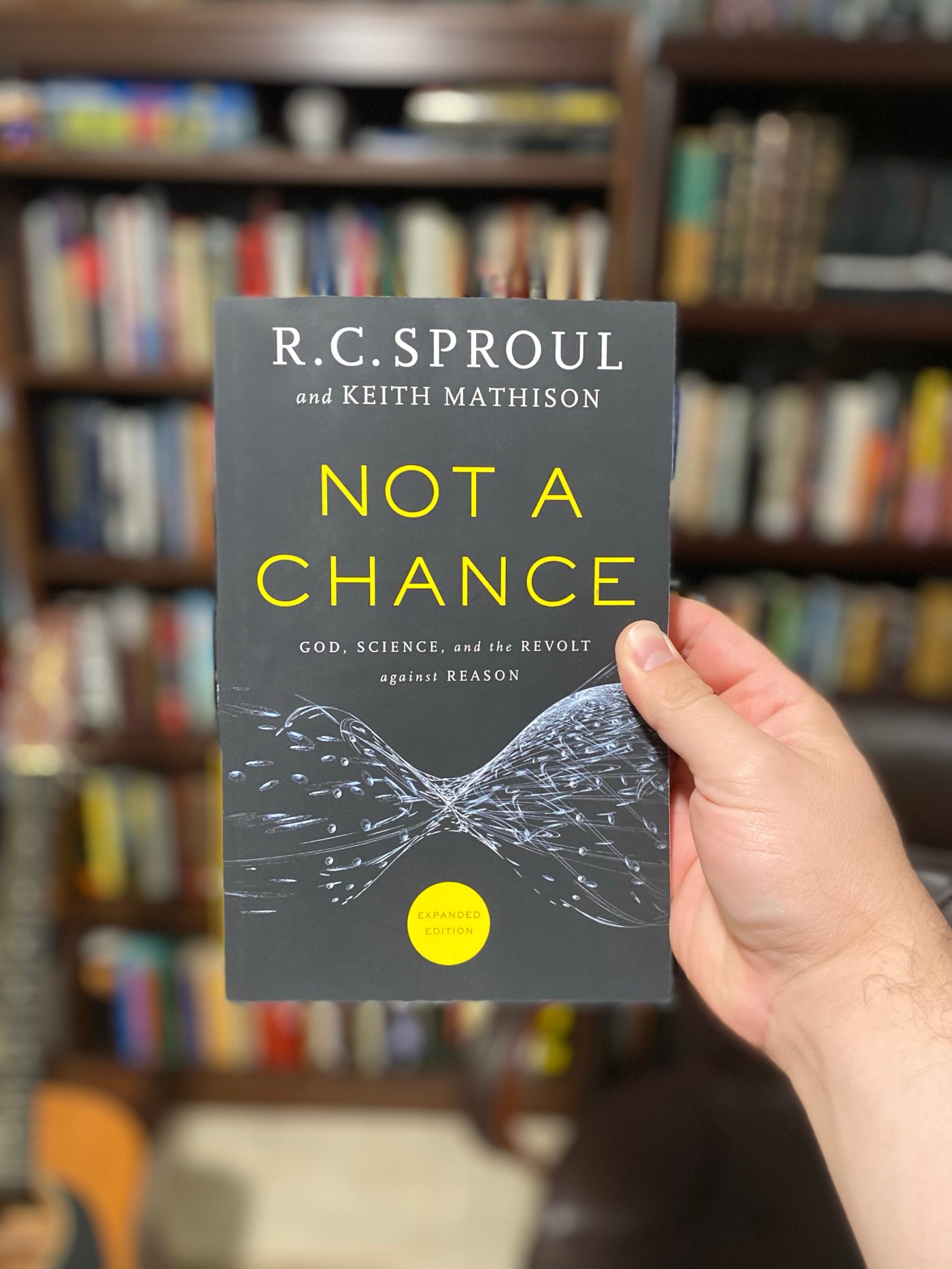
The book is Not A Chance by R.C. Sproul. It was originally published in 1994 by Baker Books. I read the 2014 paperback edition. I read it in July of 2023.
The title comes from Sproul’s main thesis which is that chance is not a being or a thing or any kind of cause from which effects can derive. This blew my hair back because every time I think I have an original thought to write about, I find a book where it’s already written way better than I could put it.
The original idea I thought I had was how I hate it when I hear evolutionists or other people from godless worldviews talk about the universe, or chance, or evolution or something like that in the language of design, intention, wiring, reason, or purpose.
An evolutionist will say something like “we’re designed by evolution to…” or “Nature gave the eagle such good eyes in order to…” Or “by chance our planet is situated just perfectly in the solar system…”
It drives me crazy. They can’t deny every possibility of there being intelligent design or a creator of any kind and then only ever speak in the language of a designer and a creator when referring to nature.
That’s what keeps them in their delusion. If the God-deniers were forced to use the language of chaos and disorder, and non-purpose when talking about life and nature, they’d soon realize how ridiculous they sound.
If they had to say “in a random chaotic series of purposeless and unrepeatable events, after billions of mutations and against astronomical odds, life came from non-life.” That’s how they should be talking.
But of course they’re not going to talk that way because they know God exists and they can’t escape the mindset of purpose and intent of a creator whose image they bear.
I read this for my Christian Science category in my book round for 2023. Also, I want to read all of Sproul’s books. He’s a great writer and a brilliant Christian thinker.
This book was a springboard for a deep dive into quantum physics. It has lead me to a lot more questions. The main question is how does a Christian approach quantum physics?
R.C. Sproul says things like the quantum leap is merely an illusion. He believes in objective reality where things cannot just pop in and out of existence in different places. Only God can create ex nihilo (out of nothing).
But if God created this cosmos and we peer deep down into the building blocks of matter and reality itself, maybe the quantum leaping particles are somehow the fingerprints of God. It gets weird.
I don’t think objective reality is in danger. The Niels Bohr school of thought is essentially that our observation and perception of something contributes to the reality and existence of that thing.
It’s the classic question, if a tree falls in the forest and there’s no one there to hear it, does it make a sound? Or if you’re not looking at the moon, does it exist? This freaked out Einstein. But apparently the math works out in Niels Bohr’s favor.
But as Christians we can agree that observation or perception determines the reality of something, because we believe in an ultimate observer, God. God is able to watch and perceive everything all the time. He never sleeps. He’s never unconscious.
He never looks away. He is perfect in knowledge and understanding the cosmos he created. He not only observes all things at all times, he’s in control of it. As Sproul is fond of saying “there are no rogue molecules.”
Sproul is an amazing apologist. He is a Thomist which means he appeals to logic and reason for his apologetic. He spars back and forth with the atheist.
That’s not quite my speed. I prefer to use presuppositional apologetics which points out that the from their worldview does not provide anything to spar with in the first place.
This book is clear and concise. Sproul is great at taking complicated concepts and explaining them in a way that is easy to understand. He’s a good writer.
I wouldn’t say Sproul misses the mark. He just uses an apologetic that I don’t think is as biblically faithful. I’m a big believer that what we win people with is what we win them to.
If we win people with high minded apologetics using logic and reason, then there is a possibility that we’ve won them to Christian mental ascension instead of God fearing Christianity.
I’d recommend this to Christians who want to learn to defend the faith. R.C. Sproul was one of the greatest Christian thinkers and theologians in the last hundred years. Any resources from him are going to be fantastic.
****************************************************
Notable Quotables
Our next question is crucial. How much influence or effect does chance have on the coin’s turning up heads? My answer is categorically, “None whatsoever.’ I say that emphatically because there is no possibility, real or imagined, that chance can have any influence on the outcome of the coin toss. Why not? Because chance has no power to do anything. It is cosmically, totally, consummately impotent. Again, I must justify my dogmatism on this point. I say that chance has no power to do anything because it simply is not anything, It has no power because it has no being.
Chance is not an entity. It is not a thing that has power to affect other things. It is no thing. (p22)
When scientists attribute instrumental power to chance, they have left the domain of physics and resorted to magic. Chance is their magic wand
only rabbits to make not but entire universes appear out of nothing. (p24)
“There is a God” and “There is no God” are equally insightful propositions.” (Niels Bohr)
Perhaps the two propositions are equally “insightful,” but they cannot be equally true. Indeed they could only equal each other in insight value if we deem false insights equal in value to true insights. (p30)
There is no greater erroneous assumption muddying the waters of contemporary science than the assumption that chance has instrumental, causal power. (p43)
The theory moves from the physical into the metaphysical. If the physical boundary of space is violated, then it must be a metaphysical phenomenon. (p56)
light exhibits properties that have similarities to both waveness and particleness but cannot be conformed to either, then a new category must be assigned. (p90)
The classical formula of the Trinity is that God is one in one thing (one in A, essence) and three in a different thing (three in B, persona).
The formula is not meant to say that essence and person are the same things. Essence refers to the being of God, while person is used here as subsistence within being. Essence is primary and persona is secondary. Essence is the similarity, while persona is the dissimilarity in the nature of God. He is unified in one essence, but diversified in three personae. (p91)
It is said that Christ is one person with two natures (essences). He has a divine nature and a human nature. He is one in person (A) and two in nature (B). Again we have a paradox but no contradiction. The church did not say that Christ is one in A and two in A at the same time and in the same relationship. (p92)
That is why the formula for the incarnation is not that Christ is totally God and totally man at the same time and in the same way. We are not saying that Christ’s physical body is a divine body. We are saying that the single person has two natures. The divine nature is truly divine, the human nature truly human. The two coexist or are united in one person, but the two natures are not mixed, confused, separated, or divided. (p92)
Now the correspondence theory of truth gets a new twist. Truth is then described as “that which corresponds to reality as it is perceived by God.” Here room is made, not only for the existence of God, but for the ultimate authority of the revelation of God. If information about reality can be communicated by a perfect perceiver of reality, then we are rescued from both subjectivism and skepticism. (p98)
Is the logical necessarily the real, or is the real logical? Can the formally true be materially false? Can the materially true be formally false?
These questions probe the heart of the matter. The ultimate question is this: Is reality rational or irrational? Is the universe cosmos or chaos? (p150)
How do we know that the real is rational? We don’t. What we do know is that if it isn’t rational, we have no possible way of knowing anything about reality.
That the real is rational is an assumption. It is the classical assumption of science. Again it is a necessary assumption for science to be possible. (p153)
First, if the cosmos is an illusion, then we still have to account for the illusion. If it is a false illusion, then it isn’t an illusion. If it is a “true” illusion, then something or someone must exist to have the illusion. If so, then whatever is having the illusion must be self-created, self-existent, or created (caused) by something that is (ultimately) self-existent.
…if the illusion is absolute in the sense that nothing exists, including whatever is having the illusion, then the jig is up. We have no question to answer because nothing exists. (p154)
The phrase random selection (or random mutation) is also somewhat confusing.
To make a “selection” suggests some sort of intentionality, a trait usually associated with intelligence. Is it possible to have an unintentional intention? (p158)
The statement “Everything has an antecedent cause” contains within it a definition of causality that is precisely what is in dispute.
To verify such an ambitious law would require that we know something, at least, about everything that is.
I assert, then, that to define the “law” of causality by saying that “everything has an antecedent cause” is utterly arbitrary and not worthy of science. It is a lousy law, a law decreed by arrogant fiat. (p166)
[Bertrand] Russell argues that the First Cause may be the world itself.
This poses the following question: When we say that the world is self-existent, do we mean that everything in the world is self-existent or that only part of the world is self-existent and causes other effects?
If everything in the world is self-existent, including you and me, then, manifestly, there would be no effects whatsoever in the world. (p175)
there cannot be any “higher power” unless there IS also a higher being who generates that power…why are we inclined to substitute power for being?…Cosmic dust or Super Energy does not say, “Thou shalt not steal.” I never have to worry about being judged personally by an impersonal force. (p181)
The mysterious behavior of quantum particles posits at least a temporary limit to our powers of perceiving the real cause(s) of motion or change. But they do not give us license to adopt an irrational, unscientific view of chance as a causal agent, force, or power. (p202-203)
Many contemporary scientists, it would seem, have had plenty of practice believing six impossible things before breakfast. In fact, some have become experts. The irony is that many of them mock Christians for belief in God while simultaneously making statements that are, by definition, nonsensical. (p208)
Even the concept of a neuron itself is a pattern of neurons firing in the brain. “The very theory which says that theories are neurons firing is itself naught but neurons firing.” If this is the case, [Stephen] Barr asks, why should we believe materialism?
“If ideas are just patterns of nerve impulses, then how can one say that any idea (including the idea of materialism itself) is superior to any other? One pattern of nerve impulses cannot be truer or less true than another pattern, any more than a toothache can be truer or less true than another toothache.” (p229)
 Solomon White
Leave a comment