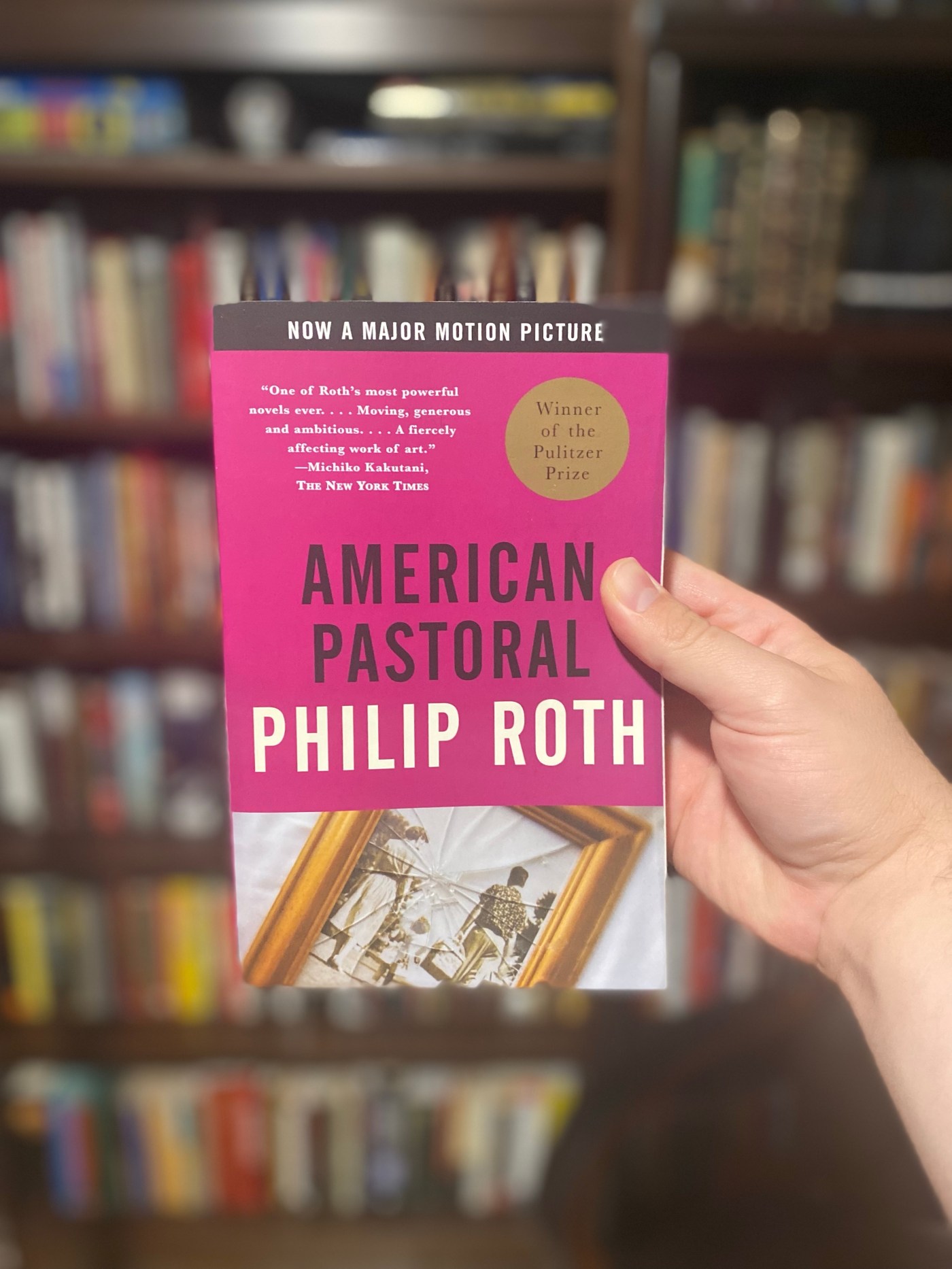
The book is American Pastoral by Philip Roth. It was originally published in 1997 by Houghton Mifflin Company. I read the 1998 Vintage paperback edition. I read it in July of 2023.
The title refers to a type of painting called American pastoral, which is like a landscape portrait. It basically means a nice quaint picturesque image of what America is supposed to be. For this book that means a nice family with a nice house, safe community, and good schools and jobs.
Good wholesome American family. This book is the story of all of that blowing up, literally.
The daughter who transports him out of the longed-for American pastoral and into everything that is its antithesis and its enemy, into the fury, the violence, and the desperation of the counterpastoral—into the indigenous American berserk. (p86)
I read this because I’ve heard that Philip Roth was a great writer. It was made into a movie in 2016 starring Ewen McGregor. The trailer said the book was long thought to be unfilmable. That intrigued me. I haven’t seen the movie but I could see how it would be a challenge to put to film.
In this book, Roth is saying that the picture perfect American pastoral, the innocent wholesome salt-of-the-earth really doesn’t exist. As one of the main characters says. “Life is just a short period of time in which we are alive.”
In one of the more intense scenes there’s this description.
“The building’s rusted fire escape would just come down, just come loose from its moorings and crash onto the street, if anyone stepped on it–a fire escape whose function was not to save lives in the event of a fire but to uselessly hang there testifying to the immense loneliness inherent to living.” (p225)
Roth comes off as cynical. It may be one of those situations where an author is getting the diagnoses correct but the solution is just hopelessness.
It’s correct that true happiness and satisfaction cannot ultimately be found in anything the world has to offer, even traditionally culturally good things like hard work and family. But the answer is not that true happiness and satisfaction doesn’t exist at all. It’s only found in Christ and his Word.
This book reminded me of Mad Men. It’s set in the same time period and carries the same themes. Peel away the veneer of a seemingly perfect American family and see the real pain and horrors underneath.
In fact, I remember an episode where Don Draper is reading Portnoy’s Complaint by Philip Roth. It’s obvious the creators of the show were definitely influenced by Roth.
The main character “the Swede” is a great character. He does everything right but so many things go so wrong. He remains perfectly reasonable and steady but everyone else just cannot be as normal as him. I’ll have to do a deep dive on his character because there’s a lot to unravel.
The story stayed clear. Philip Roth is a fantastic writer. His use of language is smart and creative. At times he is rigidly narrative and then he gets poetic and thoughtful.
The tone felt like a normal look at chaotic situation. It was painfully common.
So many things go so well for “the swede” and the way he is what everyone is trying to be, but I can’t imagine anyone would want to trade their life for his.
I’d recommend this to readers of Updike and lovers of modern realist fiction. Roth is a great writer. Although I feel like it was about 100 pages too long.
****************************************************
Notable Quotables
Mr. Levov was one of those slum-reared Jewish fathers whose rough-hewn, undereducated perspective goaded a whole generation of striving, college-educated Jewish sons: a father for whom everything is an unshakable duty, for whom there is right way and a wrong way and nothing in between, a father whose compound of ambitions, biases, and beliefs is so unruffled by careful thinking that he isn’t as easy to escape from as he seems. Limited men with limitless energy; men quick to be friendly and quick to be fed up; men for whom the most serious thing in life is to keep going despite everything. And we were their sons. It was our job to love them. (p11)
Conflicting Jewish desires awakened by the sight of him were simultaneously becalmed by him; the contradiction in Jews who want to fit in and want to stand out, who insist they are different and insist they are no different, resolved itself in the triumphant spectacle of this Swede who was actually only another of our neighborhood Seymours whose forebears had been Solomons and Sauls and who would themselves beget Stephens who would in turn beget Shawns. Where was the Jew in him? (p20)
I kept waiting for him to lay bare something more than this pointed unobjectionableness, but all that rose to the surface was more surface. What he has instead of a being, I thought, is blandness —the guy’s radiant with it. (p23)
The fact remains that getting people right is not what living is all about anyway. It’s getting them wrong that is living, getting them wrong and wrong and wrong and then, on careful reconsideration, getting them wrong again. That’s how we know we’re alive: we’re wrong. Maybe the best thing would be to forget being right or wrong about people and just go along for the ride. But if you can do that well, lucky you. (p35)
“Writing turns you into somebody who’s always wrong. The illusion that you may get it right someday is the perversity that draws you on. What else could? As pathological phenomena go, it doesn’t completely wreck your life.” (p63)
The sight of a coffin going into the ground can effect a great change of heart-all at once you find you are so disappointed in this person who is dead-but what the sight of a coffin does for the mind in its search for the truth, this I don’t profess to know. (p66)
You should have seen them. Knockout couple. The two of them all smiles on their outward trip into the USA. She’s post-Catholic, he’s post-Jewish, together they’re going to go out there to Old Rimrock to raise little post-toasties. Instead they get that fucking kid.” (p73)
He had learned the worst lesson that life can teach-that it makes no sense. And when that happens the happiness is never spontaneous again. It is artificial and, even then, bought at the price of an obstinate estrangement from oneself and one’s history. (p81)
The daughter who transports him out of the longed-for American pastoral and into everything that is its antithesis and its enemy, into the fury, the violence, and the desperation of the counterpastoral—into the indigenous American berserk. (p86)
She was only eleven. Momentarily it was frightening. This was not anything he had ever worried about for a second, this was a taboo that you didn’t even think of as a taboo, something you are prohibited from doing that felt absolutely natural not to do, you just proceeded effortlessly-and then, however momentary, this. (p91)
The Swede was giving in to the ordinary human wish to live once again in the past to spend a self-deluding, harmless few moments back in the wholesome striving of the past, when the family endured by a truth in no way grounded in abetting destruction but rather in eluding and outlasting destruction, overcoming its mysterious inroads by creating the utopia of a rational existence. (p122-123)
The building’s rusted fire escape would just come down, just come loose from its moorings and crash onto the street, if anyone stepped on it–a fire escape whose function was not to save lives in the event of a fire but to uselessly hang there testifying to the immense loneliness inherent to living. (p225)
They are crying intensely, the dependable father whose center is the source of all order, who could not overlook or sanction the smallest sign of chaos–for whom keeping chaos far at bay had been intuition’s chosen path to certainty, the rigorous daily given of life and the daughter who is chaos itself. (p231)
Oh where oh where is that outmoded America, that decorous America where a woman had twenty-five pairs of gloves? Your kid blows your norms to kingdom come, Seymour, and you still think you know what life is!”
Life is just a short period of time in which we are alive. Meredith Levov, 1964.
You wanted Miss America? Well, you’ve got her, with a vengeance-she’s your daughter! (p277)
“If what begins, you are telling me is what I was…he wasn’t, wasn’t enough, then, then I’m telling you. I’m telling you that what anybody is is not enough.”
“You got it! Exactly! We are not enough. We are none of us enough! Including even the man who does everything right! Doing things right,” (p280)
This is all something else, something he knows absolutely nothing about. No one does. It is not rational. It is chaos. It is chaos from start to finish. (p281)
It was as though while their lives were rich and full they were secretly sick of themselves and couldn’t wait to dispose of their sanity and their health and all sense of proportion so as to get down to that other self, the true self, who was a wholly deluded fuckup. (p329)
 Solomon White
Leave a comment