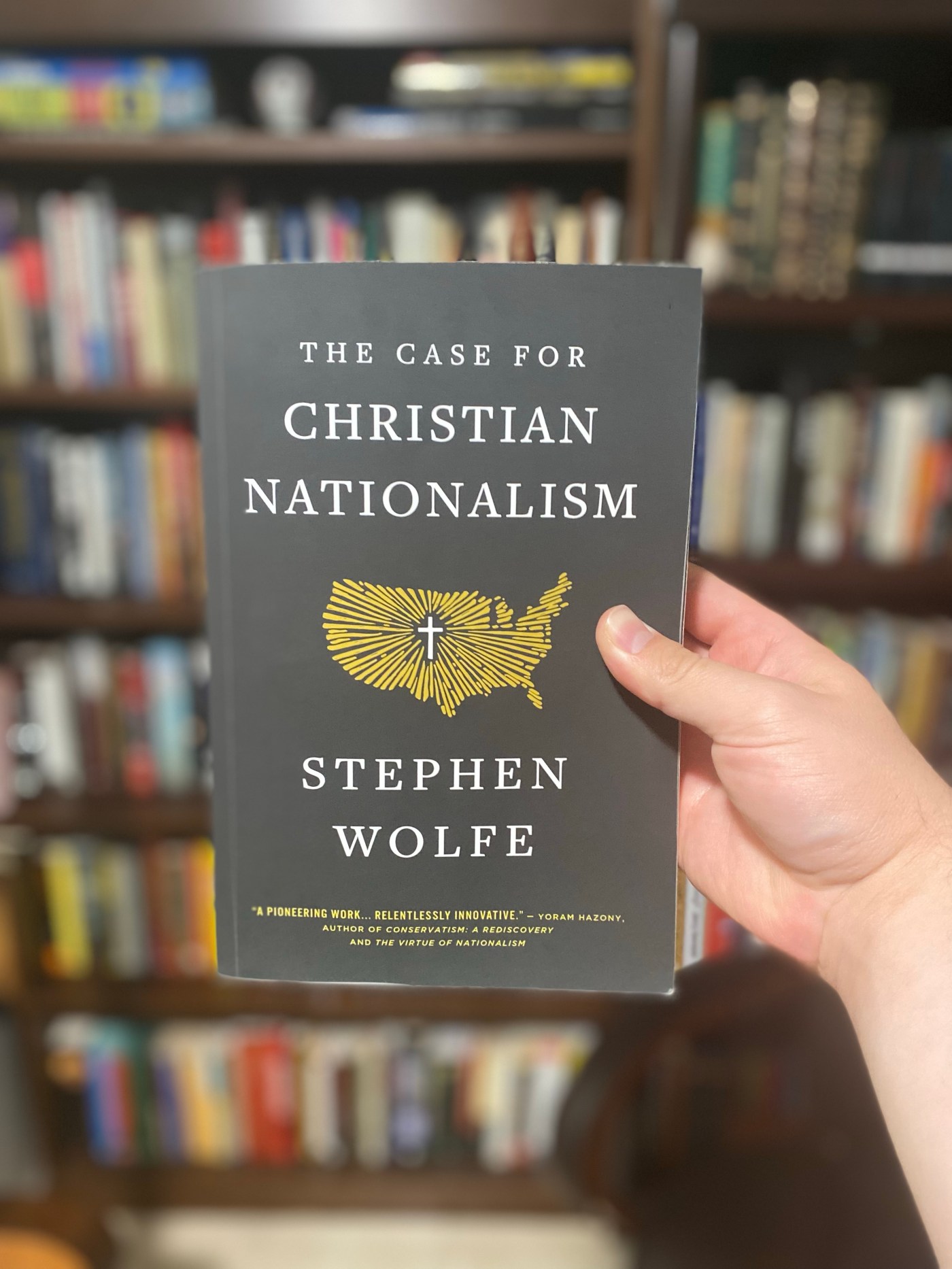
The book is The Case for Christian Nationalism by Stephen Wolfe. It was originally published in 2022 by Canon Press. I read the 2022 paperback edition. I read it in May of 2023.
The title is the author’s thesis. He makes his case for why America should be a Christian nation and how to get there.
This book has been mentioned in mainstream press. It’s been heavily criticized by mainstream evangelical and conservative commentators online. James Lindsay criticized Stephen Wolfe calling him a dangerous reaction to far left politics. Lindsay is fiercely against woke ideology calling it a religion. But he’s an atheist so it makes sense he’d also be against a Christian nation.
It sounded controversial and it caused me to ask a lot of questions about what obeying God’s law really means, not only for myself or a church, but for humans in general.
Why do Christians pray for a revival to break out in our city and not for our state or nation, and ignore the practical implications that might have on how society is formed and ordered.
I think it’s a quasi-gnostic mindset we have that separates our soul and body. Our souls can belong to God but our bodies are subject to the secular state. I plan to read Doug Wilson’s Mere Christendom. I think that will be a more scripturally grounded take on Christian nationalism.
The most compelling argument Wolfe makes is that there is no neutrality. We will either live in a Christian nation or a pagan nation. Neutrality is a myth. I strongly believe that.
I also believe that this entire world actually really belongs to Christ. God owns the trees and the mountains and the oceans and all creatures on the earth.
He owns the law. He owns peace and freedom and justice. And not in some spiritual ethereal way some day in the sweet by and by.
He owns it all right now in a way that there is no such thing as a secular law. That’s like saying there is a secular tree. It doesn’t make sense.
What I didn’t like about this book is it is seriously lacking scripture. God’s word is nowhere. But Wolfe is upfront about that. He does not claim to be making a theological or scriptural case.
Wolfe is a Thomist so everything was built on logical arguments and the natural law. There was a lot of logical speculation about the prelapsarian world. It makes sense and he uses a ton of early church father’s quotations to make his points.
He’s basically saying, if you disagree with him, you also disagree with Luther and Calvin and the puritans and reformers. They seem to all think in theonimic terms concerning how we should live and be ruled by civil magistrates.
We’re living in a time where we need to get weird. Aaron Renn talks about the three worlds of evangelicalism.
There was Positive World where being a Christian was a net positive in a person’s life. Calling yourself a Christian, going to church and believing in God was the good decent patriotic thing to do.
Then there was Neutral World where being a Christian didn’t help or hurt you socially in any real way. “You do you.”
Now we are in Negative World where being a Christian is a detriment and liability to your social life. We need to lean into that. We need to get weird.
There were definitely parts where I disagreed with Wolfe. He says that America will be turned into a Christian nation by the work and leadership of a “Christian Prince.”
He never outright says it but I guess he means the Christian prince will be like the president or something. He says the Christian prince should not be a pastor or theologian.
I believe that the Christian nation will come about by the work of the Holy Spirit moving through fathers leading families. It will be the consistent work of a Christian father–led movement.
I also am not sure why Wolfe is so reluctant to separate himself from white nationalists. Of critics he writes,
“They disregard and dismiss the reasons for Christian nationalist beliefs and instead rely on racial explanations, such as “whiteness,” to account for Christian nationalism. My intent here is neither to defend nor reject what they consider Christian nationalism, nor to denounce or distance myself from its alleged connotations. (p8)
Why not denounce white nationalism? The benefit of the doubt I give Wolfe is that the pagan left call everything racist and at a certain point it’s useless to defend yourself or denounce things because they won’t listen anyway. I don’t know. I mean it’s also not that hard to just say this has absolutely nothing to do with race. He does say that elsewhere but it’s not a driving point of the book.
Neutrality is a myth. We’re Christians and we have to live somewhere. And we have to conduct our societies with some form of morality and judicial framework. As Christians why should we not actively be trying to make sure that is a godly biblical framework for the civil law and magistrates? There is a lot more that could be said about this book. I’ll post excerpts and quotes with further analysis in the future.
I’d recommend this book to Christian men and fathers. It is time to get weird and start getting back to doing things the way God intended and using our minds and bodies how they were created to be used.
****************************************************
Notable Quotables
They disregard and dismiss the reasons for Christian nationalist beliefs and instead rely on racial explanations, such as “whiteness,” to account for Christian nationalism. My intent here is neither to defend nor reject what they consider Christian nationalism, nor to denounce or distance myself from its alleged connotations. (p8)
The argument is that a spiritual relation—something that Christians share regardless of nationality-is different in kind from a civil relation and therefore cannot serve as the ground for flourishing civil society. (p27)
to leave government out of religion?” I agree that we’ve learned much, but we should also learn from our own time that governmental and societal “neutrality” are impossible and that secularism is pervasive and relentless. It has evolved into a sort of pagan nationalism, in which bizarre moralities and rites are imposed upon all areas of life…established Christianity is better than its secularist alternative. (p36)
Since civil society is a composition of households and men are the head of households, the public signaling of political interest (whether through voting or other mechanisms) would be conducted by men, for they represent their households and everyone in it. Vocational associations (or collegia) would likely be male-dominated as well, because households as productive operations would participate in them, and men would represent their households in them. This would be ubiquitous around the world, as it follows logically from the divinely ordained (and hence universal), hierarchical arrangement of the household. (p73)
Christians in general, as restored human beings, have obligations to sacred and secular things. The sacred, being higher, ought to be sought above all lesser things, but the lesser things are essential to our complete good and ought to be ordered to the sacred. Thus, Christians ought to
not only as a correct, direct, and adorn social life with Christianity matter of obedience but also to order mankind to sacred things and his highest good. Indeed, the chief aim of Christian nationalism is ordering the nation to the things of God -subordinating the secular to the sacred in order to orient it to the sacred. (p105)
We should follow Calvin in affirming the following:
God has appointed to his children alone the whole world and all that is in the world. For this reason, they are also called the heirs of the world; for at the beginning Adam was appointed to be lord of all, on this condition, that he should continue in obedience to God. Accordingly, his rebellion against God deprived of the right, which had been bestowed on him, not only himself but his posterity. And since all things are subject to Christ, we are fully restored by His mediation, and that through faith; and therefore all that unbelievers enjoy may be regarded as the property of others, which they rob or steal. (p114)
The most striking creedal statement is found in Justice Anthony Kennedy’s opinion in Planned Parenthood v. Casey (1992): “At the heart of liberty is the right to define one’s own concept of existence, of meaning, of the universe, and of the mystery of human life.” This statement is the inevitable conclusion of a liberal creedalist project. (p119)
A Christian nation is not a holy nation in the sense that Israel was holy when under the Mosaic Covenant. No nation today is God’s nation by some special divine command or by exclusive divine favor. (p176)
Should a Christian father not order his household to Christ? If he should, why shouldn’t civil ruler order the civil realm to Christ and his kingdom? The fact that the instituted church serves the soul does not preclude Christians from ordering the things of the body to the soul. (p196)
Being a member of a Christian family does not save any of its members. No one accuses Christian families of being hypocrite-factories, sending their kids straight to hell. So why is preparation permitted in the home but not in civil society? It seems that the typical reasons to reject cultural Christianity strike just as hard against Christian families. (p234)
I’m ambivalent about national flags located inside or outside churches, but national flags should not be displayed in a sanctuary and especially not within sight during worship. The worshipper should see pulpit, table, and font. (p240)
Secularism dominates the institutions and has normalized a “neutral” value system that conflicts with Christian moral teaching. “Neutrality” and “diversity” provide the perfect cover for the pervasive use of implicit power to undermine and control religion. (p341)
We lack the spirit for this sort of dominion today–a once-uncontroversial spirit that animated the magisterial Protestant reformers and Christians prior to the Reformation. We must revitalize and return to it. The Christian’s posture towards the earth ought to be that it is ours, not theirs, for we are co-heirs in Christ. (p347)
Experience over the last decades has made evident that there are two options: Christian nationalism or pagan nationalism…Neutral World political theology is simply irrelevant to our new world; it is obsolete. (p381)
However, in the modern world, in which the state governs every square inch with maximal power, most traditional skills are made obsolete by mass production; the masculine virtues don’t have an outlet. Indeed, the system is so designed for an ease of activity and separation from nature that masculinity is seen as a threat, and so it is pathologized. (p463)
 Solomon White
Leave a comment