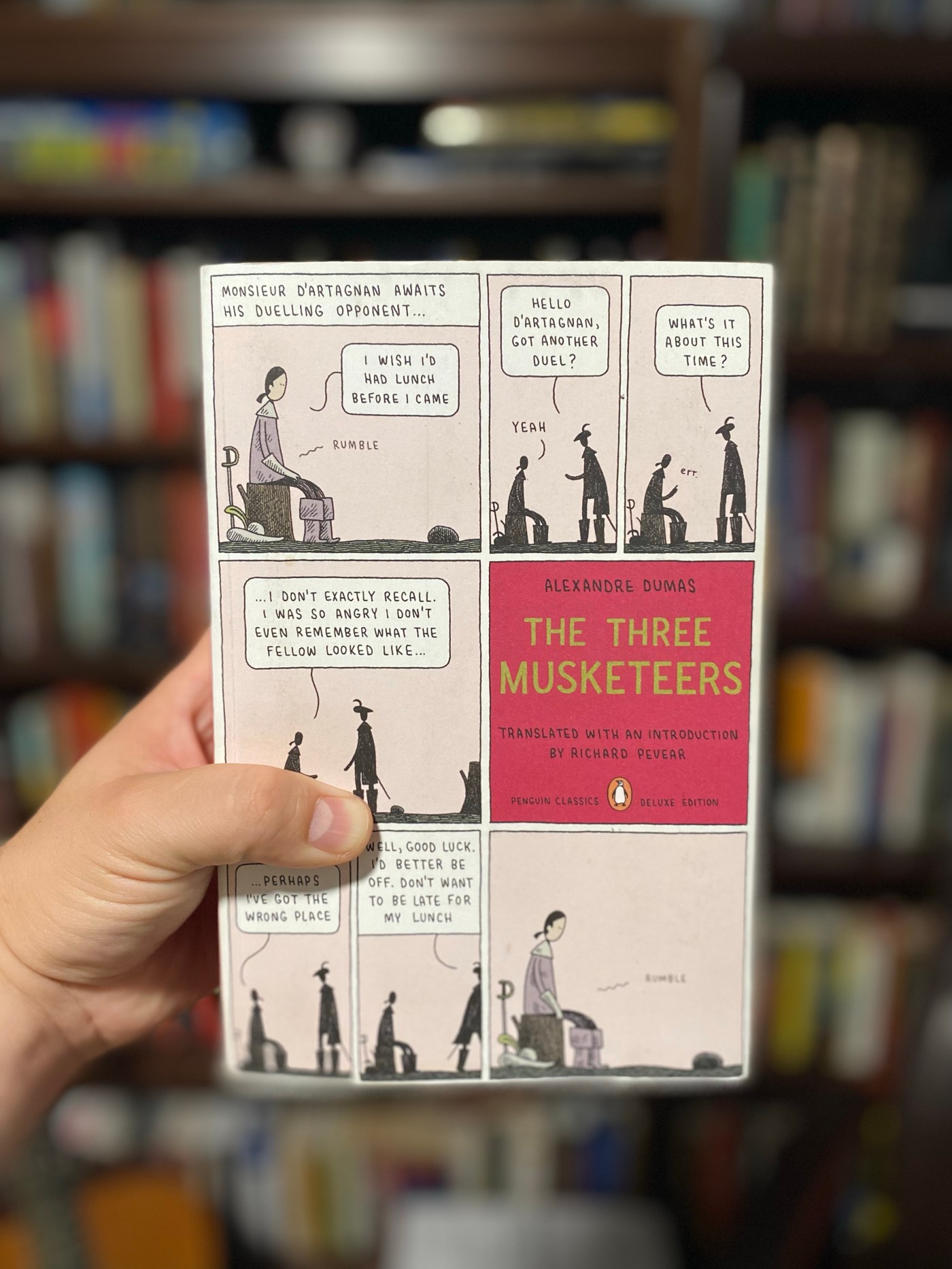
The book is The Three Musketeers by Alexander Dumas. It was originally published in 1844. I read the 2007 Penguin Classics Deluxe Edition. I read it in March of 2023.
The title refers to the three musketeers, Athos, Porthos, and Aramis. They’re the established musketeers. Then a named D’Artagnon joins them.
I read it because I want to read more classics. And Dumas was next on my list of authors to read.
This is an adventure story. Dumas was writing in the 1800s about 1600s France under the reign of King Louis XIII. He paints a picture of the chivalric age of swordsman and gentlemen.
The chivalric men of the 1600s were not great men. Hardley gentlemen and a little stupid. They make their living by finding a rich lady and basically becoming her gigolo. When the musketeers need new clothes or weapons, they bilk it out of a rich lady. Although the love they have for their ladies does seem genuine. They’re not con artists. It’s almost as if the traditional roles are reversed, where instead of a woman finding a man to provide for her and then genuinely loving him for doing so, the musketeers find a woman to pay the bills and love them for it.
It was interesting how many cliches were this book. There’s a chapter called “The Plot Thickens.” And one chapter actually starts with the line “it was a dark and stormy night.” But of course, these weren’t cliches yet in 1844. They were written genuinely. This does make reading the classics difficult but I like origin stories. It’s cool to see where these literary tropes come from.
The French names and places got a little confusing. There are a lot of characters and they travel a lot and I couldn’t pronounce a lot of the French words. I looked up videos on French pronunciation. That didn’t help much. There should be videos where people explain in English how to pronounce foreign words specifically from literature.
The tone was lighthearted and adventurous. Some of the violent parts are almost cartoony. D’Artagnon was a good hero for the story but I wouldn’t want his temper and fool hearted chivalry. Milady is one of the best villains I’ve ever read. You absolutely hate her but you’re also impressed by her. Her drive to manipulate and deceive is almost attractive. She’s a fantastic femme fatale.
I’d recommend this to real readers. It will test your patience in reading. It gets slow at times and it’s a bit of a slog through 673 pages. But it’s a great book.
********************************
Notable Quotables
It is by his courage, understand me well, it is by his courage alone that a gentleman makes his way nowadays. (p7)
And now, gentlemen,” said d’Artagnan, without bothering to explain his conduct to Porthos, “all for one and one for all -that’s our motto, isn’t it?” (p105)
“Ah! I’d much rather I had never seen you,
d’Artagnan, with that naive coarseness cried that women often prefer to the affectations of politeness, because It reveals the depths of thought and proves that feeling has won out over reason, (p127)
A knave does not laugh in the same way as an honest man; a hypocrite does not weep the same tears as a man of good faith. All falsity is a mask, and however well made the mask is, one always manages, with a bit of attention, to distinguish it from a face. (p260)
He never gave advice unless he was asked. And even then one had to ask him twice.
In general, people ask for advice,” he used to say, “only so as not to follow it; or, if they do follow it, it’s only so as to have someone to blame for having given it.” (p371)
 Solomon White
Leave a comment