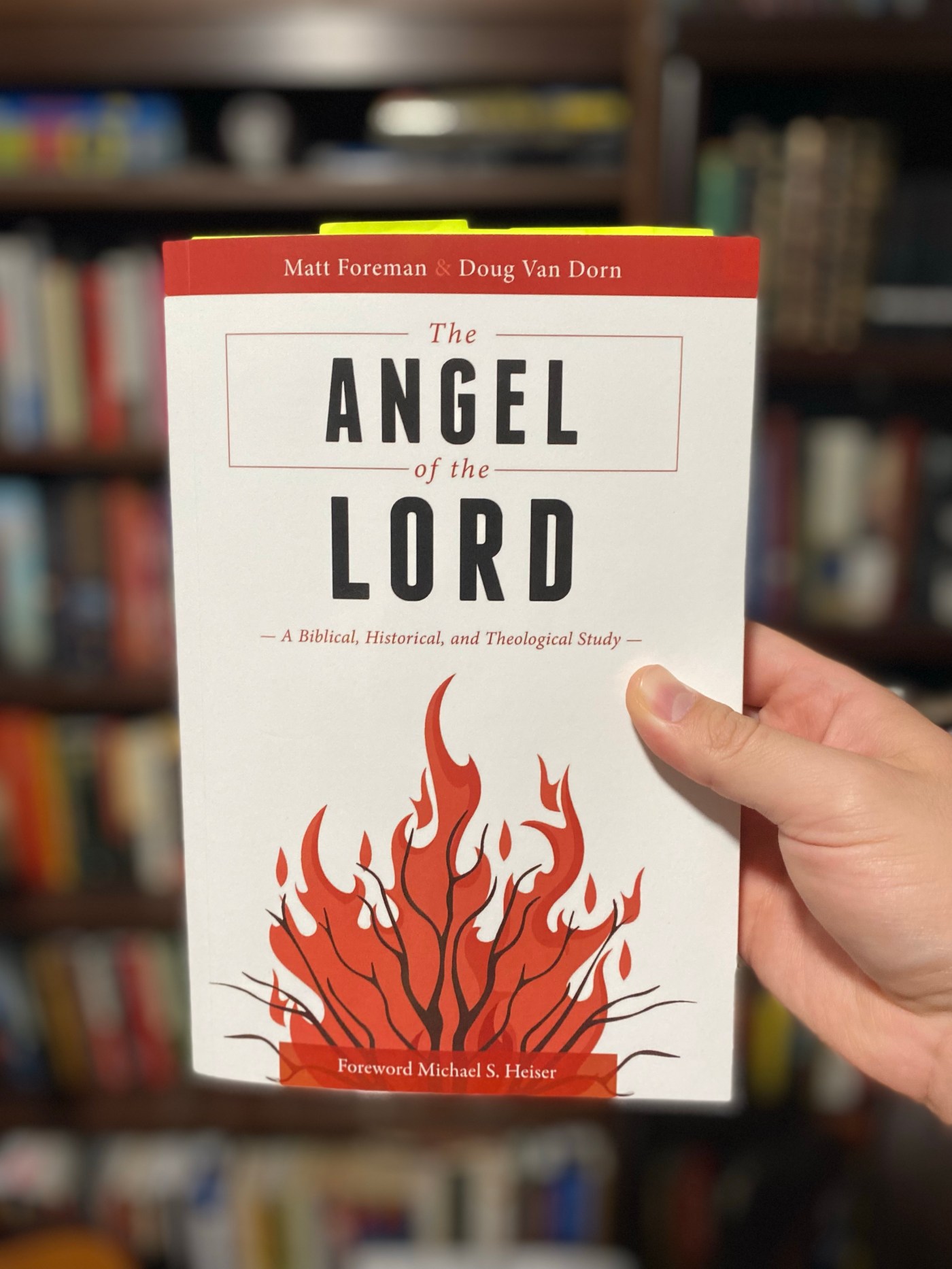
The book is Angel of the Lord by Matt Foreman and Doug Van Dorn. It was originally published in 2020 by Waters of Creation Publishing. I read the 2020 paperback edition. I read it in May of 2023.
The title refers to the subject of the book, the Angel of the Lord, who is the preincarnate Christ appearing in the Old Testament.
I read this book because these have been problem passages for me for a long time. I’d see these Christophanies in the Old Testament and they were very strange. Who is the “angel of the Lord?” I figured this book would clear some things up and mostly it did.
Foreman and Van Dorn are saying that the angel of the Lord is the preincarnate Christ showing up in the Old Testament. I’ve heard it explained to me before, that this is Jesus in the Old Testament. But I think that’s not quite right. As Augustine points out, a theophany or a Christophany are temporary. The incarnation is perpetual. Jesus is in the same form now as when he ascended into heaven after his resurrection. While it’s not different in essence, it is different in form from the man that Jacob wrestled.
I was glad to see Foreman and Van Dorn also address the issue of the angel of the Lord showing up as Michael the archangel. Jehovah’s Witnesses have taken this to mean that Jesus used to be Michael and therefore a created being, and not God himself. The authors point out another instance where Jesus takes on the moniker of another biblical figure without actually being that figure. Satan.
2 Samuel 24:1 says “Again the anger of the Lord was kindled against Israel, and he incited David against them, saying, “Go, number Israel and Judah.”
But in its parallel verse in 1 Chronicles 21:1 it says “Then Satan stood against Israel and incited David to number Israel.”
So in one place it’s the Lord and in another places it’s Satan. But “satan” in Hebrew literally means “adversary.” And when the anger of the Lord is kindled against his people, he becomes their adversary and he is against them in a serious and detrimental way. Similarly, when Joshua is about to fight the battle of Jericho, Jesus shows up in the form of Michael the archangel, “the commander of the Lord’s army.” The Lords appearing and being referenced with names that belong to other characters, does not mean that the angel or the preincarnate Christ actually is that character.
This book provided insight in a lot of ways. One of my main takeaways was that in many places where the immutability of God is challenged, passages where God appears to learn something or change in some way, these are times where the angel of the Lord is speaking. For example when Abraham is stopped from killing Isaac at the last minute, it’s actually the angel that stops him and says “for now I know that you fear God.” (Gen 22:12). Now, there is scriptural precedent for Jesus’ knowledge being limited or different in some way from the Father’s. In Luke 2:52 we see how young Jesus “increased in wisdom and stature.”
This could also be attributed to verses like Genesis 6:7 where we see “the Lord” say
“I will blot out man whom I have created from the face of the land, man and animals and creeping things and birds of the heavens, for I am sorry that I have made them.”
I used to consider this as “anthropomorphized language” used by Moses to express a point, (and I still think this is a legit interpretation as well), but now I can see how it could be the preincarnate Christ speaking as “the Lord.” This makes more sense when you consider that all things were created through preincarnate Christ (Col. 1:16).
The authors miss the mark a little bit when they talk about Psalm 82. Jesus quotes from Psalm 82 when he’s chastising the pharisees in John 10. He’s defending himself calling himself God by quoting Psalm 82 where it says
“I said, “You are gods,
sons of the Most High, all of you;
nevertheless, like men you shall die,
and fall like any prince.”
Jesus and the writer of that Psalm are rebuking unjust judges. A judge is someone who represents God in a microcosm, they’re acting as a little god. But both the judges in Jesus time and the Psalm of Asaph were judging unjustly so even though they were given the representative position of a god, “like men you shall die.”
Foreman and Van Horn take Psalm 82 to refer to the divine council, a family of gods like a pantheon or something in heaven that God judges from. Their point is to make a link between the angel and God based on the use of the second Elohim (“Elohim” is actually plural in Hebrew). A big problem I have with this is that it’s how the Mormons twist Jesus’ words in John 10 to show that we humans will also be gods one day.
I take the plural use of Elohim to mean the trinity, the three persons of the Godhead. Foreman and Van Horn (and Mormons) take it to mean the divine council of real gods or divine god-type beings in heaven.
I’d recommend this to Jewish people and I’d have a lot of questions for them. How is Jacob wrestling God in such a literal way that his hip gets broken? Why is the angel of the Lord referred to as God? Many questions. I’d also recommend this to any Christians who are struggling with understanding how God could regret something or seems to learn things in the Old Testament. Big questions were answered in this book.
**************************
Notable Quotables
We would simply say that because angels are called “men,” that Jesus took the form of an angel-man, whatever that looked like we have no idea. But to assume that it necessarily means he looked fully human is pure speculation, much less that he was a human, which is simply unacceptable. Indeed, it is heretical. (p48)
Jacob starts out wrestling with God and ends clinging to him. In many ways, that was the point. All of Jacob’s life, he had been wrestling: wrestling with Esau, wrestling with Laban, wrestling with his family. In reality, all his life he had been wrestling with God. And he finally wins when he loses! (p56)
Jehovah’s Witnesses.
The Witnesses say that the Angel of the LORD is both Michael and Christ (a view also within mainstream orthodoxy from the beginning through today). Their deficiency is that they believe he is a created being rather than the eternally begotten Son of God. (p267)
What had never happened before, and has never happened since, is that God became human flesh (sarx) and dwelt among us. Jesus did not come here as an angel in the NT like he did in the OT. As we have seen, John himself says that he was there among the people in the OT (John 1:11), but this was as an angel, not as a human, (p307)
 Solomon White
Leave a comment